
This easy slow cooker chicken soup has a clear, savory broth, tender chicken, plenty of vegetables and egg noodles that still have some bite. The cooker handles the broth and chicken, but the noodles go in near the end. That one timing choice prevents the soft, swollen noodles that often make leftover crock-pot soup disappointing.
Boneless chicken thighs are used because they stay juicy during the longer cooking window. Carrots and celery are cut into substantial pieces, not tiny dice, and frozen peas are added only for the final few minutes. The result is a practical chicken noodle soup that can go from cooker to bowl without extra pans.
This recipe was developed through culinary research and editorial review. Slow cookers heat at different rates, so use the time as a window and use temperature and texture as the finish tests.
If homemade broth is the priority, start with the slow cooker chicken bone broth recipe. For a creamy one-pot dinner instead, see the slow cooker chicken, broccoli and rice recipe.
Why this slow cooker chicken soup works
- Chicken thighs are forgiving enough for slow cooking but still get removed as soon as they reach a safe temperature.
- Thick-cut carrots and celery hold their shape better than finely diced vegetables.
- Low-sodium broth leaves room to season at the end, after the liquid has concentrated.
- Dried egg noodles cook during the final 15 to 25 minutes rather than for hours.
- Frozen peas and lemon juice go in last, preserving their color and fresh flavor.
The soup is streamlined, not hands-off to the point of sacrificing texture. Plan to return near the end to check the chicken, shred it and add the noodles.
Ingredients
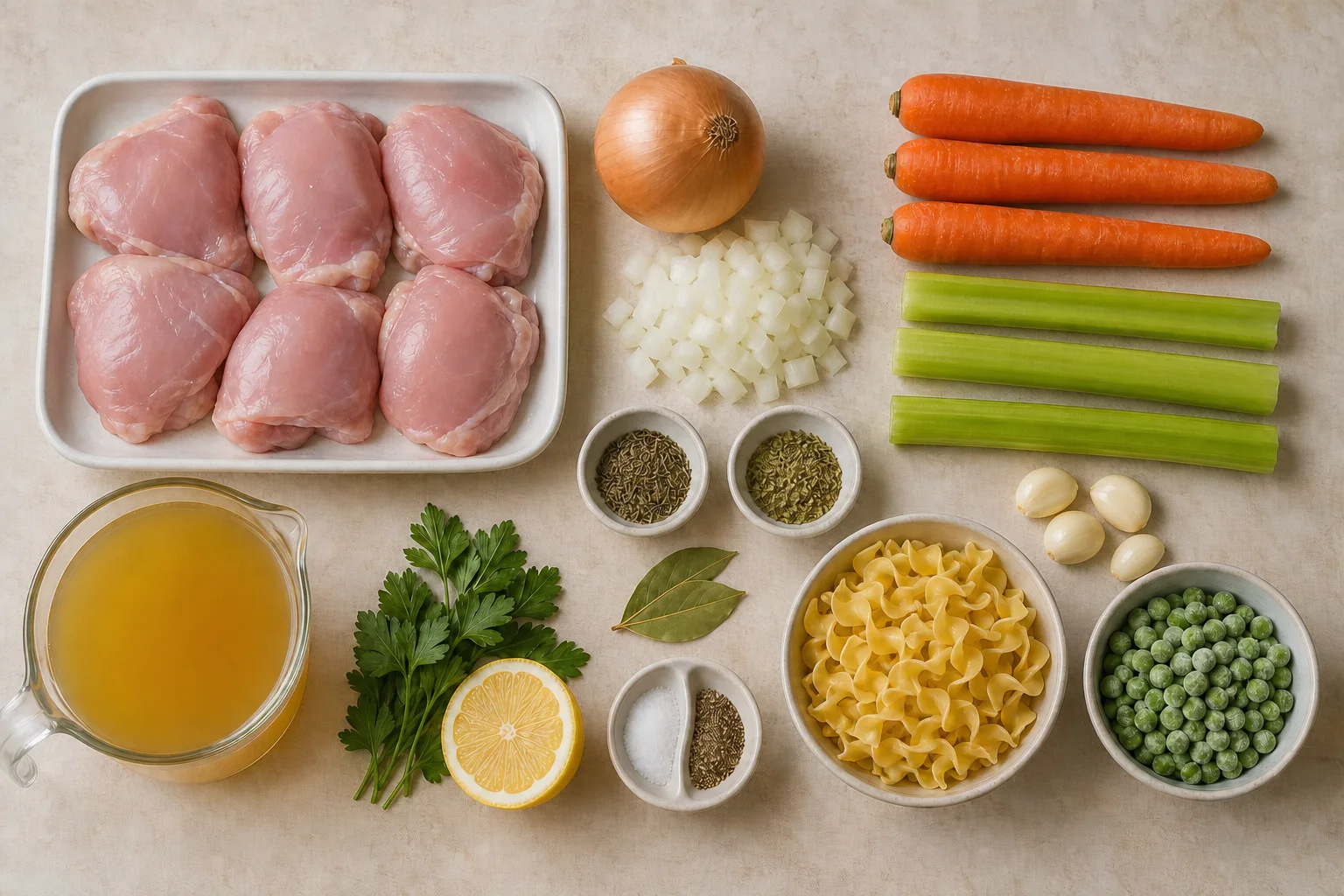
- 1 1/2 pounds boneless skinless chicken thighs, fully thawed and trimmed
- 1 medium yellow onion, diced
- 3 medium carrots, cut into 1/2-inch rounds
- 3 celery ribs, cut into 1/2-inch pieces
- 4 garlic cloves, minced
- 1 1/2 teaspoons dried thyme
- 1 teaspoon dried oregano
- 2 bay leaves
- 8 cups low-sodium chicken broth
- 1/2 teaspoon kosher salt, plus more after cooking if needed
- 1/2 teaspoon black pepper
- 6 ounces wide dried egg noodles
- 1 cup frozen peas
- 2 tablespoons fresh lemon juice
- 1/4 cup chopped flat-leaf parsley
Ingredient notes and substitutions
Chicken thighs: Boneless, skinless thighs remain tender across a wider cooking window than breasts. Bone-in thighs also work, but remove the skin first and allow extra time. Pull out every bone before returning shredded meat to the soup.
Chicken breasts: Substitute the same weight of boneless, skinless breasts. Begin temperature checks earlier because lean breast meat dries faster. Remove each piece individually when its thickest center reaches 165°F.
Broth: Use low-sodium broth so the soup can be adjusted after the noodles absorb liquid. Eight cups creates a brothy soup; reserve another cup for reheating if you prefer plenty of liquid.
Egg noodles: Wide dried egg noodles give the familiar chicken-noodle texture. Pasta thickness and brands vary, so check early. Small shells or rotini can be used, but follow texture rather than assuming the same time.
Gluten-free noodles: Cook them separately according to the package and add them to individual bowls. Many rice- or corn-based noodles become fragile when held in hot soup.
Peas: Frozen green beans, corn or chopped spinach can replace peas. Add spinach only after switching off the cooker; residual heat will wilt it.
Herbs: One tablespoon chopped fresh thyme can replace dried thyme. Rosemary is stronger; use no more than 1/2 teaspoon dried and crush it before adding.
How to make easy slow cooker chicken soup
1. Prepare the vegetables
Cut the carrots and celery into roughly 1/2-inch pieces. Keeping them substantial helps them survive several hours of moist heat without disappearing into the broth. Dice the onion and mince the garlic.
2. Layer the cooker
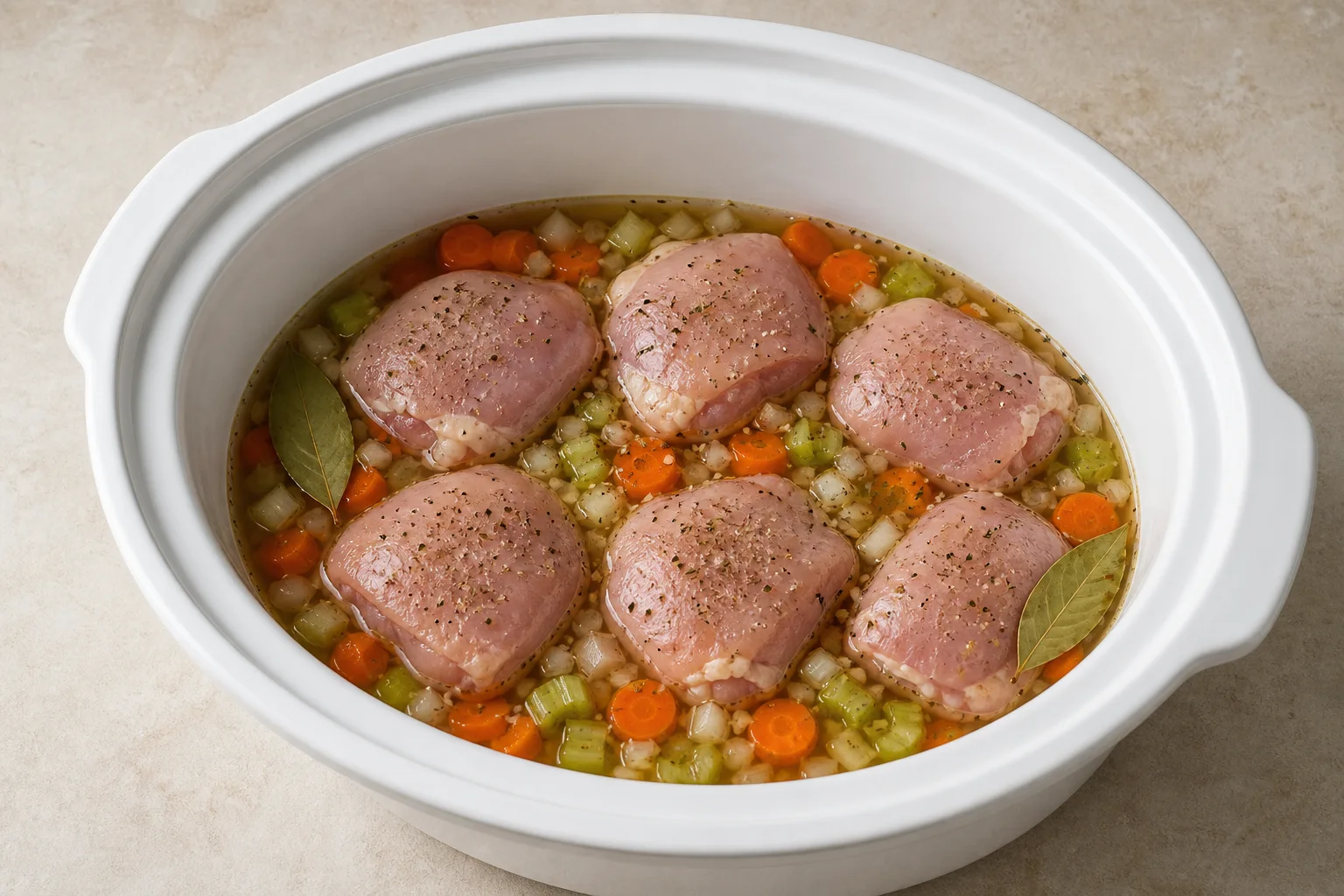
Put the onion, carrots, celery and garlic in a 6-quart slow cooker. Sprinkle in thyme, oregano, salt and pepper, then add the bay leaves. Arrange the thawed chicken thighs in one layer over the vegetables.
Pour in the broth. The chicken does not need to be seared first, and browning it would add another pan without making or breaking this clear soup.
3. Cook until the chicken is done
Cover and cook on low for 5 to 6 hours or on high for 2 1/2 to 3 1/2 hours. Keep the lid closed during the first part of cooking so heat does not repeatedly escape.
Begin checking at the earliest time. Insert a clean instant-read thermometer into the thickest center of each thigh without touching the ceramic. Remove each piece as it reaches 165°F; see the federal safe minimum internal temperature chart.
4. Rest and shred the chicken
Transfer the chicken to a clean plate and let it rest for 5 minutes. Discard the bay leaves. Shred the meat into bite-size pieces with two forks, removing any pieces of fat or cartilage.
5. Cook the noodles at the end
Turn the cooker to high if it was on low. Stir the dried egg noodles into the hot broth, cover and cook for 15 to 25 minutes. Stir once after 10 minutes so noodles at the surface change position.
Start tasting at 15 minutes. Stop when the noodles are just tender; they continue absorbing broth as the soup stands.
6. Finish without overcooking
Return the shredded chicken and add frozen peas. Cover for 3 to 5 minutes, just until the peas and chicken are hot. Switch off the cooker, stir in lemon juice and parsley, then taste.
Add salt only after tasting the broth with a noodle. Broth brands and enhanced chicken vary widely in sodium.
The best timing for vegetables and noodles
Not every ingredient belongs in the cooker at the beginning.
- Add onion, thick carrots, celery, garlic and dried herbs at the start.
- Remove the chicken as soon as each piece reaches 165°F.
- Add dried egg noodles only after the chicken is out and the cooker is on high.
- Add frozen peas and shredded chicken for the last 3 to 5 minutes.
- Add lemon juice and parsley after cooking so their flavor stays bright.
If you know the soup will be stored for several days, cook the noodles separately. Put noodles in each serving bowl and ladle hot soup over them. The stored broth stays clearer and the pasta keeps a better texture.
How to know when the chicken is ready
Color alone is not a dependable doneness test. Check every separate piece with a thin-probe thermometer because smaller thighs may finish before larger ones.
The chicken is ready when the coolest part of its thickest center reaches 165°F. Transfer it to a clean plate rather than the plate or board that held it raw. USDA also recommends thawing meat or poultry before placing it in a slow cooker; its slow cooker food-safety guidance explains why proper thawing and prompt heating matter.
Do not use a delayed-start timer with raw poultry. If the ingredients are prepared ahead, refrigerate the raw chicken separately and load the cooker just before turning it on.
How to keep noodles from getting mushy
The simplest fix is to treat noodles as a finishing ingredient. Slow cookers vary, and the broth may not return to a vigorous simmer quickly, so 15 to 25 minutes is a checking window rather than a guarantee.
Use these safeguards:
- Choose dried noodles, not fresh refrigerated noodles, for in-cooker cooking.
- Keep the cooker covered except for one stir and texture checks.
- Test a noodle at 15 minutes and then every few minutes.
- Switch off the cooker as soon as the center is tender.
- Do not leave finished soup on warm for hours with noodles in it.
For make-ahead soup, boiling noodles separately is the more reliable option. Toss drained noodles with a tiny amount of oil, chill them promptly and store them apart from the broth.
Troubleshooting
The broth tastes flat
First add salt in small pinches; under-seasoned broth often tastes weak rather than merely unsalty. Lemon juice provides brightness, and black pepper adds aroma. If the broth still lacks depth, stir in a teaspoon of low-sodium soy sauce or a small spoonful of white miso after cooking. Those are optional fixes, not part of the base recipe.
The vegetables are mushy
They were probably cut too small, cooked beyond the suggested window or held on warm too long. Use thick pieces next time. For a cooker known to run hot, add carrots and celery after the first 60 to 90 minutes on low.
The noodles soaked up the broth
That is normal during storage. Add extra broth or water while reheating and adjust seasoning afterward. For future batches, store separately cooked noodles and broth.
The noodles are still firm
Check that the cooker is set to high and the broth is very hot. Cover and continue in 5-minute increments. A crowded or low-powered cooker may need longer.
The chicken is dry
The chicken likely stayed in the cooker after reaching 165°F. Begin checking earlier, especially with breasts. Shred it into larger pieces and return it only long enough to heat through.
The soup is greasy
Trim obvious fat before cooking. After cooking, skim surface fat with a wide spoon. For make-ahead soup, chill it promptly; the solidified fat is easy to lift from the top before reheating.
Storage, freezing and reheating
Divide soup into shallow containers and refrigerate it within 2 hours. Federal cold-storage guidance lists cooked meat or poultry leftovers at 3 to 4 days in a refrigerator kept at 40°F or below.
Refrigerated noodles keep absorbing broth. Loosen each portion with a splash of broth or water, then reheat until steaming hot throughout. Reheat only the amount you intend to eat.
For the best freezer texture, freeze the soup without noodles for up to 3 months. Cool it promptly, portion it and leave headspace for expansion. Thaw overnight in the refrigerator, reheat the broth and vegetables, and add freshly cooked noodles. Soup frozen with noodles remains safe when handled correctly, but the noodles will be much softer.
Make-ahead plan
Up to one day ahead, chop the vegetables and refrigerate them in a covered container. Keep raw chicken sealed and separate on the lowest refrigerator shelf. Measure dried herbs into a small container and refrigerate opened broth.
At cooking time, load the cooker and start it immediately. Do not assemble raw chicken and broth in the removable crock and leave it at room temperature. If the ceramic insert has been refrigerated, check the manufacturer’s directions before transferring it directly into a heated base; sudden temperature changes may damage some inserts.
Serving ideas
Serve the soup with whole-grain toast, crackers or a simple green salad. A small spoonful of grated Parmesan adds savory flavor, while chopped dill gives a different herbal finish.
For a heartier bowl, add drained white beans with the peas. For a lighter soup, omit noodles and increase vegetables, though that changes the yield and nutrition estimate.
Frequently asked questions
Can raw chicken go directly into slow cooker soup?
Yes, when it is fully thawed, the slow cooker is turned on immediately and the chicken cooks to 165°F in its thickest center. Keep raw poultry and its utensils away from ready-to-eat ingredients.
Can I use frozen chicken?
No. Thaw it safely in the refrigerator before slow cooking. Frozen poultry can spend too long warming through in a slow cooker.
Can I put uncooked noodles in the slow cooker?
Yes, but add dried egg noodles only near the end, when the broth is already hot. Begin checking after 15 minutes and stop cooking when they are just tender.
Can I use rotisserie chicken?
Yes. Omit the raw chicken and cook the vegetables in broth until tender. Add about 3 cups shredded cooked chicken with the peas, only long enough to heat through. Check the salt before adding any because rotisserie chicken is often well seasoned.
Should chicken soup cook on low or high?
Either setting works. Low offers a broader window for the vegetables and aromatics to soften; high is useful when time is short. In both cases, temperature—not the clock—confirms the chicken is ready.
Why is my slow cooker chicken soup cloudy?
Shredded chicken particles, starch from noodles and vigorous stirring can cloud the broth. It does not make the soup unsafe. Cook noodles separately and stir gently if a clearer broth matters.
Can this soup stay on the warm setting?
Brief holding may be possible if the appliance keeps food safely hot, but the noodles continue softening and chicken can dry out. For better texture, cool leftovers promptly instead of holding the finished soup for hours.
Recipe development note
This recipe was developed through culinary research and editorial review. It has not been represented as a personal kitchen test. Chicken size, noodle brand, broth sodium and slow-cooker performance vary, so verify temperature and texture in your own cooker.
Nutrition is an estimate based on generic ingredients and will vary with broth, chicken and noodle brands. The accompanying visuals are AI-assisted food-editorial images, not photographs of a kitchen test.
Recipe at a glance
| Metric | Details |
|---|---|
| Prep time | 20 minutes |
| Cook time | 330 minutes |
| Total time | 355 minutes |
| Yield | 8 servings |
Printable recipe card
Easy Slow Cooker Chicken Soup Recipe
Ingredients
Equipment
Method
- Cut carrots and celery into 1/2-inch pieces. Dice onion and mince garlic.
- Put onion, carrots, celery and garlic in a 6-quart slow cooker. Add herbs, salt and pepper, then arrange thawed chicken thighs over the vegetables.
- Pour in chicken broth and cover.
- Cook on low for 5 to 6 hours or high for 2 1/2 to 3 1/2 hours, beginning checks at the earliest time.
- Remove each thigh when its thickest center reaches 165°F. Rest 5 minutes, discard bay leaves and shred chicken into bite-size pieces.
- Set cooker to high. Stir dried egg noodles into hot broth, cover and cook 15 to 25 minutes, stirring once and checking early.
- Return shredded chicken and add frozen peas. Cover 3 to 5 minutes, just until hot.
- Switch off cooker, stir in lemon juice and parsley, taste with a noodle and adjust seasoning.
Notes
- Use fully thawed chicken and remove each piece at 165°F.
- Add noodles only near the end so they do not become mushy.
- For make-ahead soup, cook and store noodles separately.
- Refrigerate leftovers within 2 hours and use within 3 to 4 days.
- This recipe was developed through culinary research and editorial review.
This recipe was developed through culinary research and editorial review. Chicken size, noodle brand, broth sodium and slow-cooker performance vary; verify temperature and texture in your cooker.
Nutrition is an estimate based on generic ingredients; actual values vary with broth, chicken and noodle brands.