
This Crock-Pot chicken pot pie with biscuits has a creamy chicken-and-vegetable filling and genuinely golden, fluffy biscuits. The biscuits bake on a sheet pan instead of steaming on top of the slow-cooker filling. That separation is the reliable fix for pale biscuit tops and gummy bottoms.
The filling begins with thawed chicken thighs, onion, carrots, celery, herbs and broth. Chicken is removed when it reaches 165°F, then the sauce is thickened before frozen peas, corn and a modest amount of cream are added. Bake the biscuits during the last part of cooking and split one over each bowl just before serving.
This recipe was developed through culinary research and editorial review. Chicken size, vegetable cuts, biscuit brands and slow-cooker heat vary, so temperature, tenderness and sauce consistency determine the finish.
For a brothy meal with egg noodles, see the easy slow cooker chicken soup recipe. The slow cooker chicken and potatoes recipe uses a similar remove-the-chicken-first method.
Why the biscuits bake separately
A slow cooker traps steam. That environment is excellent for braising chicken but poor for browning biscuits. Dough placed directly on wet filling may cook through eventually, yet its underside absorbs moisture while its top remains pale.
Baking on a preheated sheet pan gives biscuits dry oven heat and airflow. They rise, brown and develop a firm bottom. Serving them on top preserves the pot-pie look without sacrificing texture.
This approach also makes leftovers easier: filling and biscuits can be stored separately, so the biscuits do not dissolve into the sauce overnight.
For homemade biscuits to serve over the filling, flaky cottage cheese biscuits includes a cold-butter folding method; bake them separately using the biscuit recipe's oven instructions.
Ingredients
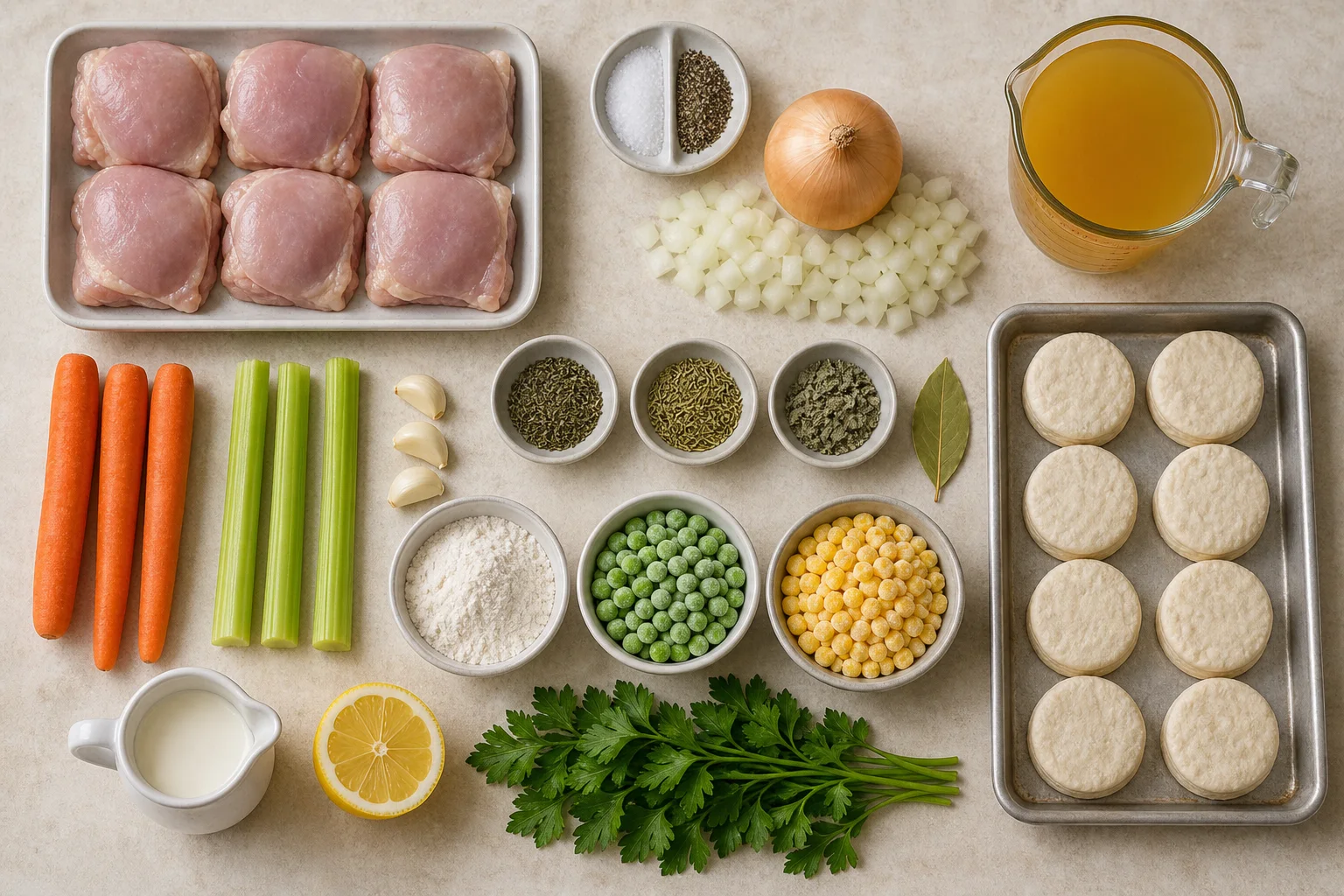
- 1 3/4 pounds boneless skinless chicken thighs, fully thawed and trimmed
- 1 teaspoon kosher salt, divided
- 1/2 teaspoon black pepper
- 1 medium yellow onion, diced
- 3 medium carrots, cut into 1/2-inch pieces
- 3 celery ribs, cut into 1/2-inch pieces
- 3 garlic cloves, minced
- 1 teaspoon dried thyme
- 1/2 teaspoon dried rosemary, crushed
- 1/2 teaspoon dried sage
- 3 cups low-sodium chicken broth, divided
- 1 bay leaf
- 1/3 cup all-purpose flour
- 1 cup frozen peas
- 1 cup frozen corn
- 1/2 cup heavy cream
- 1 tablespoon fresh lemon juice
- 1/4 cup chopped flat-leaf parsley
- 1 refrigerated or frozen package of 8 large unbaked biscuits
Ingredient notes and substitutions
Chicken thighs: Boneless skinless thighs stay juicy across a wider slow-cooking window. Remove visible fat before cooking so the sauce is not greasy.
Chicken breasts: Substitute the same weight of boneless skinless breasts. Begin temperature checks earlier and remove each piece individually at 165°F.
Vegetables: Carrots and celery go in at the start. Frozen peas and corn wait until the end so they retain color and do not become soft.
Broth: Low-sodium broth leaves room to season after the liquid concentrates. Reserve one cup cool broth for making the flour slurry.
Flour: Flour thickens the broth into a classic pot-pie sauce. For gluten-free filling, use a cup-for-cup gluten-free flour blend and verify the broth; choose separate gluten-free biscuits and follow their package.
Cream: Half a cup rounds the sauce without turning it into a bowl of cream. Whole milk can replace it, but the sauce will be lighter. Do not add dairy at the beginning because prolonged heat can make it separate.
Biscuits: Use eight large refrigerated or frozen unbaked biscuits. Package time and temperature take priority because dough size and formulas vary. Do not use ready-baked biscuits for the stated total time.
How to make Crock-Pot chicken pot pie with biscuits
1. Cut the vegetables evenly
Dice onion and cut carrots and celery into 1/2-inch pieces. Consistent cuts help the vegetables become tender at the same time. Mince the garlic and crush the dried rosemary between your fingers.
2. Load the slow cooker
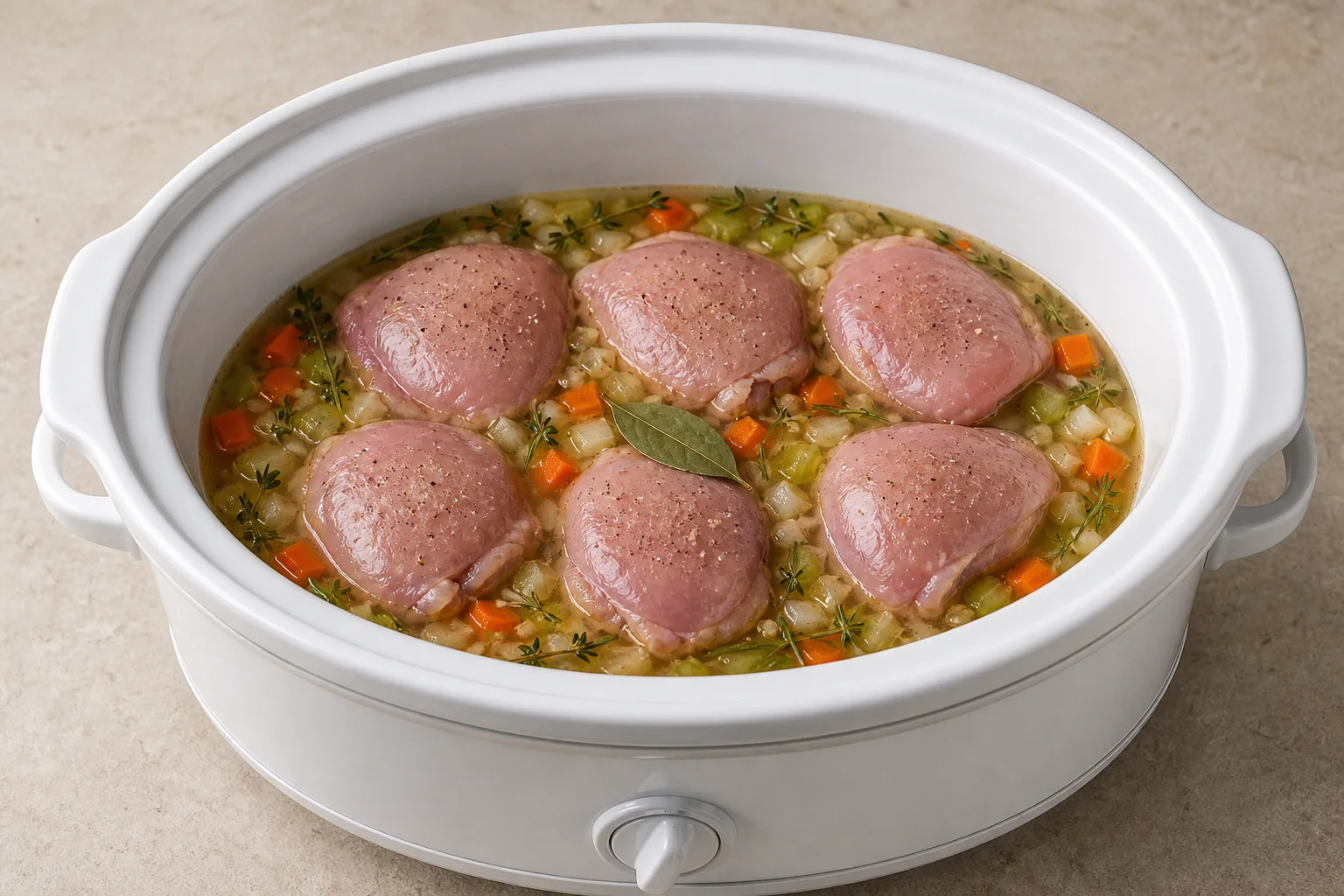
Put onion, carrots, celery and garlic in a 6-quart slow cooker. Add thyme, rosemary, sage, 1/2 teaspoon salt, black pepper, 2 cups broth and the bay leaf. Stir.
Pat fully thawed chicken dry; do not rinse it. Season with the remaining 1/2 teaspoon salt and arrange the thighs over the vegetables with minimal overlap.
3. Cook and check the chicken
Cover and cook on low for 4 1/2 to 5 1/2 hours or high for 2 1/2 to 3 1/2 hours. Begin checking at the earliest time.
Insert a clean instant-read thermometer into the thickest center of each thigh. Transfer each one to a clean plate as soon as it reaches 165°F, the federal safe minimum temperature for poultry. Rest for 5 minutes.
4. Shred the chicken
Discard the bay leaf. Shred or cut the rested chicken into bite-size pieces, removing any fat or cartilage. Keep it on the clean plate while the sauce thickens.
5. Thicken the filling
Whisk flour into the reserved 1 cup cool broth until smooth. For the least risk of lumps, pour 2 cups hot cooking liquid into a saucepan, whisk in the slurry and bring it to a gentle boil for 2 to 3 minutes. Return the thickened sauce to the cooker and stir.
Alternatively, whisk the slurry directly into the slow cooker, cover and cook on high for 20 to 30 minutes. Stir twice. The direct method is convenient but slower.
6. Bake the biscuits
While the sauce thickens, heat the oven and arrange unbaked biscuits on a parchment-lined sheet pan according to their package directions. Bake until deeply golden and the center of a test biscuit is fully baked, not wet or doughy.
Transfer biscuits to a wire rack. Do not cover them tightly; trapped steam softens their crust.
7. Finish the filling
Stir shredded chicken, frozen peas and frozen corn into the thickened sauce. Cover and heat on high for 5 to 10 minutes.
Switch off the cooker. Stir in cream, lemon juice and parsley. Taste the sauce with a piece of chicken and vegetable before adding more salt.
8. Assemble each bowl
Ladle hot filling into shallow bowls. Split a warm biscuit and set the halves on top just before serving. Keep extra biscuits separate at the table.
How thick should the filling be?
Pot-pie filling should coat a spoon and hold vegetables in suspension, but it should still flow when ladled. It thickens further as it stands and after refrigeration.
If the filling is thin, simmer a portion in a saucepan or cook it on high with the lid slightly ajar for 10 minutes. If it is too thick, add warm broth 2 tablespoons at a time.
Never sprinkle dry flour directly into hot filling. It forms persistent lumps and can leave a raw flour taste. Mix flour completely with cool liquid first, then bring the sauce to a brief boil so the starch reaches its thickening potential.
How to prevent gummy biscuits
- Bake biscuits separately in the oven, not on wet slow-cooker filling.
- Leave space between biscuits so hot air can circulate.
- Follow the specific package temperature and timing.
- Check the center of one biscuit before removing the tray.
- Cool on a rack rather than a solid plate.
- Put biscuits on bowls only at serving time.
- Store leftover biscuits apart from filling.
If the bottoms remain pale, bake on a preheated light-colored metal sheet pan. A glass dish heats differently and can change browning.
Can biscuits cook on top of the filling?
Some recipes place dough directly over hot filling. It can work when the filling is simmering strongly and the lid stays closed, but the result is closer to a steamed dumpling: soft, pale and moist underneath.
This recipe promises fluffy golden biscuits, so it uses the oven. If a dumpling-style top is what you want, use a recipe specifically calibrated for raw dough in a slow cooker rather than transferring these package directions.
Food-safety setup
Start with fully thawed chicken. USDA slow cooker safety guidance advises thawing meat or poultry before slow cooking and keeping perishable ingredients refrigerated until preparation.
Do not use a delayed-start timer with raw chicken. Load the cooker and switch it on immediately. Keep the raw-meat board, knife and plate away from biscuits, parsley and other ready-to-eat foods.
When checking multiple thighs, clean the thermometer probe between pieces. Put cooked chicken on a clean plate, not the one that held it raw.
Troubleshooting
The filling is watery
The slurry may not have become hot enough, or the cooker released more moisture than expected. Use the saucepan method for fast control. Bring the sauce to a gentle boil while whisking, then return it to the cooker.
The filling is lumpy
Whisk it in a saucepan or pass the sauce through a fine-mesh strainer before returning vegetables and chicken. Next time, add hot liquid gradually to the smooth cold slurry while whisking.
The chicken is dry
It stayed in the cooker after reaching 165°F. Begin checks earlier, especially with breasts. Cut dry chicken into larger pieces and coat it generously with sauce rather than shredding it finely.
The carrots are still firm
Remove safely cooked chicken and let the vegetables continue on high in 15-minute increments. Cut carrots consistently to 1/2 inch next time and keep them in the liquid near the bottom.
The sauce is greasy
Trim thigh fat before cooking and skim surface fat before adding the slurry. Chilling make-ahead filling also lets you lift solidified fat from the top.
The biscuits are brown outside but raw inside
They may be unusually large or the oven may run hot. Lower the heat slightly and continue baking, tenting loosely with foil if the tops are already dark. Follow the package and verify the center of a test biscuit.
The filling tastes flat
Add salt in small pinches after tasting. Lemon juice adds brightness, black pepper adds aroma and parsley gives freshness. Do not solve flatness with more cream; dairy can mute flavor further.
Make-ahead options
Chop the onion, carrots and celery up to two days ahead and refrigerate them in a sealed container. Keep raw chicken sealed separately on the lowest refrigerator shelf.
The complete filling can be cooked one day ahead. Cool it in shallow containers within 2 hours, refrigerate and reheat rapidly on the stove or in a microwave. Bake biscuits close to serving time.
Do not partly cook chicken, chill it and finish later. Complete the cooking process in one continuous session.
Storage and reheating
Refrigerate filling in shallow airtight containers within 2 hours and use within 3 to 4 days, consistent with the federal cold-storage chart. Store biscuits in a separate airtight container after they cool.
Reheat filling in a saucepan over medium heat, stirring and adding broth as needed. Bring sauces, soups and gravies to a boil during reheating; chicken pieces should reach 165°F. USDA leftover guidance advises against reheating cold leftovers in a slow cooker.
Warm biscuits in a 325°F oven for about 5 to 8 minutes. Microwaving makes them soft, which is acceptable for speed but less crisp.
Freezing instructions
Freeze the filling without cream for the smoothest result. Cool promptly, portion into freezer-safe containers and freeze for up to 3 months for best quality. Thaw overnight in the refrigerator, reheat to 165°F and stir in cream, lemon and parsley after heating.
Fully finished filling can be frozen, but dairy may look slightly grainy after thawing. Whisk gently while reheating. Bake fresh biscuits instead of freezing them on top of filling.
Frequently asked questions
Can I use frozen chicken?
No. Thaw chicken safely in the refrigerator before slow cooking. This cooking window is calibrated for fully thawed pieces.
Can I use rotisserie chicken?
Yes. Omit raw chicken and cook the vegetables in broth until tender. Add about 3 1/2 cups shredded cooked chicken with the peas and corn, only long enough to reach 165°F. Reduce initial salt because rotisserie chicken is often salty.
Can I use canned cream soup?
You can build a different shortcut version with condensed soup, but it is not a direct substitution for broth, flour and cream because sodium and thickness change substantially.
Can I use homemade biscuits?
Yes. Bake your preferred biscuit dough separately according to its tested recipe, then serve over the filling. Do not assume refrigerated-dough timing applies.
Can I leave out the cream?
Yes. Replace it with more broth for a lighter, dairy-free filling and use dairy-free biscuits. The flour slurry still provides body.
Can the finished pot pie stay on warm?
The filling can be held briefly if the appliance maintains food safely hot, but chicken and vegetables continue softening. Keep biscuits separate and serve as soon as practical.
What size slow cooker works best?
A 6-quart cooker gives the chicken and vegetables enough space while keeping a useful depth of liquid. Follow your appliance’s fill guidance.
Recipe development note
This recipe was developed through culinary research and editorial review. It has not been represented as a personal kitchen test. Chicken size, vegetable cuts, biscuit formulas and slow-cooker heat vary; verify poultry at 165°F and bake biscuits to their own doneness cues.
Nutrition is an estimate based on generic ingredients and one large biscuit per serving. The accompanying visuals are AI-assisted food-editorial images, not photographs of a kitchen test.
Recipe at a glance
| Metric | Details |
|---|---|
| Prep time | 25 minutes |
| Cook time | 330 minutes |
| Total time | 360 minutes |
| Yield | 8 servings |
Printable recipe card

Crock-Pot Chicken Pot Pie With Biscuits Recipe
Ingredients
Equipment
Method
- Dice onion; cut carrots and celery into 1/2-inch pieces; mince garlic.
- Add vegetables, garlic, herbs, 1/2 teaspoon salt, pepper, 2 cups broth and bay leaf to a 6-quart slow cooker. Arrange thawed chicken over vegetables and season with remaining salt.
- Cover and cook on low 4 1/2 to 5 1/2 hours or high 2 1/2 to 3 1/2 hours, beginning checks at the earliest time.
- Remove each thigh when its thickest center reaches 165°F. Rest 5 minutes, discard bay leaf and shred chicken into bite-size pieces.
- Whisk flour with reserved 1 cup cool broth. Boil with 2 cups cooking liquid in a saucepan for 2 to 3 minutes, then return thickened sauce to cooker.
- Bake biscuits separately on a sheet pan according to package directions until deeply golden and fully baked in the center. Cool briefly on a rack.
- Add shredded chicken, peas and corn; cover on high 5 to 10 minutes. Switch off cooker and stir in cream, lemon juice and parsley; adjust seasoning.
- Ladle hot filling into bowls and top each portion with a split warm biscuit immediately before serving.
Notes
- Bake biscuits separately so they brown and do not become gummy underneath.
- Use fully thawed chicken and remove each piece at 165°F.
- Mix flour with cool broth and boil the sauce to activate thickening.
- Store filling and biscuits separately.
- This recipe was developed through culinary research and editorial review.
This recipe was developed through culinary research and editorial review. Chicken size, vegetable cuts, biscuit formulas and slow-cooker heat vary; verify poultry at 165°F and bake biscuits to their own doneness cues.
Nutrition is an estimate based on generic ingredients and one large biscuit per serving; actual values vary by brand.