
These healthy oatmeal raisin cookies have visible rolled oats, chewy edges and soft centers without the puffy, cake-like texture that often comes from adding applesauce or mashed banana. Maple syrup provides moisture, a small amount of brown sugar improves caramelization, and whole-wheat pastry flour keeps the dough cohesive without making it heavy.
“Healthy” needs context. These are still cookies with butter and added sweeteners. The useful distinctions are a whole-grain oat-and-wheat base, a measured amount of sweetener, fruit in place of candy pieces and a clear 16-cookie yield. They are not sugar-free, a high-fiber medical food or a substitute for an overall balanced eating pattern.
This recipe was developed through culinary research and editorial review. Rolled-oat thickness, flour absorption, egg size, raisin dryness and pan color vary, so follow the rested-dough, pressed-shape and set-edge cues rather than adding flour before the oats hydrate.
For a nutty cookie with a completely different dough structure, see the healthy peanut butter cookies. The banana yogurt muffin recipe is a better choice when you specifically want a soft, fruit-sweetened breakfast bake.
What keeps an oat cookie soft instead of cakey
Applesauce and banana contribute water and fruit solids. They can be useful in muffins, but in a small cookie they often create steam and a puffy, cake-like crumb. This recipe gets moisture from maple syrup and an egg while melted butter supplies richness and controlled spread.
Old-fashioned rolled oats absorb liquid gradually. A 30-minute room-temperature rest allows that absorption to happen before baking. The dough becomes scoopable without needing an excessive amount of flour.
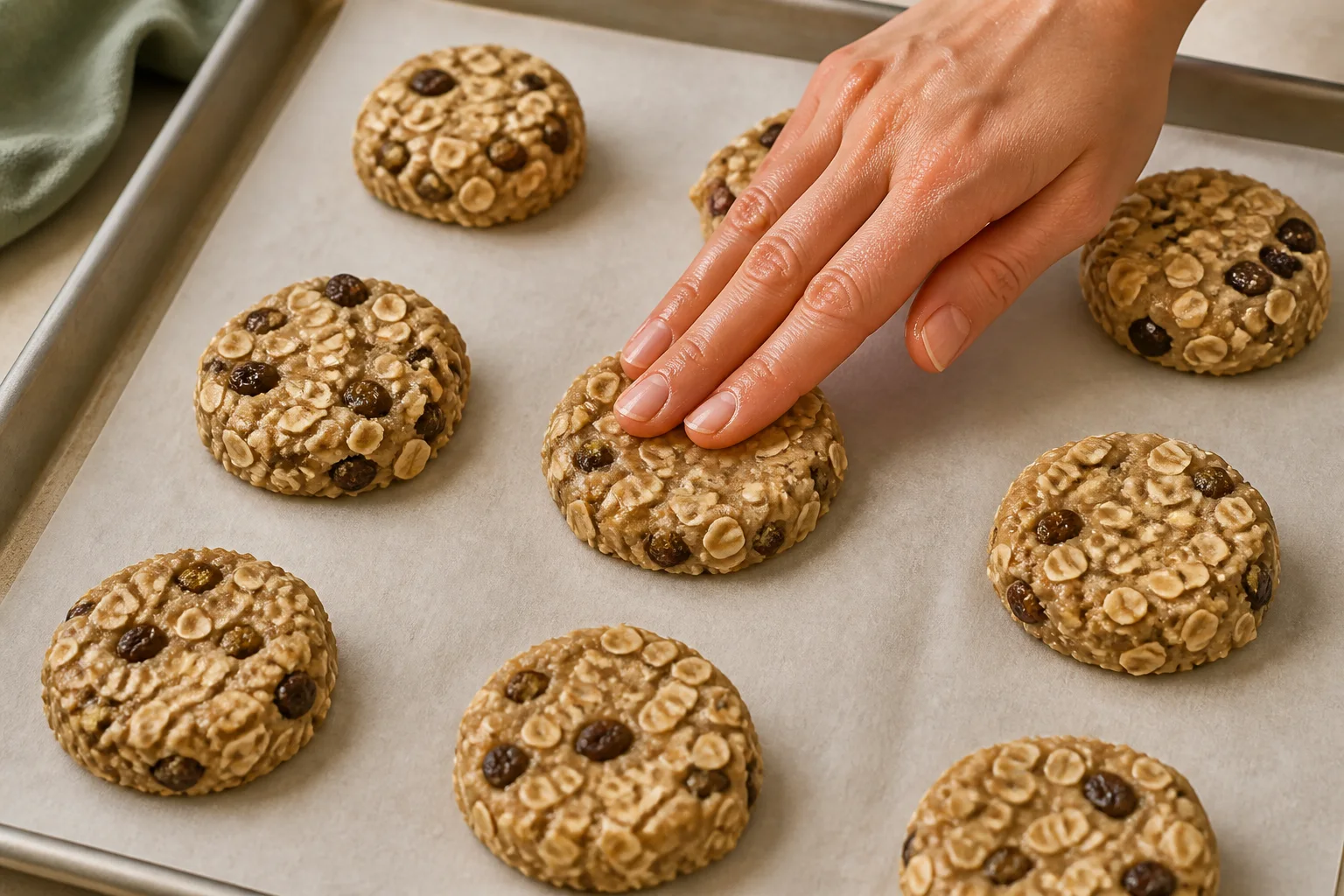
Pressing the portions to 1/2 inch also matters. Oat-heavy dough does not flow like a high-sugar chocolate-chip dough. If a round scoop goes into the oven, it may stay domed and seem underdone at the center even when the bottom has browned.
Ingredients
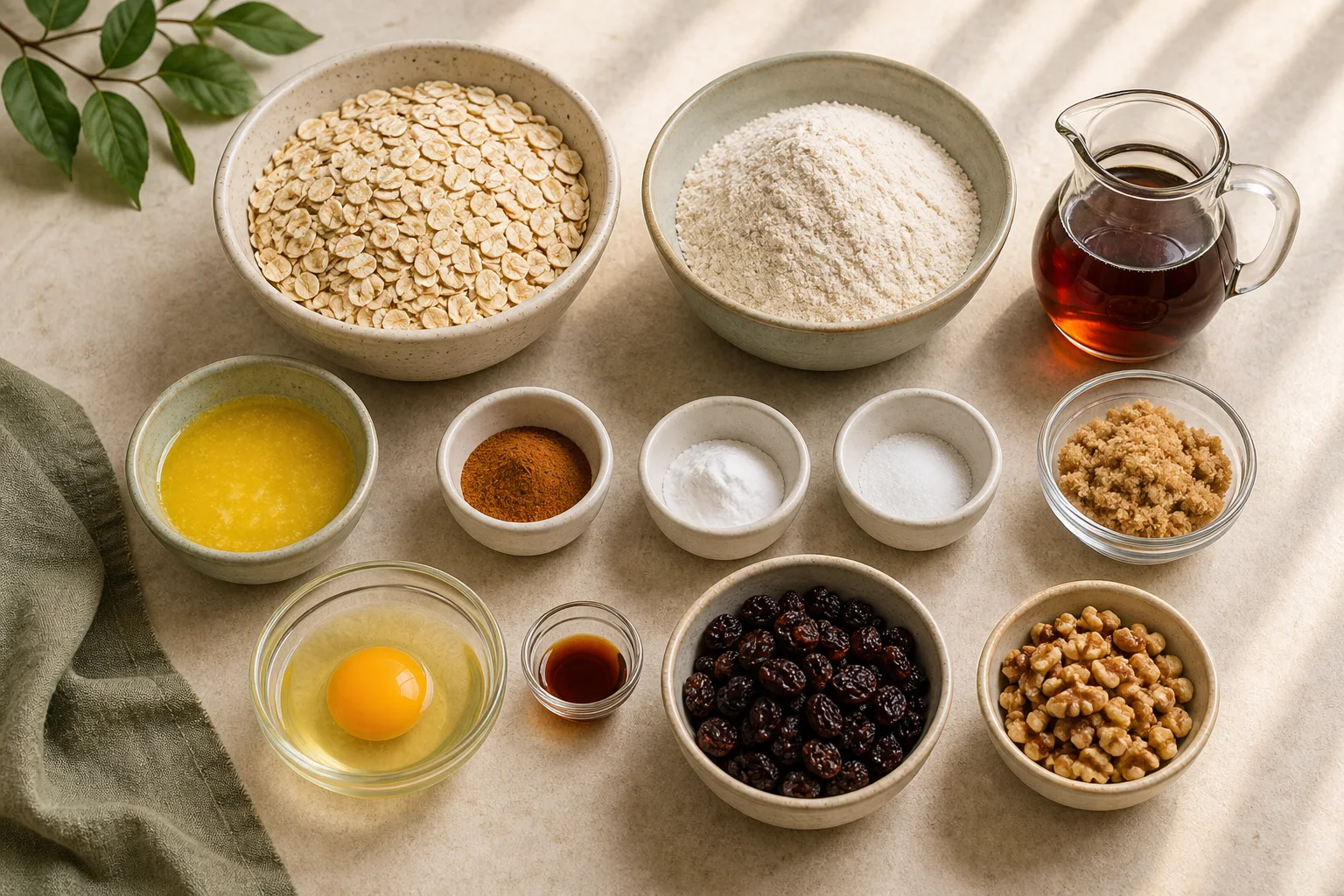
- 1 1/2 cups old-fashioned rolled oats, 150 grams
- 3/4 cup whole-wheat pastry flour, 90 grams
- 1 teaspoon ground cinnamon
- 1/2 teaspoon baking soda
- 1/4 teaspoon fine salt
- 1/4 cup unsalted butter, melted and cooled slightly, 56 grams
- 1/3 cup pure maple syrup, 105 grams
- 2 tablespoons packed light brown sugar, 25 grams
- 1 large egg, at cool room temperature
- 1 teaspoon vanilla extract
- 1/2 cup raisins, 75 grams
- 1/3 cup chopped walnuts or pecans, optional
Ingredient notes and substitutions
Rolled oats: Old-fashioned rolled oats create the clearest chewy texture. Quick oats absorb faster and produce a more uniform, less distinct crumb; use the same weight and check the dough after only 20 minutes of resting. Steel-cut oats remain too hard and are not a substitute.
Whole-wheat pastry flour: This is milled from softer wheat and keeps cookies more tender than regular whole-wheat flour. White whole-wheat flour can replace it by weight, but the cookies may be slightly firmer. All-purpose flour works but removes the all-whole-grain distinction.
Butter: Melted butter encourages chew and spread without requiring a mixer. Refined coconut oil can replace it by weight, but it firms more dramatically as it cools and can make portioning harder. A neutral liquid oil changes spread and is not a direct swap in this formula.
Maple syrup: Pure maple syrup supplies sweetness and controlled liquid. Honey can replace it by weight; the flavor will be more floral and the edges may brown sooner.
Brown sugar: Two tablespoons improve caramelization and retain moisture. Coconut sugar works by weight but often produces a slightly drier texture. Removing it entirely will make the cookies paler and less chewy.
Raisins: Regular or golden raisins work. Break apart any compressed clumps before measuring. Very dry raisins can pull moisture from the dough; the optional soak below corrects that issue.
Nuts: Walnuts or pecans add crunch and fat. They are optional, and the nutrition estimate excludes them. Toast and cool the nuts before chopping for stronger flavor.
How to make healthy oatmeal raisin cookies
1. Prepare the raisins
Check the raisins before mixing. If they feel plump and flexible, use them directly. If they are hard or shriveled, cover them with warm water for 10 minutes, then drain and blot thoroughly dry.
The short soak prevents very dry fruit from pulling water from the cookie centers. Surface water must be removed so it does not make wet pockets in the dough.
2. Mix the dry ingredients
In a medium bowl, whisk rolled oats, whole-wheat pastry flour, cinnamon, baking soda and salt. Lift the oats from the bottom several times so the small amounts of soda and salt distribute throughout.
Break up any flour lumps. Baking soda concentrated in one area can leave a bitter spot and uneven browning.
3. Mix the wet ingredients
In a separate large bowl, whisk melted butter, maple syrup and brown sugar until the sugar is dispersed. Add the egg and vanilla and whisk until smooth and slightly thickened.
The butter should be warm enough to remain liquid but not hot enough to cook the egg. If it has begun to resolidify, set the bowl over lukewarm water briefly and whisk.
4. Form the dough
Add the oat mixture to the wet ingredients. Fold with a sturdy spatula until no dry flour remains, then fold in raisins and optional nuts.
The fresh dough will look loose between the oats. Do not add extra flour at this stage; the rest period changes it substantially.
5. Rest for 30 minutes
Cover the bowl and let the dough stand at room temperature for 30 minutes. Stir once after 15 minutes so evenly hydrated oats move through the bowl.
The rested dough should hold a soft mound on a scoop. If the room is above 75°F and the butter keeps the dough very loose, refrigerate it for the final 10 minutes.
6. Heat the oven and portion
Heat the oven to 350°F with a rack in the center. Line two light-colored sheet pans with parchment paper.
Divide the dough into 16 portions of about 2 tablespoons or 38 grams. Place them 2 inches apart. Press each portion with damp fingertips into a disk about 1/2 inch thick, keeping the edges together rather than letting them crack.
7. Bake until the edges set
Bake one pan at a time for 10 to 13 minutes. The edges should be lightly browned and set; the centers should look matte on top but remain soft when touched very gently.
Rotate the pan after 8 minutes if the oven browns unevenly. Do not bake until the entire cookie is rigid. The centers finish setting on the hot pan.
8. Cool in two stages
Leave the cookies undisturbed on the pan for 10 minutes. Transfer with a thin spatula to a wire rack and cool completely.
The raisins stay hot longer than the surrounding dough, so avoid biting into a cookie straight from the oven. The finished chew becomes clearer after the cookie reaches room temperature.
Dough texture and spread guide
| Rested dough | Likely cause | Small correction |
|---|---|---|
| Holds a soft mound and presses cleanly | Balanced hydration | Bake as written |
| Slowly spreads before baking | Warm room, very thin syrup or large egg | Chill 10 minutes |
| Feels wet after chilling | Flour or oats absorbed less than expected | Fold in 1 tablespoon rolled oats; wait 5 minutes |
| Crumbles when pressed | Flour was heavy or raisins very dry | Add 1 teaspoon maple syrup or milk |
Make only one correction and wait before repeating it. Oats continue absorbing liquid, so a rapid series of additions can turn a workable dough dry.
How to prevent a dry oatmeal cookie
Weigh flour and oats
Rolled oats settle irregularly in cups, and flour compacts when scooped directly from a bag. Weighing 150 grams of oats and 90 grams of flour removes the two largest measurement variables.
Do not skip the rest
If the fresh dough looks loose, it is tempting to add flour. Thirty minutes later, the oats would have absorbed liquid as well, leaving twice the correction and a dry result.
Keep the raisins flexible
Fresh, pliable raisins contribute chew. Hard raisins act like tiny sponges, taking moisture from the cookie. Soak only when needed and blot well.
Remove the cookies while the centers are soft
The hot pan continues transferring heat. Edges should be set and centers matte, but the whole cookie should not feel firm at removal.
Store only after complete cooling
Warm cookies release steam in a closed container. That moisture first softens the edges, then redistributes unevenly and can leave surfaces tacky.
How this differs from a breakfast cookie
“Breakfast cookie” usually describes a larger, softer oat round that may include banana, applesauce, seeds and very little added sugar. Its texture often resembles a portable baked oatmeal more than a conventional cookie.
This recipe keeps the chew and browned edges people expect from an oatmeal raisin cookie. It can be eaten at any time, but calling it breakfast does not change the added sweetener or serving size.
If you want a meal-prep breakfast, pair a cookie with protein and fresh fruit rather than treating several cookies as nutritionally identical to a bowl of oatmeal. The food label or exact ingredient brands give more reliable personal nutrition information than a broad recipe name.
What “healthy” means here
FDA materials identify rolled oats among whole-grain ingredients and set a daily reference value of 28 grams for dietary fiber. That does not mean one oatmeal cookie is automatically “high fiber.” FDA explains that 20% Daily Value or more is generally considered high for a nutrient; this recipe does not make that regulated-style claim.
The recipe uses rolled oats and whole-wheat pastry flour instead of refined flour, but it also contains butter, maple syrup and brown sugar. Raisins contribute fruit flavor and natural sugars, yet dried fruit is more concentrated than fresh fruit.
Think of the cookie as a portioned whole-grain dessert. If a medical condition requires a specific amount of carbohydrate, fiber, sodium or added sugar, calculate from the exact labels or consult a qualified professional.
Flavor variations
Cranberry orange: Replace raisins with unsweetened or reduced-sugar dried cranberries and add 1 teaspoon finely grated orange zest. Dried cranberries often contain added sugar, so read the label.
Apple cinnamon: Replace half the raisins with 1/3 cup very small diced dried apple. Do not use fresh apple in this formula; its water changes the dough.
Walnut: Add the optional 1/3 cup toasted chopped walnuts. Keep the pieces small so the edges remain cohesive.
Chocolate chip: Replace raisins with 1/2 cup mini chocolate chips. The result is sweeter and no longer an oatmeal raisin cookie.
Ginger: Add 1/2 teaspoon ground ginger with the cinnamon and use golden raisins.
Do not add mashed banana or applesauce without redesigning the flour and leavening. Those wet ingredients move the texture toward cake or baked oatmeal.
Troubleshooting
The cookies are cakey
The egg may have been unusually large, the portions left too thick or baking soda replaced with baking powder. Press to 1/2 inch and use the listed leavener.
The cookies are hard after cooling
They baked too long, had too much flour or were portioned too small. Weigh the ingredients and remove the pan while centers remain soft.
The cookies fall apart
They may be too hot, underbaked or short on flour because of a measuring error. Complete the 10-minute pan rest before moving. A fully cooled cookie should hold while remaining tender.
The cookies spread into each other
The dough or pan was warm. Chill the rested dough for 10 minutes and use a completely cool sheet pan. Leave 2 inches between portions.
The cookies stay domed
Oat-heavy dough does not spread dramatically. Press each scoop before baking. A dome can remain soft inside while its bottom overbrowns.
The raisins burn
Raisins sitting on the outer edge can scorch. Push exposed fruit into the dough before baking and avoid placing a pan close to the lower heating element.
The bottoms brown too quickly
Use a light-colored pan on the center rack. Reduce the oven to 340°F for a dark pan and begin checking 1 to 2 minutes earlier.
The cookies taste soapy or bitter
Baking soda was overmeasured or not dispersed. Level the half teaspoon and whisk the dry mixture thoroughly before combining.
Storage and freezing
Cool cookies completely, then store in an airtight container at room temperature for up to 3 days. Place parchment between layers. A small piece of plain bread in the container can soften cookies, but replace it daily and keep it from touching them if allergen or cross-contact concerns apply.
Refrigerate for up to 7 days for longer storage. Let a cookie stand at room temperature or warm it for 5 to 8 seconds in the microwave. Long microwave heating makes raisins extremely hot and can toughen the edges.
Freeze baked cookies in a rigid airtight container for up to 2 months. Thaw inside the closed container at room temperature so condensation forms less directly on the cookies.
To freeze dough, portion and press it first. Freeze the disks on a lined pan, transfer to a freezer bag, and bake from frozen at 350°F with approximately 2 extra minutes. Check the edges rather than relying only on the clock.
Frequently asked questions
Can I use quick oats?
Yes, by weight. Rest the dough for 20 minutes first because quick oats absorb faster. The final texture will be finer and less chewy.
Can I use steel-cut oats?
No. They remain firm and require a different hydration and cooking process.
Can I make oat flour for this recipe?
The recipe uses rolled oats plus whole-wheat pastry flour, not oat flour. Grinding the rolled oats would remove the visible chewy oat structure and change absorption.
Can I leave out the raisins?
Yes. The dough will be slightly less sweet and the yield may be a little lighter. Add optional toasted nuts or leave the cookies plain.
Are these cookies sugar-free?
No. Maple syrup and brown sugar are added sweeteners, and raisins contain naturally occurring sugar.
Are oatmeal cookies gluten-free?
Not this formula, because it includes whole-wheat pastry flour. Oats also require appropriate labeling and cross-contact controls for someone with celiac disease.
Why rest oatmeal cookie dough?
Resting gives rolled oats time to absorb liquid. It makes the dough easier to portion and reduces the urge to add too much flour.
Can I eat the dough raw?
No. It contains raw egg and uncooked flour. USDA specifically advises that raw cookie dough with raw egg is unsafe.
Recipe development note
This healthy oat cookie recipe was developed through culinary research and editorial review. It has not been represented as a personal kitchen test. Rolled-oat thickness, flour absorption, egg size, raisin dryness, pan color and oven calibration vary; use the rested-dough, pressed-thickness and set-edge cues.
Nutrition is an estimate without optional nuts or substitutions. The accompanying visuals are AI-assisted food-editorial images, not photographs of a kitchen test.
Printable recipe card
Healthy Oatmeal Raisin Cookies Recipe
Ingredients
Equipment
Method
- Use flexible raisins directly. If hard or shriveled, soak in warm water 10 minutes, then drain and blot thoroughly dry.
- Whisk rolled oats, whole-wheat pastry flour, cinnamon, baking soda and salt until evenly distributed.
- Whisk melted butter, maple syrup and brown sugar. Whisk in the egg and vanilla until smooth and slightly thickened.
- Fold dry ingredients into wet just until no flour remains. Fold in raisins and optional nuts.
- Cover and rest at room temperature for 30 minutes, stirring once halfway. The dough should hold a soft mound.
- Heat the oven to 350°F. Divide dough into 16 portions of about 38 grams on parchment-lined light pans and press to 1/2 inch thick.
- Bake one pan at a time for 10 to 13 minutes, until edges are lightly browned and centers look matte but remain soft.
- Leave cookies on the pan for 10 minutes, then transfer with a thin spatula to a wire rack and cool completely.
Notes
- Weigh oats and flour for the most repeatable texture.
- Do not add flour before the 30-minute oat-hydration rest.
- Press each portion to 1/2 inch; oat-heavy dough does not spread dramatically.
- Remove while centers are soft and allow a 10-minute pan rest.
- Do not eat raw dough; it contains raw egg and uncooked flour.
- Contains wheat, milk and egg; optional nuts add a tree-nut allergen.
- This recipe was developed through culinary research and editorial review.
This recipe was developed through culinary research and editorial review. Rolled-oat thickness, flour absorption, egg size, raisin dryness, pan color and oven calibration vary; use the rested-dough, pressed-thickness and set-edge cues.
Nutrition is an estimate per cookie without optional nuts or substitutions; actual brands and portions vary.