
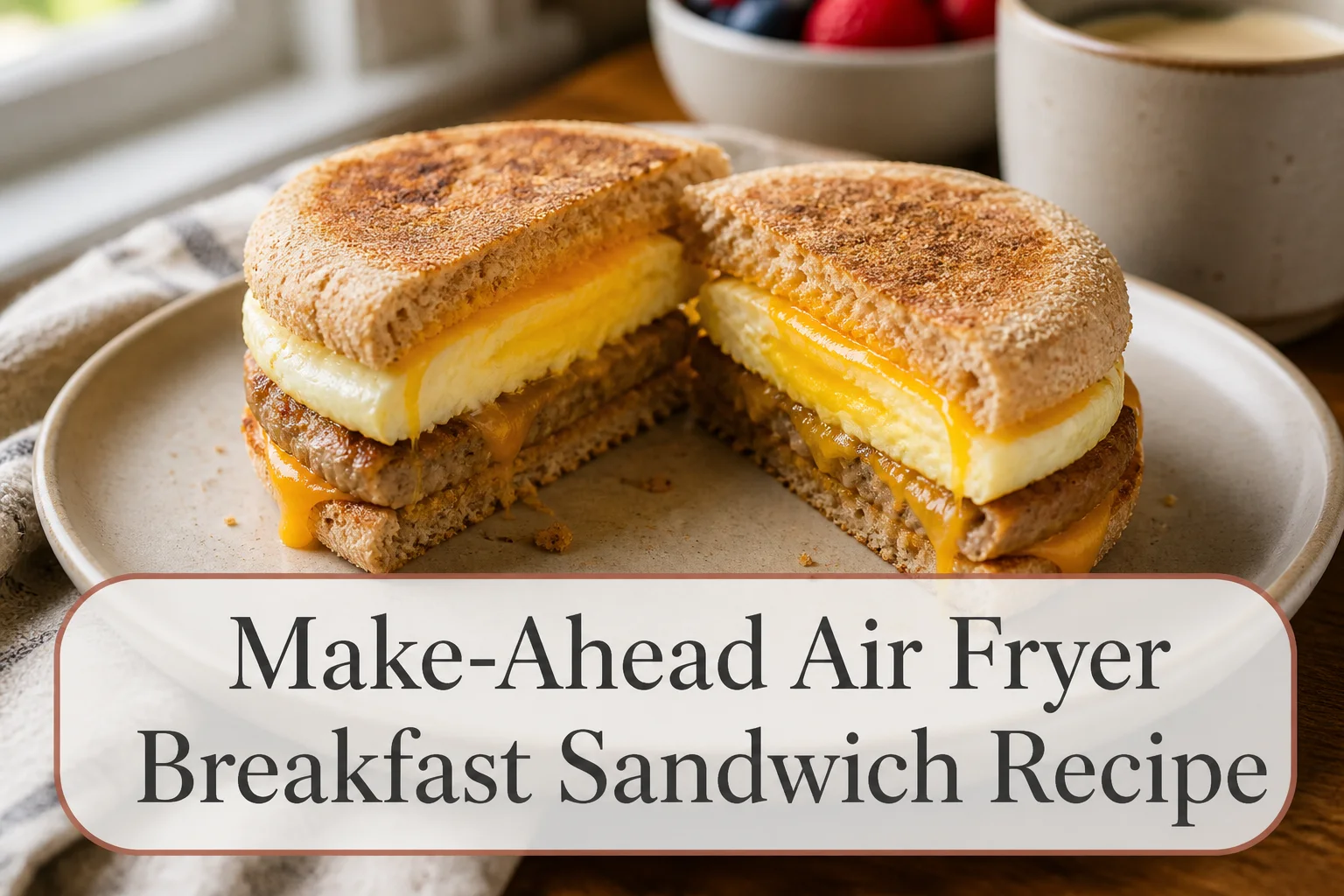
This air fryer breakfast sandwich combines a softly set egg patty, fully cooked turkey sausage and melted cheddar on a crisp English muffin. The method cooks the eggs gently first, then warms and toasts the assembled sandwiches just long enough to melt the cheese.
The recipe makes four sandwiches, so breakfast can be served immediately or cooled and wrapped for later. Separate directions for refrigerated and frozen sandwiches prevent the common combination of a cold center and an over-toasted muffin.
This recipe was developed through culinary research and editorial review. Air-fryer power, ramekin material and sandwich temperature change the timing, so verify the egg and reheated center with an instant-read thermometer.
For another batch breakfast, try the high-protein breakfast casserole or add air fryer diced potatoes on the side.
Why the egg cooks separately
An English muffin browns much faster than a raw egg sets. Trying to cook both from the beginning can leave wet egg in the center or dry, hard bread around it.
Small greased silicone cups shape the eggs into even patties at a moderate 300°F. Once the egg reaches 160°F, assembling the sandwich takes only a few minutes. The muffin stays crisp, the sausage heats through and the cheese melts without toughening the egg.
Use four cups that fit with clearance around them. If the basket holds only two, cook the eggs in two batches. Do not stack molds.
Ingredients
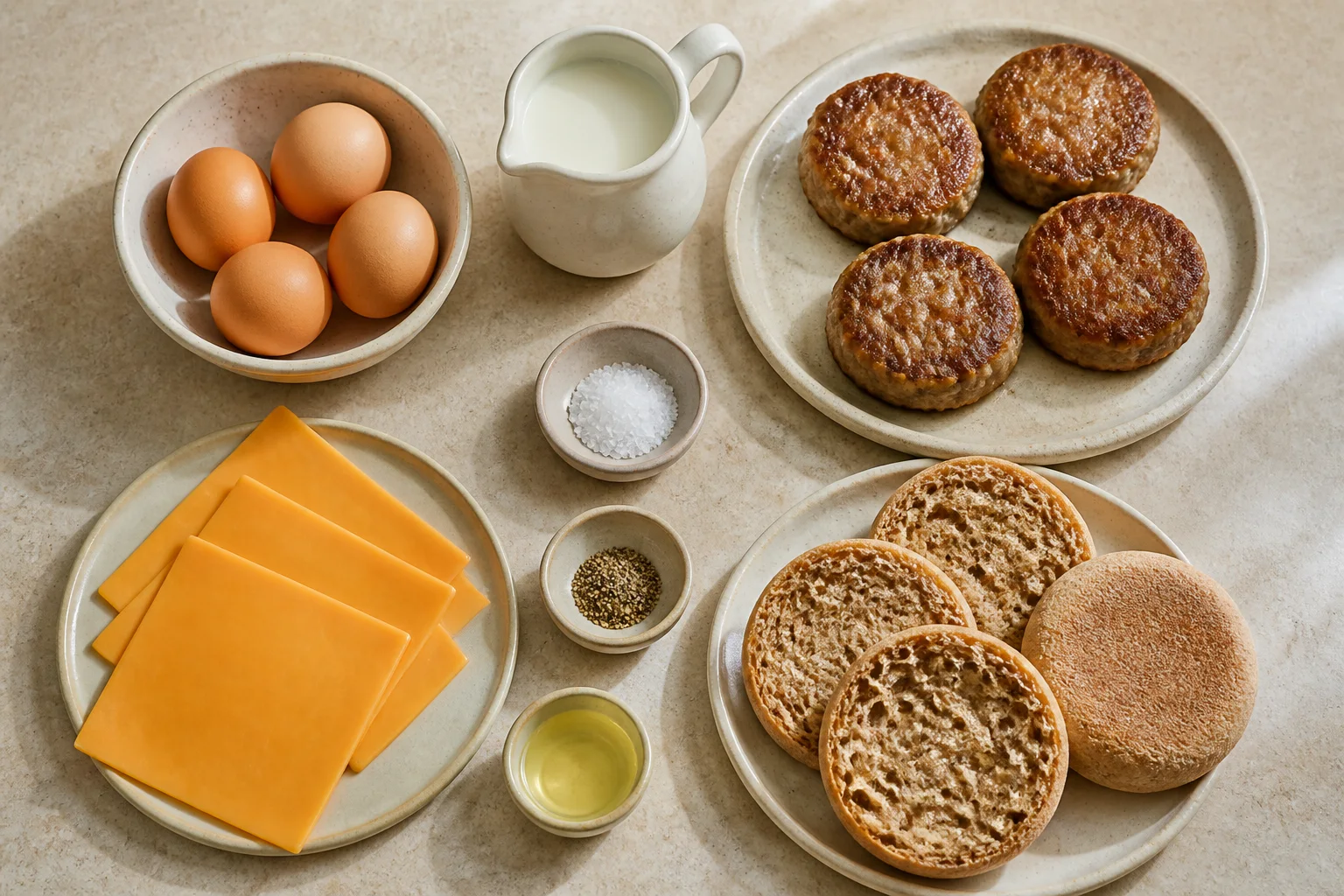
- 4 large eggs
- 2 tablespoons milk
- 1/4 teaspoon fine salt
- 1/8 teaspoon black pepper
- Cooking spray or 1 teaspoon neutral oil
- 4 fully cooked turkey sausage patties, thawed if frozen
- 4 whole-wheat English muffins, split
- 4 slices sharp cheddar cheese
- Hot sauce or sliced tomato for serving, optional
Ingredient notes and substitutions
Eggs: Large eggs fill standard 4-inch silicone egg cups without becoming too thick. Carton egg whites work, but they set more firmly and may cook a minute sooner.
Milk: A small splash loosens the egg. Dairy or unsweetened plant milk works. More liquid makes the patties delicate and can lengthen cooking.
Sausage: Use fully cooked patties, not raw sausage. Turkey, chicken, pork or a plant-based patty can work; follow its package heating guidance.
English muffins: Whole-wheat muffins add a sturdy, nutty base. Sourdough or regular muffins work at the same timing. Bagels are denser and require a separate reheating approach.
Cheese: Cheddar melts reliably. American, pepper Jack or a thin slice of Swiss can replace it. Very thick cheese delays center heating.
For the sausage layer, the air fryer breakfast sausage guide covers links and patties and explains why raw and fully cooked products need different handling.
For a homemade sandwich base, whole-wheat English muffins includes the griddle method and explains how to cool and fork-split the muffins before toasting.
How to make an air fryer breakfast sandwich
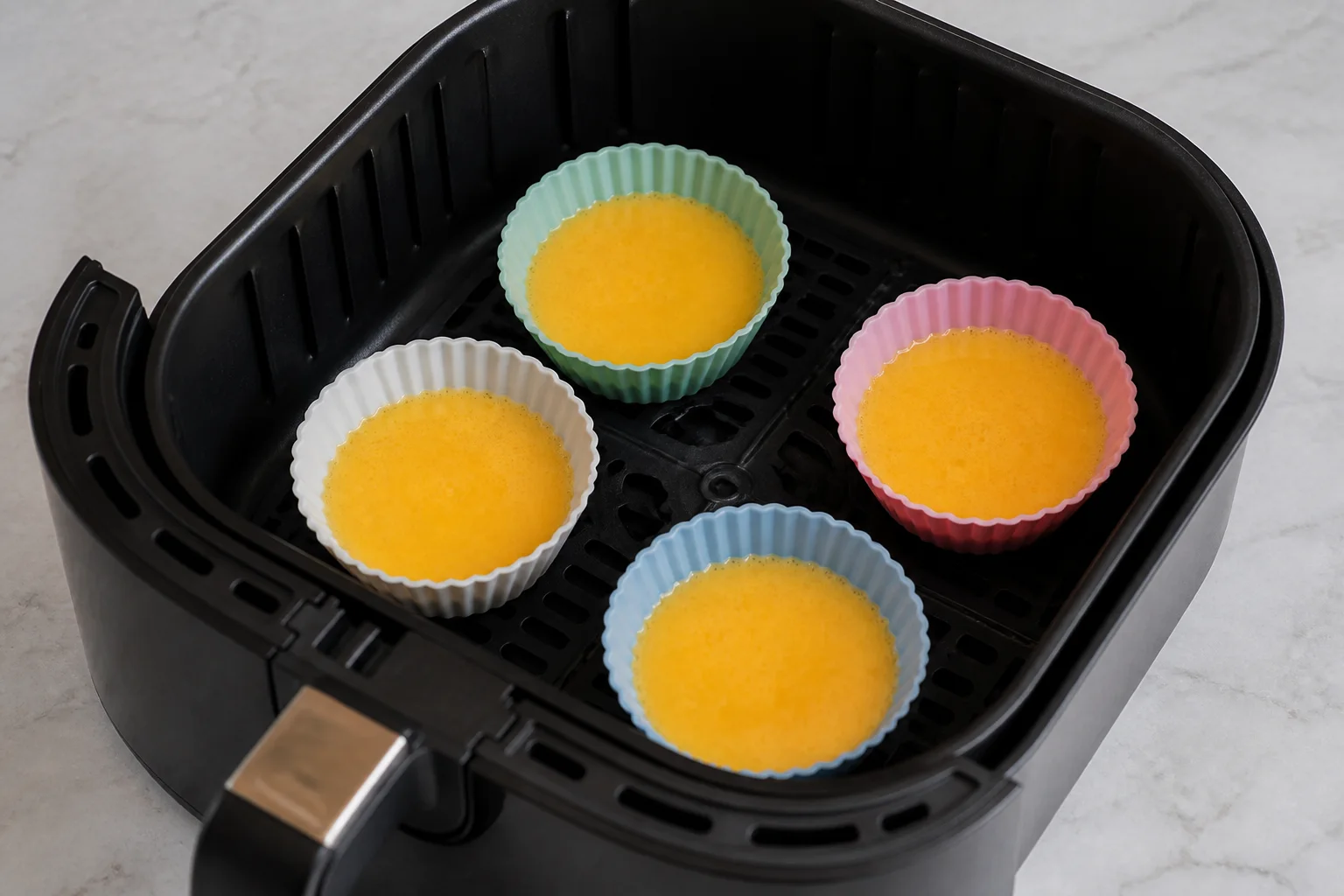
1. Prepare the egg cups
Grease four heat-safe silicone egg cups or shallow ramekins approved for the air fryer. Confirm that air can circulate around each cup and that nothing touches the heating element.
2. Whisk the eggs
Whisk eggs, milk, salt and pepper until the whites and yolks are fully combined. Divide evenly among the cups.
3. Air fry gently
Place the cups in the basket. Cook at 300°F for 7 minutes. Check the centers, then continue 1 to 3 minutes until set and 160°F. Rest 2 minutes before loosening the edges with a flexible spatula.
4. Build the sandwiches
Place one egg patty and one fully cooked sausage patty on each muffin bottom. Add cheese, then the muffin tops. For immediate serving, the components can still be warm.
5. Melt and toast
Arrange sandwiches in one layer. Air fry at 350°F for 3 to 5 minutes, checking at 3 minutes. They are ready when the cheese melts, sausage is hot and muffin edges are crisp.
6. Serve or cool
Serve immediately, or take the sandwiches apart slightly and cool until no longer steaming before wrapping for storage. Wrapping while hot traps condensation and softens the bread.
Air fryer breakfast sandwich time guide
| Sandwich condition | Temperature | Common time | Important cue |
|---|---|---|---|
| Freshly assembled, warm filling | 350°F | 3 to 5 minutes | Cheese melted, bread crisp |
| Refrigerated, unwrapped | 330°F | 6 to 9 minutes | Center reaches 165°F |
| Frozen, foil-wrapped first stage | 300°F | 12 to 15 minutes | Center beginning to heat |
| Frozen, unwrapped final stage | 350°F | 3 to 5 minutes | Center 165°F, muffin crisp |
Times assume a standard English-muffin sandwich with a cooked egg and fully cooked sausage patty. Thick bagels, oversized sausage and very cold freezers need different timing.
How to air fry a frozen breakfast sandwich
Remove plastic, paper towel and storage wrap. Enclose the frozen sandwich in foil and heat at 300°F for 12 minutes. Carefully open it and check the center.
Continue wrapped for up to 3 minutes if still cold. Then remove the foil and air fry at 350°F for 3 to 5 minutes to crisp the muffin. The center should reach 165°F.
Foil use varies by appliance. Keep it secured around the food, never allow it to touch the heating element and follow the manufacturer’s accessory directions. If foil is not permitted, thaw the sandwich overnight and use the refrigerated method.
Make-ahead assembly
Let egg patties and sausage cool before building. A slice of cheese between the muffin and egg creates a modest moisture barrier. Avoid tomato or wet sauce before storage; add those after reheating.
Wrap each sandwich tightly in freezer-safe wrap, then place all four in a labeled freezer bag. Refrigerate up to 4 days or freeze up to 2 months for best texture.
For the most even result, thaw a frozen sandwich overnight in the refrigerator. Reheat unwrapped at 330°F for 6 to 9 minutes, turning once, until the center reaches 165°F.
Troubleshooting
The egg is rubbery
The temperature was too high or cooking continued after 160°F. Use 300°F and shallow cups, then check early in a powerful model.
The frozen center is cold
The sandwich is too thick for one high-heat step. Use the two-stage wrapped-then-unwrapped method and verify 165°F at the center.
The muffin is too dark
Reduce final crisping time or use 330°F. Muffins with added sugar brown faster.
The bread is soggy
The components were wrapped while steaming or wet toppings were stored inside. Cool completely and add tomato after reheating.
The cheese blows off
Keep it inside the closed sandwich, not exposed on an open muffin. Air-fryer fans can move loose slices.
The egg sticks to the cup
Grease the entire inside, including the upper edge. Rest the cooked egg 2 minutes, then loosen with a flexible spatula.
Flavor variations
Southwest: Add a pinch of cumin to the egg and use pepper Jack. Serve with salsa after reheating.
Spinach and feta: Stir 2 tablespoons finely chopped, squeezed-dry spinach into the eggs and replace cheddar with crumbled feta. The egg may need 1 extra minute.
Vegetarian: Use a fully cooked plant-based patty or omit sausage and add a second egg patty.
Bacon: Replace sausage with two pieces of separately cooked bacon. Do not put raw bacon into the egg cup.
Food-safety notes
Cook egg patties to 160°F. Reheat refrigerated or frozen assembled sandwiches to 165°F at the center. The USDA safe minimum internal temperature chart lists 160°F for egg dishes and 165°F for leftovers.
Cool cooked components promptly. Do not leave assembled sandwiches at room temperature for more than 2 hours, or more than 1 hour when the surrounding temperature is above 90°F.
Frequently asked questions
Can I put a raw egg directly on the muffin?
It is not recommended. The bread can overcook before the egg reaches a safe, even set.
Do I need to preheat the air fryer?
Preheat only if your model recommends it. Start checking early if the basket is already hot.
Can I use raw sausage?
Not in this assembly method. Cook raw sausage completely in a separate step, cool it, then build the sandwich.
Can I reheat the sandwich in parchment?
Use only manufacturer-approved accessories. Loose paper can lift toward the heating element, especially during preheating.
How long does a refrigerated sandwich take?
Most need 6 to 9 minutes at 330°F, turned once, until the center reaches 165°F.
Can I freeze the sandwiches?
Yes. Cool completely, wrap tightly and freeze up to 2 months for best texture.
Recipe development note
This air fryer breakfast sandwich was developed through culinary research and editorial review. It is not represented as a personal kitchen test. Egg-cup depth, appliance power and starting temperature vary, so use an instant-read thermometer with the stated time ranges.
Nutrition is an estimate per sandwich made with turkey sausage and cheddar. The accompanying visuals are AI-assisted food-editorial images, not photographs of a kitchen test.
Printable recipe card
Make-Ahead Air Fryer Breakfast Sandwich Recipe
Ingredients
Equipment
Method
- Grease four air-fryer-safe silicone egg cups and arrange with space around them.
- Whisk eggs, milk, salt and pepper and divide evenly among the cups.
- Air fry at 300°F for 7 minutes, then 1 to 3 minutes longer until set and 160°F; rest 2 minutes.
- Place an egg patty and fully cooked sausage on each muffin bottom, add cheddar and close.
- Air fry in one layer at 350°F for 3 to 5 minutes until cheese melts and the muffin is crisp.
- Serve immediately, or cool the components until no longer steaming before wrapping for storage.
Notes
- Use fully cooked, not raw, sausage patties.
- Cook egg dishes to 160°F.
- Reheat stored sandwiches to 165°F.
- Cool completely before wrapping to prevent soggy bread.
- Contains egg, milk and wheat unless substitutions are used.
- This recipe was developed through culinary research and editorial review.
This recipe was developed through culinary research and editorial review. Egg-cup depth, appliance power and starting temperature vary; verify doneness with a thermometer.
Nutrition is an estimate per sandwich made with turkey sausage and cheddar.