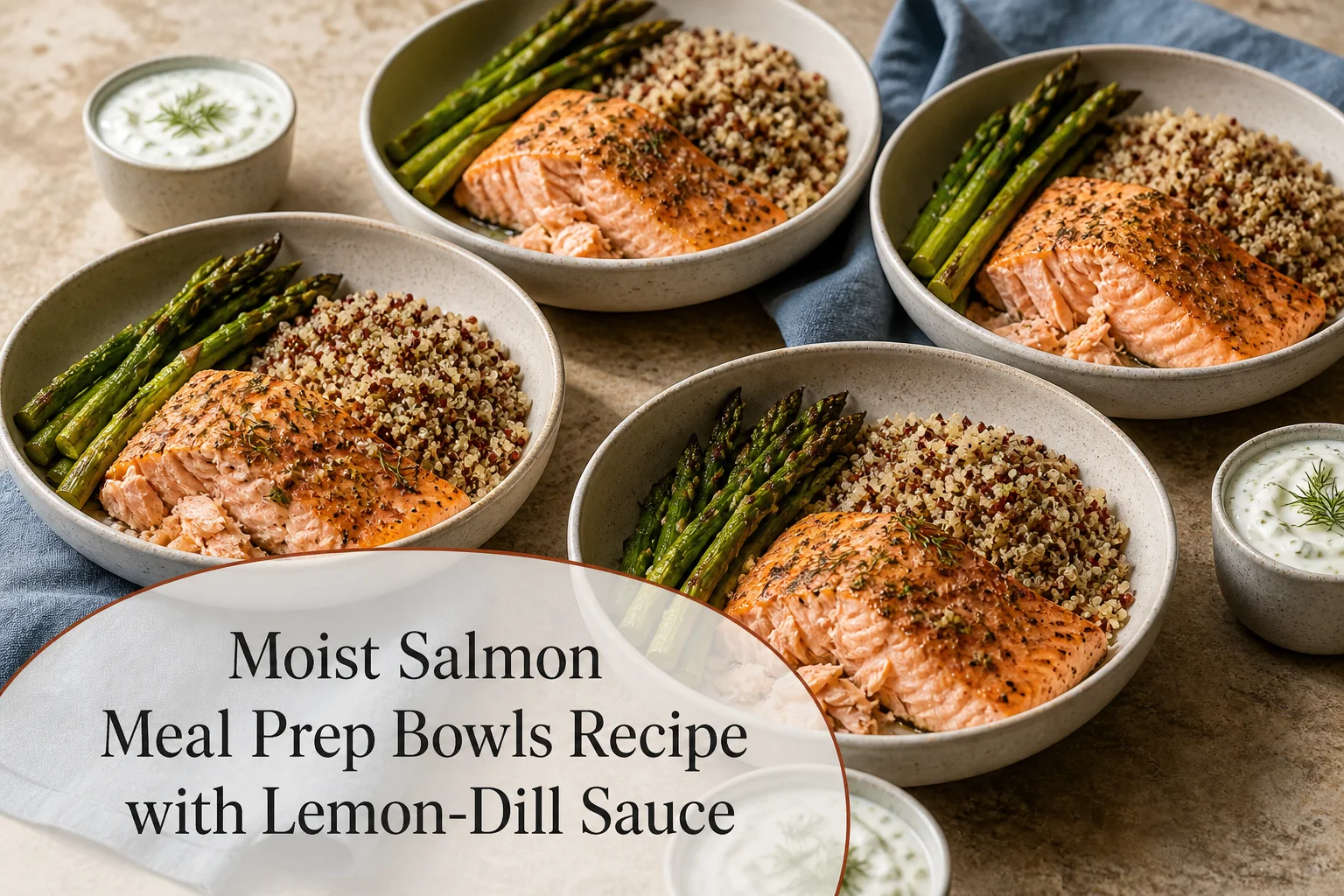
This salmon meal prep recipe makes four bowls with lemon-pepper salmon, fluffy quinoa, roasted asparagus and a cool lemon-dill yogurt sauce. The sauce is packed separately so the fish can be served cold or reheated gently without warming the yogurt.
The key to moist salmon is stopping at the endpoint instead of baking until the surface is hard. Equal-size portions cook more evenly, and a food thermometer removes the guesswork from an opaque center.
This recipe was developed through culinary research and editorial review. Fillet thickness, starting temperature and ovens vary; use the 145°F center, flaking and reheating cues below.
For poultry-based lunches, see the chicken and rice meal prep recipe or these ground turkey meal prep bowls.
Why reheated salmon becomes dry
Salmon proteins firm quickly as heat rises. A fillet baked well beyond its safe endpoint has little moisture left to protect during refrigeration and reheating.
Portioning before baking helps. Four similar center-cut pieces reach temperature close together, while one large uneven side may have a thin tail that dries before the center is ready.
For reheating, lower microwave power is more useful than simply reducing time. It allows warmth to move toward the center before the outside becomes chalky. The bowls are also good cold, which avoids a second heating cycle entirely.
Ingredients
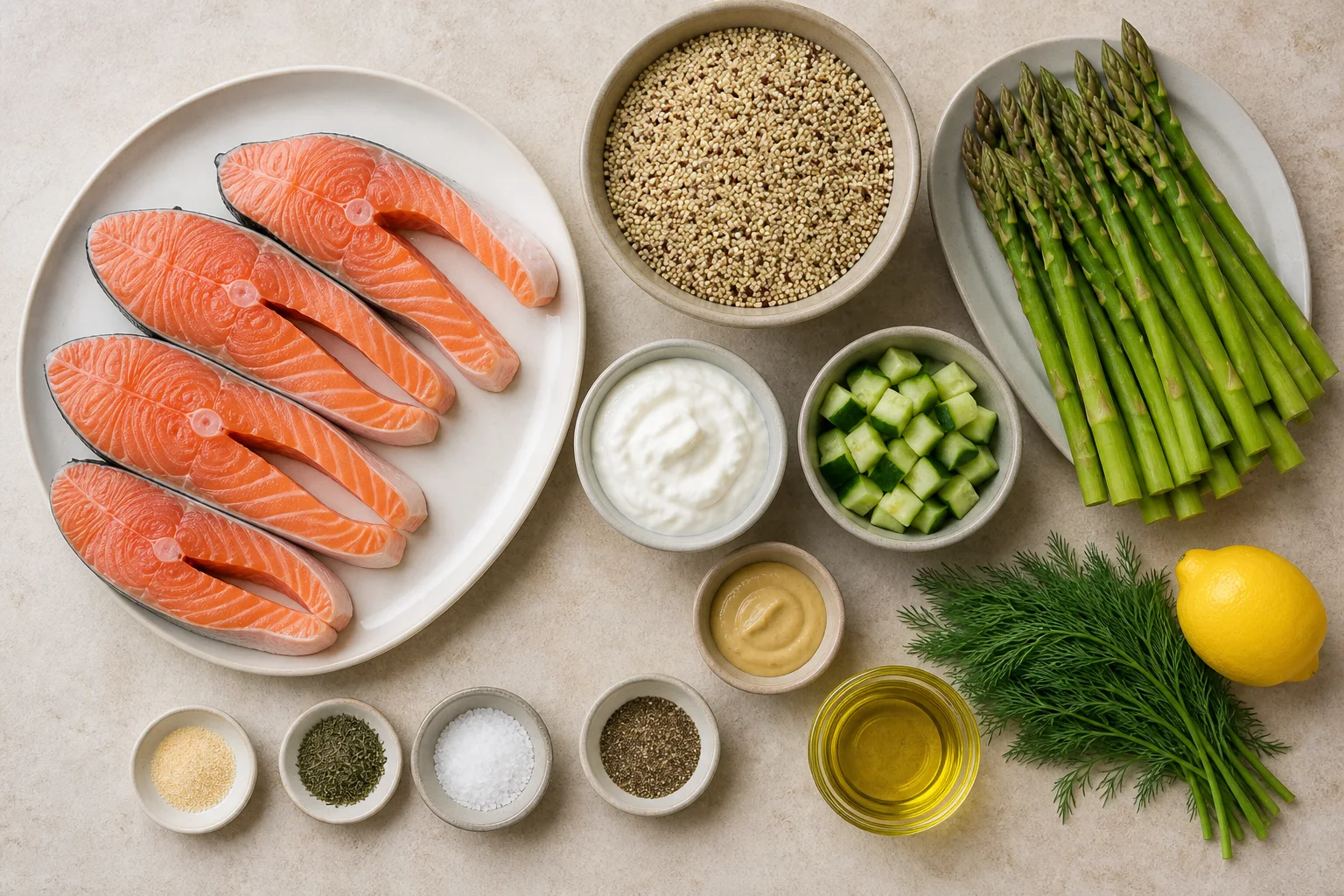
- 1 1/4 cups dry quinoa, rinsed thoroughly, 215 grams
- 2 1/4 cups water or low-sodium broth, 540 milliliters
- 1 1/2 pounds center-cut skin-on salmon, cut into 4 portions, 680 grams
- 1 pound asparagus, woody ends trimmed, 454 grams
- 3 tablespoons olive oil, divided, 42 grams
- 1 teaspoon finely grated lemon zest
- 2 tablespoons fresh lemon juice, divided, 30 milliliters
- 1 teaspoon garlic powder
- 1 teaspoon dried dill
- 3/4 teaspoon fine salt, divided
- 1/2 teaspoon black pepper, divided
- 1 cup plain Greek yogurt, 240 grams
- 2 tablespoons chopped fresh dill
- 1 teaspoon Dijon mustard
- 1 small cucumber, diced and dried, about 180 grams
Ingredient notes and substitutions
Salmon: Center-cut portions of similar thickness cook most evenly. Skin protects the bottom and is easy to remove after chilling if desired. Frozen salmon should be fully thawed in the refrigerator and patted dry.
Quinoa: Rinse until water runs mostly clear to remove bitterness. Brown rice or farro works when cooked according to its own package.
Asparagus: Choose medium spears and keep them in one layer. Broccoli or green beans can substitute, but check their own tenderness.
Greek yogurt: Thick yogurt keeps the sauce from running into the quinoa. Regular yogurt needs less lemon juice.
Cucumber: Dry the diced pieces after cutting. Surface water thins yogurt sauce during storage.
How to make salmon meal prep bowls
1. Cook the quinoa
Combine rinsed quinoa and water or broth. Bring to a boil, cover, reduce to low and cook according to the package, usually 15 minutes. Rest covered 5 minutes, then fluff and spread on a shallow tray.
2. Heat the oven
Heat the oven to 400°F. Line a rimmed sheet pan and place salmon portions skin-side down on one half.
3. Season salmon and asparagus
Mix 2 tablespoons olive oil, lemon zest, 1 tablespoon lemon juice, garlic powder, dried dill, 1/2 teaspoon salt and 1/4 teaspoon pepper. Brush salmon with half. Toss asparagus with the remaining mixture and spread beside the fish.
4. Roast and check early
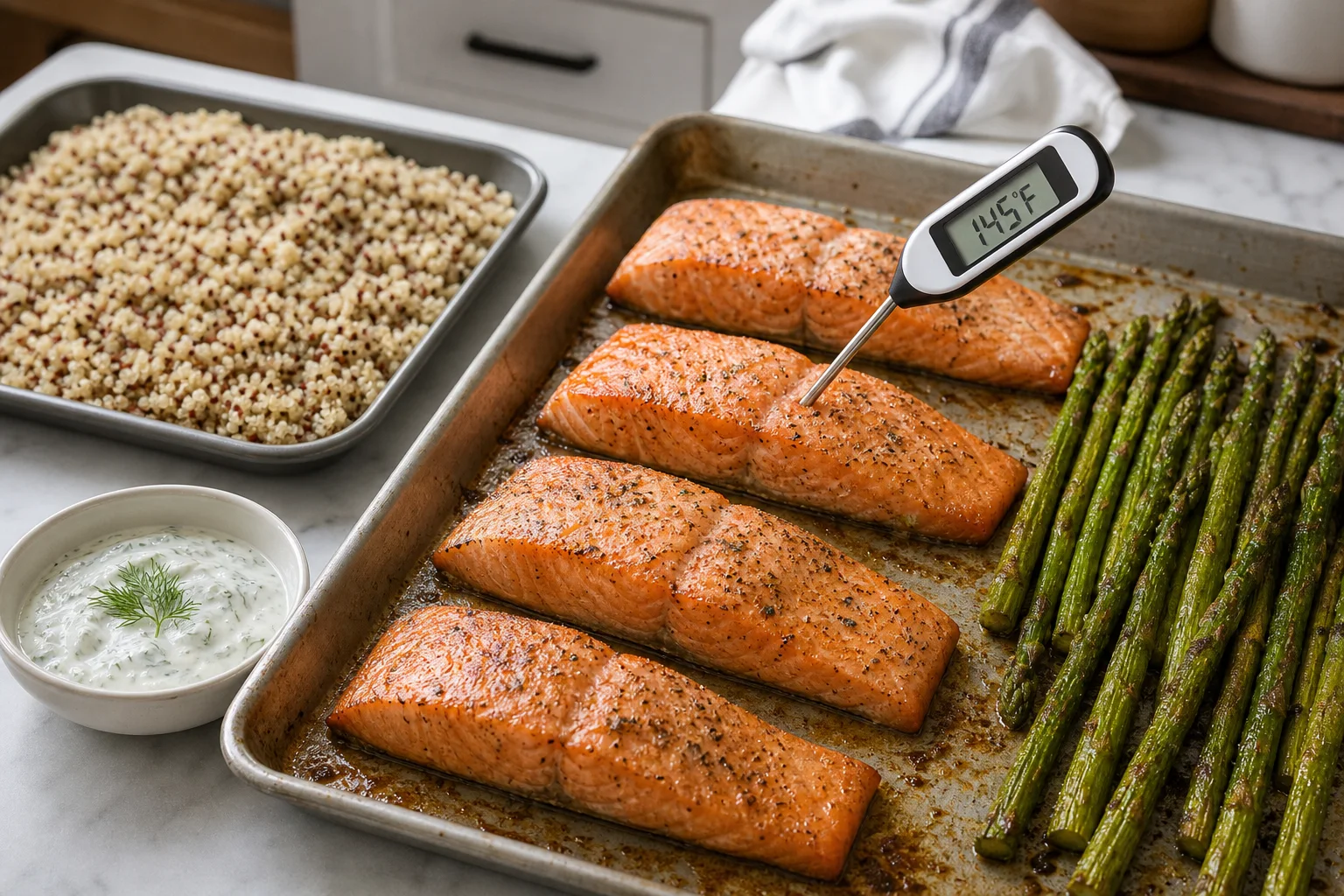
Roast 10 minutes, then begin checking the thickest center of each fillet. Remove each salmon portion when it reaches 145°F and flakes under gentle pressure, usually 11 to 16 minutes. Remove asparagus when crisp-tender.
5. Make the cold sauce
Whisk Greek yogurt, fresh dill, Dijon, remaining lemon juice, 1 tablespoon olive oil, remaining salt and pepper. Fold in the dried cucumber.
6. Cool and portion
Rest salmon 5 minutes. Divide quinoa and asparagus among four shallow containers and add one salmon portion to each. Pack sauce in four separate leakproof cups.
Salmon doneness guide
| Cue | Meaning | Action |
|---|---|---|
| Center is translucent and below 145°F | Not at recipe endpoint | Continue in 2-minute intervals |
| Thickest center reaches 145°F | Done | Remove that portion immediately |
| Flesh separates in moist flakes | Correct structure | Rest 5 minutes |
| White albumin covers the surface | Heat was aggressive or prolonged | Remove and shorten next bake |
| Edges look chalky | Thin areas overcooked | Use equal center-cut portions next time |
Packing the bowls to prevent sogginess
Cool quinoa in a thin layer before sealing. Trapped steam softens asparagus and continues warming salmon.
Keep lemon-dill sauce in separate cups. Add it only after reheating, or spoon it onto a cold bowl just before eating.
Place asparagus beside rather than beneath salmon. If the fish releases a little juice in storage, it will not soak the vegetable tips.
Protein per bowl
One of four bowls provides an estimated 41 grams of protein from salmon, quinoa and Greek yogurt sauce.
The estimate uses common U.S. ingredient data, not laboratory analysis. Salmon portion size and yogurt labels vary, so use package values when precise tracking matters.
Cold versus reheated salmon
For a cold bowl, eat directly from the refrigerator or let it stand only briefly while assembling. Stir sauce into quinoa and break salmon into large flakes.
For a warm bowl, remove the sauce cup. Add 1 tablespoon water to quinoa, cover loosely and microwave at 50% power for 60 seconds. Turn the salmon and continue in 20-second intervals until the center reaches 165°F. Add cold sauce afterward.
Gentle heat takes longer but reduces the temperature gap between edges and center. Avoid full power and long uninterrupted cycles.
Variations
Mediterranean: Add cherry tomatoes and olives after cooling; replace dill with parsley and oregano.
Brown rice: Cook by package directions and cool in a shallow layer before portioning.
Broccoli: Roast small florets in one layer; they may need a few more minutes than asparagus.
Dairy-free: Replace yogurt sauce with lemon-tahini dressing and verify sesame suitability.
Spicy: Add cayenne to the salmon and hot sauce to individual servings.
For a bowl built around smaller pieces of fish, air fryer salmon bites includes the cube size and a soy-and-honey seasoning; use that recipe's cooking guidance for the cut pieces.
Troubleshooting
The salmon is dry
It cooked past 145°F or reheated too aggressively. Use a thermometer, remove portions individually and reheat at 50% power.
White material appeared on top
That is albumin, a fish protein. It is harmless but more visible after aggressive heat. Pat fish dry and avoid overcooking.
The yogurt sauce is watery
Cucumber was wet or regular yogurt was used. Dry cucumber thoroughly and choose Greek yogurt.
Quinoa is bitter
It was not rinsed enough. Rinse in a fine-mesh strainer until the water is mostly clear.
The bowl smells strong after reheating
Cold serving avoids the aroma. If heating, use a covered container at moderate power and stop as soon as the center is hot.
Storage and food safety
Refrigerate shallow covered containers and sauce cups within 2 hours at 40°F or below. Use within 3 to 4 days; for best fish quality, the first 3 days are preferable.
USDA lists 145°F for fin fish and 165°F for reheated leftovers on its safe minimum internal temperature chart.
Freezing assembled bowls is not recommended for best quality because yogurt sauce separates and asparagus softens. Salmon and quinoa may be frozen without sauce for up to 2 months, thawed overnight in the refrigerator and reheated to 165°F.
Discard any bowl left at room temperature longer than 2 hours, or 1 hour above 90°F.
Frequently asked questions
How long does salmon meal prep last?
Keep it at 40°F or below for 3 to 4 days; quality is best during the first 3 days.
What temperature should salmon reach?
This recipe removes salmon when the thickest center reaches 145°F.
Can I eat meal-prep salmon cold?
Yes. Keep it refrigerated and add the sauce immediately before eating.
How do I reheat salmon without drying it?
Use 50% microwave power under a loose cover, turning once, until the center reaches 165°F.
Can I use frozen salmon?
Yes. Thaw fully in the refrigerator, pat dry and cook based on temperature rather than time.
Can I freeze the bowls?
Freeze salmon and quinoa without yogurt sauce for up to 2 months for best quality.
Recipe development note
This salmon meal prep recipe was developed through culinary research and editorial review. It is not represented as a personal kitchen test. Fillet thickness, starting temperature and ovens vary; use the 145°F initial endpoint and gentle reheating cues.
Nutrition is an estimate per one of four bowls. The accompanying visuals are AI-assisted food-editorial images, not photographs of a kitchen test.
Printable recipe card
Moist Salmon Meal Prep Bowls Recipe with Lemon-Dill Sauce
Ingredients
Equipment
Method
- Cook rinsed quinoa in water or broth according to its package, rest covered 5 minutes, fluff and spread on a shallow tray.
- Heat oven to 400°F and arrange salmon skin-side down on one half of a lined sheet pan.
- Mix 2 tablespoons oil, zest, 1 tablespoon lemon juice, garlic, dried dill, 1/2 teaspoon salt and 1/4 teaspoon pepper; season salmon and asparagus.
- Roast 10 minutes, then check individually; remove salmon at 145°F and asparagus when crisp-tender, usually 11 to 16 minutes.
- Whisk yogurt, fresh dill, Dijon, remaining lemon juice, oil, salt and pepper, then fold in dried cucumber.
- Rest salmon 5 minutes, divide quinoa and asparagus among four containers, add salmon and pack sauce separately.
Notes
- Use similarly thick center-cut salmon portions.
- Remove salmon when the thickest center reaches 145°F.
- Cool quinoa in a shallow layer.
- Pack yogurt sauce separately and add after reheating.
- Refrigerate 3 to 4 days; quality is best during the first 3.
- Contains fish and milk; Dijon may contain sulfites.
- This recipe was developed through culinary research and editorial review.
This recipe was developed through culinary research and editorial review. Fillet thickness, starting temperature and ovens vary; use the 145°F initial endpoint and gentle reheating cues.
Nutrition is an estimate per one of four bowls.