
These healthier chocolate chip cookies use white whole-wheat flour, oat flour and a measured amount of dark brown sugar while keeping the features people expect from a cookie: crisp golden rims, soft centers and visible pockets of chocolate. Melted butter provides spread, brown sugar retains moisture and a short chill prevents the dough from flattening before the edges set.
The recipe does not treat “healthy” as an absolute label. It uses more whole-grain flour and less added sugar than many conventional formulas, but it is still a sweet cookie containing butter and chocolate. A defined yield of 18 cookies makes the portion and nutrition estimate clear.
This recipe was developed through culinary research and editorial review. Flour absorption, butter temperature, chocolate size, pan color and oven calibration vary, so use the chilled-dough, measured-spread and center-doneness cues below.
For a peanut-butter cookie made with oat flour, see the healthy peanut butter cookies recipe. For a fruit-sweetened oat option with raisins, use the healthy oatmeal raisin cookies recipe.
How less sugar changes a cookie
Sugar does more than sweeten cookie dough. As it dissolves and heats, it encourages spread, browning and crisp edges. Brown sugar also holds moisture, helping the center remain chewy.
Removing half the sugar from a standard formula without changing anything else often produces a thick, pale and bread-like cookie. This recipe instead uses a moderate reduction, melted butter and a small amount of maple syrup. The syrup provides dissolved sugar that helps spread while the brown sugar supplies molasses flavor and chew.
Whole-wheat and oat flours absorb more water than all-purpose flour. A 30-minute chill lets them hydrate and firms the butter at the same time, creating dough that spreads gradually rather than immediately.
Ingredients
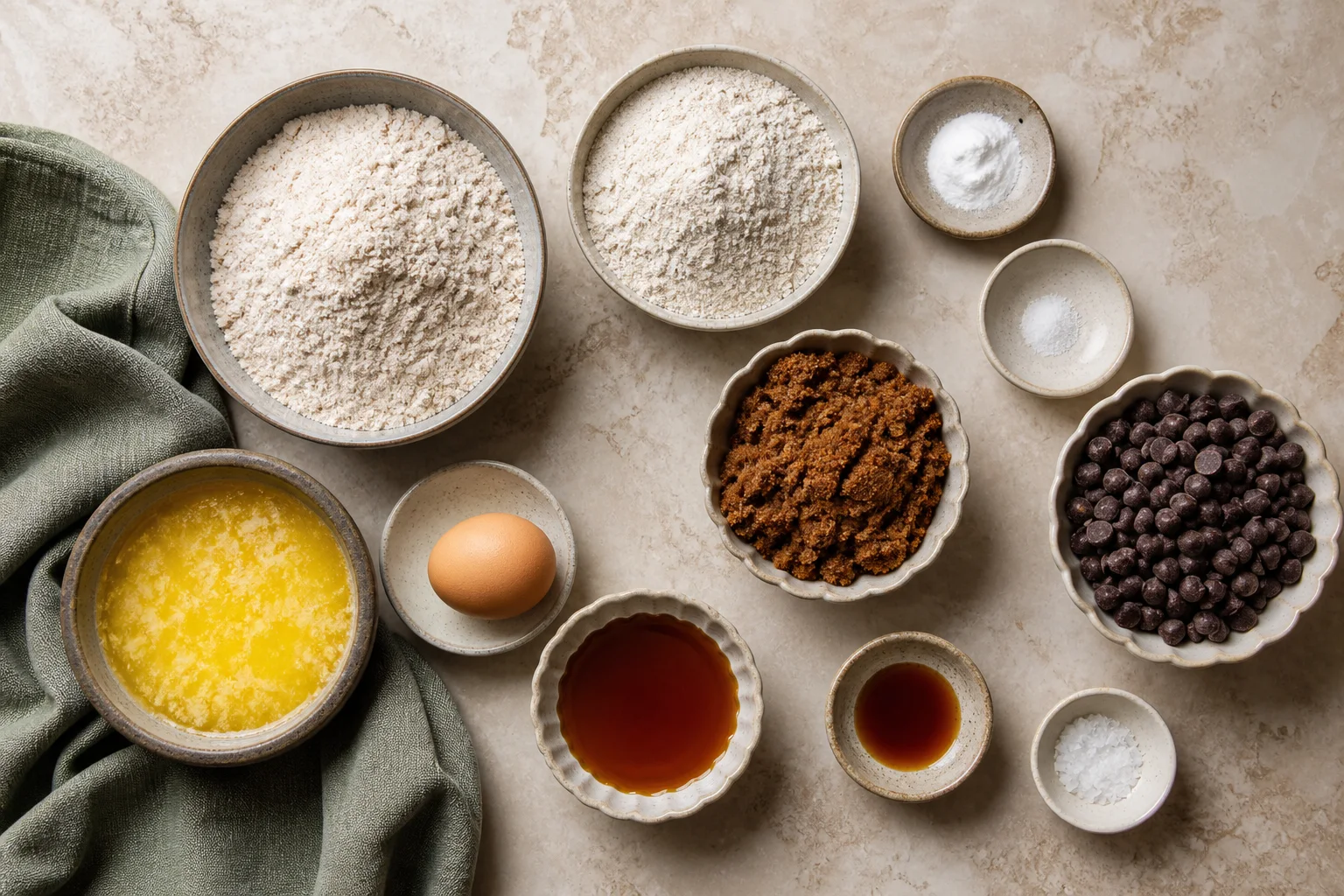
- 1 cup white whole-wheat flour, 120 grams
- 1/2 cup oat flour, 60 grams
- 1/2 teaspoon baking soda
- 1/2 teaspoon fine salt
- 6 tablespoons unsalted butter, 85 grams, melted and cooled
- 1/2 cup packed dark brown sugar, 90 grams
- 2 tablespoons pure maple syrup, 40 grams
- 1 large egg, about 50 grams without shell
- 2 teaspoons vanilla extract
- 1/2 cup semisweet chocolate chips, 85 grams
- flaky salt for the tops, optional
Ingredient notes and substitutions
White whole-wheat flour: This is milled from a lighter variety of wheat and has a milder flavor than standard whole-wheat flour. Regular whole-wheat flour works by weight but tastes nuttier and can make the cookie slightly denser.
Oat flour: Oat flour softens the wheat structure and adds moisture-holding fiber. Grind rolled oats very finely, then weigh 60 grams. Coarse oat meal leaves dry specks and changes spread.
Butter: Melted butter makes mixing simple and encourages spread. Cool it until just warm; hot butter dissolves too much sugar and creates greasy dough. Neutral oil is not a direct substitute because it stays liquid when chilled.
Dark brown sugar: Its molasses flavor makes a moderate quantity taste fuller. Light brown sugar can replace it by weight. Coconut sugar produces less spread and a drier edge.
Maple syrup: Two tablespoons provide dissolved sugar and moisture. Honey works by weight but adds a noticeable flavor and can brown more quickly.
Egg: One large egg binds the dough and supports chew. A very large egg adds extra water and can make the cookies puff before spreading.
Chocolate chips: Semisweet chips balance the less-sweet dough. Chopped dark chocolate works, but fine shards can make the dough look more chocolate-heavy and alter the nutrition estimate.
Flaky salt: Optional salt on top sharpens the chocolate flavor. Use only a few crystals because the dough already contains measured salt.
How to make healthier chocolate chip cookies
1. Prepare pans and oven
Heat the oven to 350°F with racks in the upper and lower thirds. Line two light-colored sheet pans with parchment paper.
Dark pans brown cookie bottoms quickly. If only one pan is available, let it cool between batches rather than placing dough on a hot surface.
2. Whisk the flours
In a medium bowl, whisk white whole-wheat flour, oat flour, baking soda and salt for 20 seconds. Break up every oat-flour lump.
Uniform leavener matters in a lower-sugar dough because each cookie needs the same modest lift and spread.
3. Mix the butter and sugars
In a large bowl, whisk cooled melted butter, brown sugar and maple syrup until glossy and no dry sugar pockets remain.
The mixture will look slightly grainy rather than fully dissolved. If butter pools around the edge, continue whisking until it emulsifies.
4. Add egg and vanilla
Whisk in the egg and vanilla for about 30 seconds. The mixture should thicken slightly and fall from the whisk in ribbons.
Scrape the bowl bottom where dense sugar can settle. Do not whip for several minutes; excessive air makes the cookies puffier and less chewy.
5. Fold in the dry mixture
Add the flour mixture and fold with a silicone spatula until only a few dry streaks remain. Fold in the chocolate chips and stop as soon as the dough is uniform.
Fresh dough will be soft and glossy. Do not add more flour before the hydration chill.
6. Chill for 30 minutes
Cover and refrigerate the dough for 30 minutes. It should become scoopable and hold a rounded mound without flowing.
If it remains very soft after chilling, check that the butter amount and flour weights were correct. Chill 15 minutes longer instead of adding a large amount of flour.
7. Portion and flatten slightly
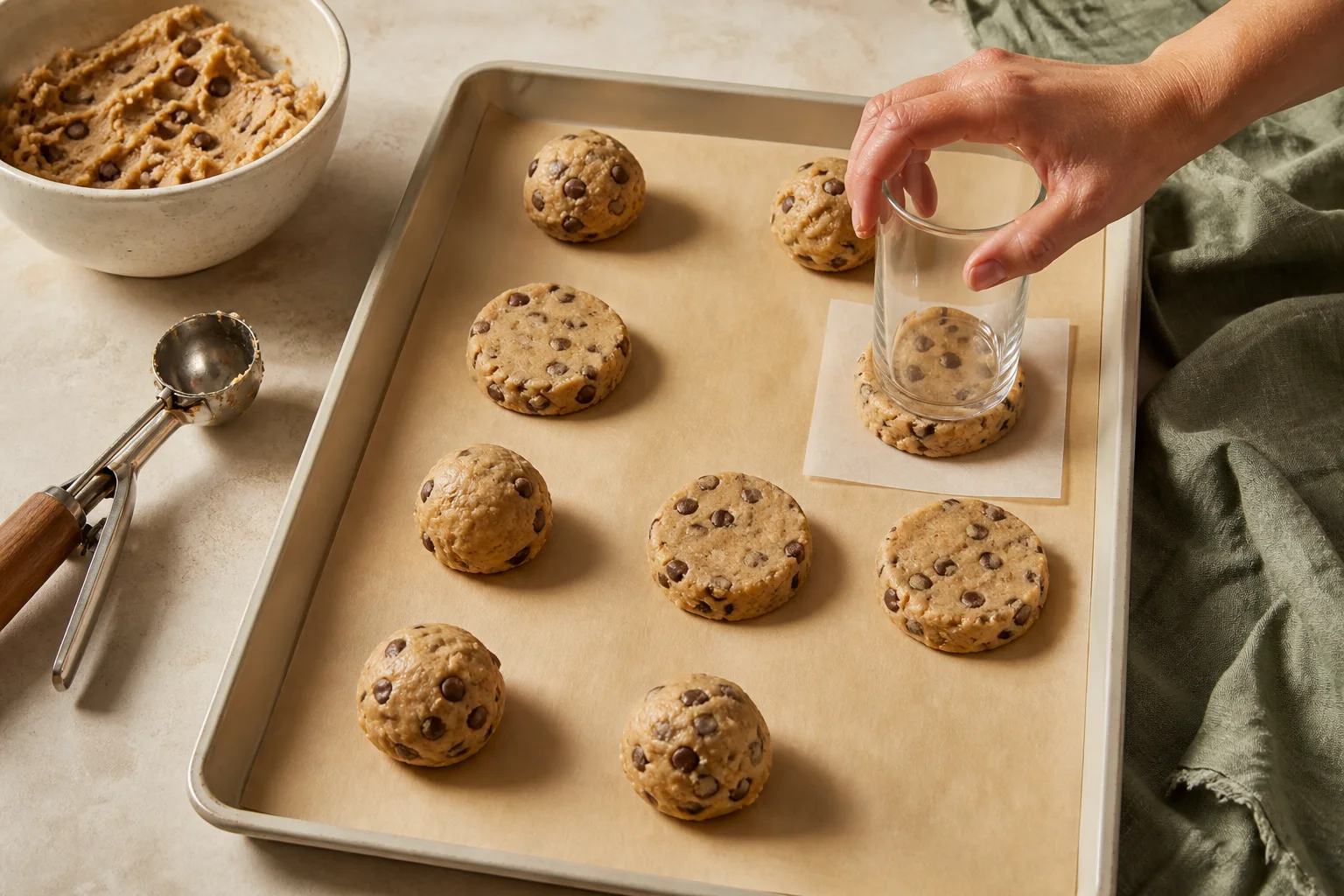
Scoop level 2-tablespoon portions, about 32 grams each, for 18 cookies. Place nine on each pan with 2 1/2 inches between them.
Roll only enough to close cracks, then press each mound into a disk about 1/2 inch thick. This small head start compensates for the reduced sugar’s lower spread.
8. Bake to soft-center cues
Bake for 9 to 12 minutes, rotating pans front to back and switching racks around minute 6. The edges should be set and light golden while the center looks matte but still soft.
Do not wait for the center to become firm in the oven. Residual pan heat continues setting the egg and flour after removal.
9. Shape and cool
For rounder cookies, immediately place a wide round cutter around each cookie and make one gentle circular motion. Add optional flaky salt.
Cool on the pans for 8 minutes, then transfer to a wire rack. The centers should settle without becoming thin or greasy.
Cookie spread guide
| Result after baking | Likely cause | Next adjustment |
|---|---|---|
| About 3 inches wide with golden rim | Dough temperature and ratio are balanced | Keep the method unchanged |
| Thick mound with little spread | Flour was packed, dough chilled too long or disks were not pressed | Weigh flour and flatten to 1/2 inch |
| Thin cookie with oily edge | Butter was hot or dough was underchilled | Cool butter and chill at least 30 minutes |
| Puffy, cake-like center | Egg was oversized or mixture was overwhisked | Use one large egg and whisk only until emulsified |
| Dark bottom with pale top | Pan is dark or rack is too low | Use a light pan and center the oven racks |
| Dry, firm center after cooling | Cookies baked until centers looked fully done | Remove when centers are matte but soft |
Measure one cookie after the first batch. If it is much wider or narrower than 3 inches, adjust chill or flattening before baking the second pan.
The first test cookie prevents a full-pan problem
Different oat flours and butter temperatures make spread hard to predict from appearance alone. Bake one cookie on a small lined pan before portioning the whole batch if ingredients or equipment are unfamiliar.
If the test cookie barely moves, flatten the remaining mounds a little more or let the dough stand 5 minutes at room temperature. Do not immediately add more maple syrup.
If the test cookie spreads thin, chill the dough 15 minutes longer. If it still spreads excessively, fold in 1 tablespoon oat flour and wait another 5 minutes.
The test also reveals oven behavior. A dark bottom before the top colors means the pan or rack is transferring too much heat.
Why the dough is pressed before baking
Conventional high-sugar dough liquefies and spreads substantially. A reduced-sugar dough retains more of its scoop shape because there is less dissolved sugar and more whole-grain flour.
Pressing to about 1/2 inch gives the center a head start without making the final cookie thin. Keep the thickness consistent so all 18 cookies finish together.
Use fingertips or the flat bottom of a small glass over parchment. Do not press the disk thinner than 1/3 inch; the center will lose its chewy contrast.
If the edges crack during pressing, smooth them gently. Large open cracks create narrow points that brown before the center.
What “healthier” means here
This cookie uses white whole-wheat and oat flour instead of only refined all-purpose flour. It also uses a moderate amount of added sugar while preserving recognizably cookie-like texture.
That does not turn it into an unlimited food or a substitute for a balanced meal. Chocolate chips, butter, brown sugar and maple syrup still contribute calories, saturated fat and added sugar.
The defined serving is one of 18 cookies. Individual dietary needs, allergies and health goals differ, so ingredient labels and qualified professional advice matter more than a broad recipe adjective.
“Healthier” is best read as a comparison to many conventional chocolate-chip-cookie formulas, not as a medical or nutrient-content claim.
Flavor variations
Walnut chocolate: Replace 1/4 cup chips with 1/4 cup finely chopped walnuts. This adds a tree-nut allergen and changes the nutrition estimate.
Orange dark chocolate: Add 1 teaspoon finely grated orange zest and use chopped dark chocolate. Zest adds aroma without extra juice.
Cinnamon oat: Add 1/2 teaspoon cinnamon and reduce chips to 1/3 cup. The cookie tastes sweeter from aroma without more sugar.
Peanut butter: Replace 2 tablespoons melted butter with 2 tablespoons smooth peanut butter. Expect slightly less spread and a peanut allergen.
Coconut: Replace 2 tablespoons chips with 2 tablespoons finely shredded unsweetened coconut. Add 1 teaspoon milk if the chilled dough cracks badly.
Smaller cookies: Use 1-tablespoon portions and begin checking at 7 minutes. Smaller cookies have more crisp edge relative to chewy center.
Troubleshooting
The cookies did not spread
Flour may have been packed, dough may be too cold or the mounds were not flattened. Weigh both flours, press to 1/2 inch and let very cold dough stand 5 minutes.
The cookies spread too much
Butter was hot, dough was not chilled or the pan was warm. Chill 15 minutes longer and use a cool lined pan. Add oat flour only in 1-tablespoon increments.
The centers are cakey
Too much egg or excessive whisking incorporated air. Use one large egg and whisk the wet mixture only until thickened and uniform.
The cookies are dry
They baked too long or flour was overmeasured. Remove when the center is matte but soft and weigh the flour.
The cookies taste strongly whole-wheat
Use white whole-wheat flour rather than standard whole-wheat. Dark brown sugar, vanilla and semisweet chocolate also balance the grain flavor.
The dough is crumbly after chilling
Oat flour absorbed more moisture than expected. Let the dough warm 5 minutes; if it still will not press, fold in 1 teaspoon milk.
The bottoms burn
Use a light-colored pan, parchment and higher rack position. Dark pans can require an oven reduction of about 15°F.
Chocolate chips fall out
The dough may be too cold or the chips are concentrated at the bowl bottom. Press stray chips into the top of each mound before baking.
Storage and freezing
Store completely cool cookies in an airtight container at room temperature for up to 4 days. Place parchment between layers and add a small piece of bread only if a softer texture is preferred; replace it daily.
Refrigeration extends storage but firms the butter and can make the cookies seem dry. Let a chilled cookie stand 10 minutes or warm it for 5 to 8 seconds in the microwave.
Freeze baked cookies in one layer, then bag for up to 2 months for best quality. Thaw covered at room temperature so condensation forms on the container rather than the cookie surface.
To freeze dough, portion and flatten the disks first. Freeze solid, bag and bake from frozen at 350°F, adding approximately 2 minutes and checking the center cue.
Do not taste raw dough. The FDA explains that flour is a raw food and should be cooked in its flour-handling safety guidance.
Frequently asked questions
Are these cookies healthy?
“Healthy” depends on the full diet and individual needs. These use whole-grain flours and less added sugar than many conventional recipes, but they remain sweet cookies with butter and chocolate.
Can I use all oat flour?
Not as a direct swap. Without wheat structure, the cookies become more fragile and spread differently. Use the separate oat-flour peanut butter cookie recipe linked above for an oat-based formula.
Can I use all-purpose flour?
Yes. Replace the white whole-wheat flour with 120 grams all-purpose flour. The flavor becomes milder and spread may increase slightly.
Can I reduce the sugar further?
Every reduction changes spread, browning and chew. Cutting more than 1 tablespoon brown sugar is likely to produce a thicker, paler cookie unless the formula is rebalanced.
Why chill the dough?
Chilling firms melted butter and lets whole-grain flour absorb moisture. The cookie then spreads gradually enough for the edges to set.
How large should each cookie be?
Use a level 2-tablespoon scoop or about 32 grams. The baked target is approximately 3 inches wide.
Can I freeze the dough?
Yes. Freeze portioned, flattened disks and bake from frozen, adding about 2 minutes while using the same edge and center cues.
Why are the centers soft when removed?
The cookies continue cooking on the hot pan for 8 minutes. Removing them while the center is matte but soft preserves chew after cooling.
Recipe development note
These healthier chocolate chip cookies were developed through culinary research and editorial review. They are not represented as a personal kitchen test. Flour absorption, butter temperature, chocolate size, pan color and oven calibration vary; use the chill, test-cookie, spread and doneness cues.
Nutrition is an estimate per one of 18 cookies without optional flaky salt. The accompanying visuals are AI-assisted food-editorial images, not photographs of a kitchen test.
Printable recipe card

Chewy Healthier Chocolate Chip Cookies Recipe
Ingredients
Equipment
Method
- Heat the oven to 350°F with racks in the upper and lower thirds. Parchment-line two light-colored sheet pans.
- Whisk white whole-wheat flour, oat flour, baking soda and salt for 20 seconds.
- Whisk cooled melted butter, brown sugar and maple syrup until glossy with no dry sugar pockets.
- Whisk in egg and vanilla for about 30 seconds until slightly thickened and emulsified.
- Fold in the flour mixture, then chocolate chips, stopping as soon as no dry streaks remain.
- Cover and refrigerate 30 minutes, until the dough holds a rounded scoop without flowing.
- Divide into 18 level 2-tablespoon portions, about 32 grams each, and press into half-inch disks 2 1/2 inches apart.
- Bake 9 to 12 minutes, rotating and switching racks around minute 6, until edges are light golden and centers are matte but soft.
- Add optional flaky salt, cool on pans 8 minutes and transfer to a wire rack.
Notes
- Cool melted butter before mixing.
- Chill dough 30 minutes for hydration and controlled spread.
- Portion about 32 grams and flatten to one-half inch.
- Remove when edges are golden and centers are matte but soft.
- The recipe uses more whole-grain flour and less added sugar than many conventional formulas but remains a sweet cookie.
- Contains wheat, milk and egg.
- This recipe was developed through culinary research and editorial review.
This recipe was developed through culinary research and editorial review. Flour absorption, butter temperature, chocolate size, pan color and oven calibration vary; use the chill, spread and doneness cues.
Nutrition is an estimate per one of 18 cookies without optional flaky salt.