
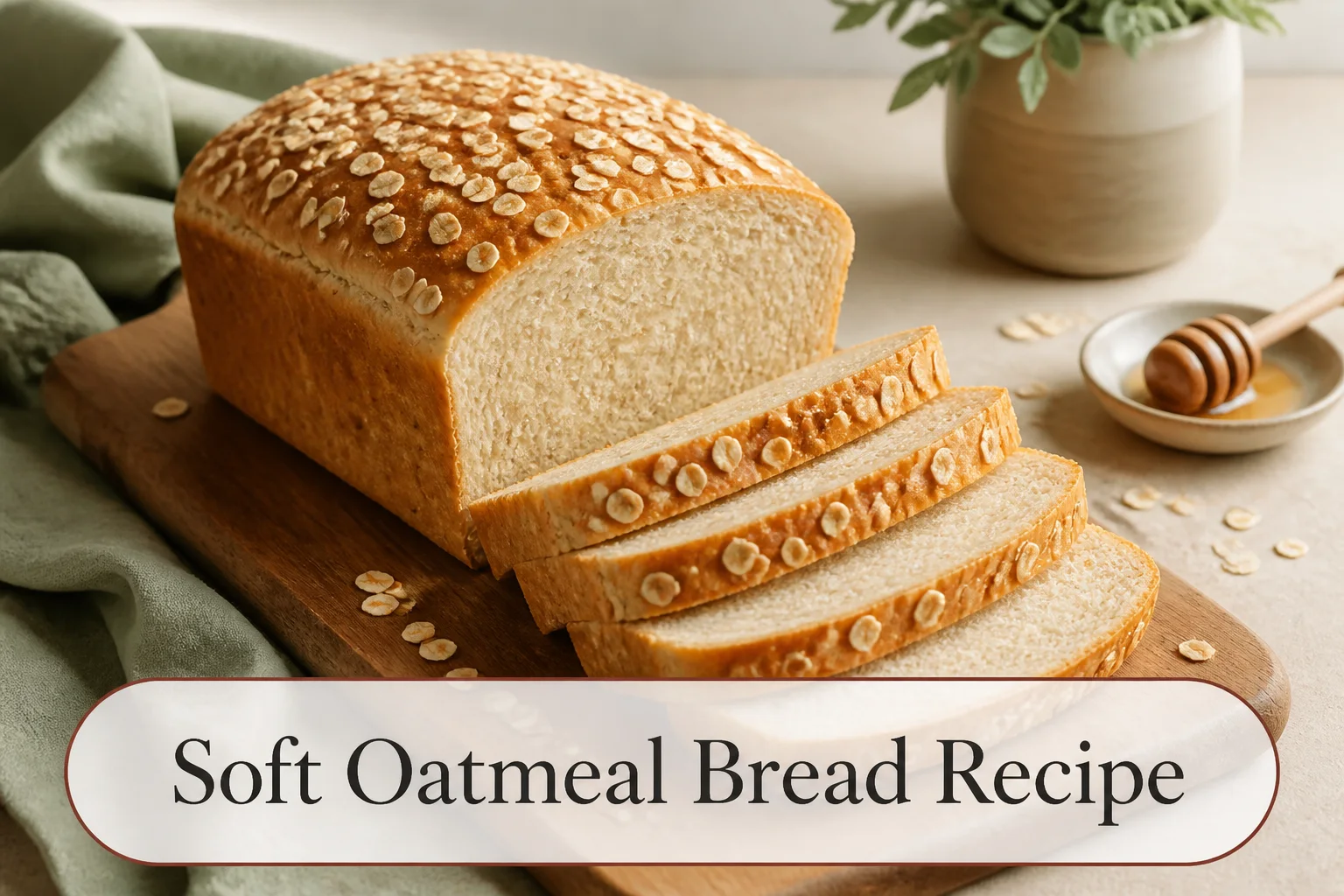
This oat bread recipe makes a soft, lightly sweet sandwich loaf with a golden crust and visible rolled oats on top. The crumb is sturdy enough for toast and sandwiches but tender enough to bend rather than crumble.
The key is a hot oat soak. Boiling water hydrates and softens the rolled oats before they enter the dough, so they do not continue pulling moisture from the loaf during baking and cooling. Bread flour then supplies the gluten strength that oats cannot provide on their own.
This recipe was developed through culinary research and editorial review. Oat thickness, flour protein, room temperature, yeast activity and pan material vary, so use the cooled-soaker, dough, rise-height and internal-temperature cues instead of treating the times as fixed deadlines.
For oat-based desserts, compare the healthy oatmeal raisin cookies and peanut butter oat-flour cookies. If you need a completely flourless loaf, the flourless cottage cheese bread recipe is a separate egg-foam style with a very different texture.
Why oats can make bread dry or crumbly
Oats absorb substantial water, but they do not form the elastic gluten network that gives wheat bread height and flexibility. Adding a large amount of dry rolled oats directly to an ordinary dough creates two problems: the oats compete with the flour for moisture, and the percentage of structure-forming wheat falls.
Soaking solves the first problem. Keeping bread flour as the main dry ingredient solves the second. The finished loaf still tastes clearly of oatmeal, but the dough can trap gas during proofing and produce clean slices.
Overflouring is the other common cause. A soft oat dough can feel slightly tacky during the first minutes of kneading. Adding repeated handfuls of flour makes it easier to handle immediately but leaves the baked crumb tight and dry.
Ingredients
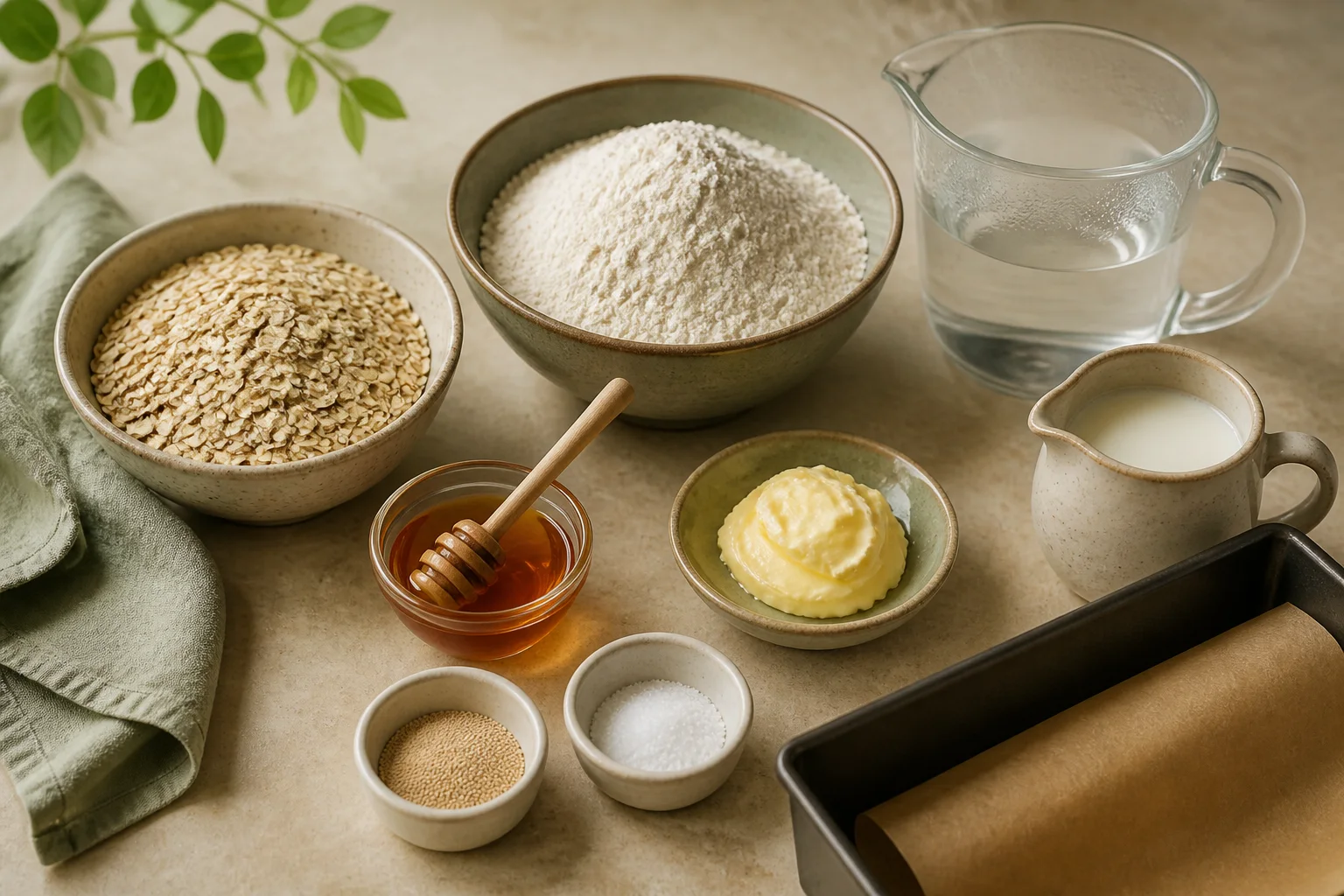
- 1 cup old-fashioned rolled oats, 90 grams
- 1 cup boiling water, 227 grams
- 1/4 cup whole milk, 57 grams, cool or room temperature
- 3 tablespoons honey, 63 grams
- 2 tablespoons unsalted butter, softened, 28 grams
- 2 1/4 teaspoons instant yeast, 7 grams
- 1 1/2 teaspoons fine salt, 9 grams
- 3 cups bread flour, 360 grams, plus up to 2 tablespoons only if needed
- nonstick cooking spray or softened butter, for the bowl and pan
- 1 tablespoon milk, for the top
- 2 tablespoons rolled oats, for topping
Ingredient notes and substitutions
Rolled oats: Old-fashioned rolled oats give a tender, visible oat texture. Quick oats can be used by weight but soften more completely and make a finer crumb. Steel-cut oats do not hydrate on this schedule and are not a substitute.
Boiling water: Water must be freshly boiled when poured over the oats. It swells the starches and softens the flakes. Do not add yeast to this hot mixture; the milk and cooling period bring it below 110°F first.
Milk: Whole milk tenderizes and supports browning. Two-percent milk works. For a dairy-free loaf, use unsweetened plain soy milk or additional water and replace butter with a neutral dairy-free baking fat.
Honey: Honey supplies mild sweetness and helps retain moisture. Maple syrup works by weight, though its flavor is less traditional. Brown sugar can replace it, but add 1 tablespoon water because dry sugar does not supply the same liquid.
Bread flour: Its higher protein provides the strength needed around the oats. All-purpose flour can work, but the loaf may rise a little less and feel more tender. Whole-wheat flour is not a full one-for-one substitute without additional water and a redesigned rise.
Instant yeast: Instant yeast can be mixed directly into the cooled oat mixture and flour. Active dry yeast can replace it in the same weight; dissolve it in the milk first and expect the rises to take slightly longer.
Butter: Softened butter incorporates after the flour begins hydrating and helps the crumb remain tender. Neutral oil can replace it by weight but produces a slightly different mouthfeel.
How to make soft oatmeal bread
1. Soak the rolled oats
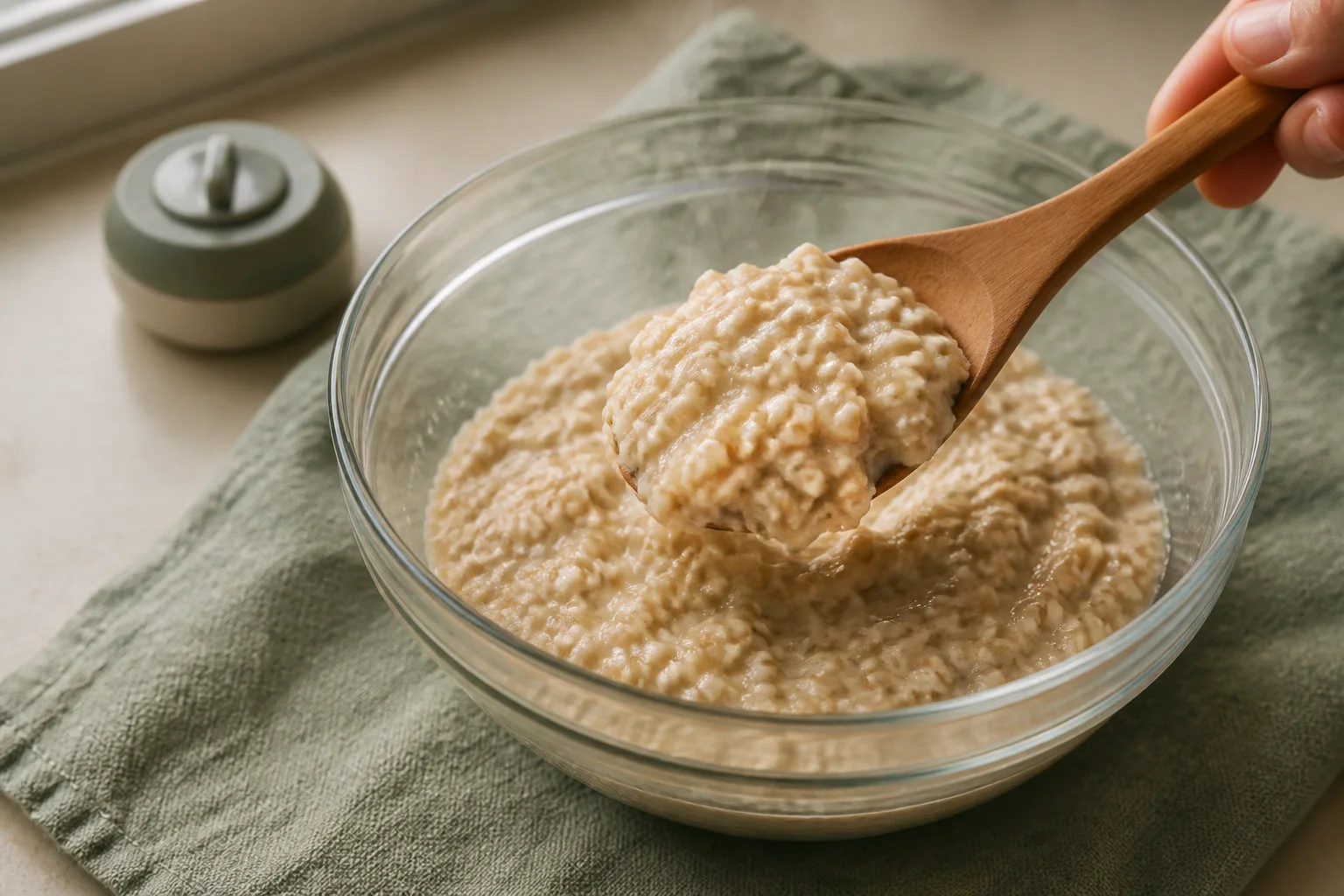
Place 1 cup rolled oats in the mixer bowl or a large heatproof mixing bowl. Pour 1 cup boiling water evenly over them and stir until every flake is wet.
Cover loosely and let stand for 20 minutes. The mixture will thicken into a spoonable porridge as the oats absorb water.
2. Cool the oat mixture
Stir in the cool milk and honey. Check the temperature with an instant-read thermometer; it should be between 85°F and 105°F before yeast is added.
If it is hotter than 110°F, wait and stir again. Excess heat can weaken or kill yeast. If it has cooled below 75°F, the dough will still rise, but it may take longer.
3. Form the dough
Add instant yeast, salt and 3 cups bread flour. Mix on low with the dough hook for 2 minutes, or stir with a sturdy spoon until no dry flour remains.
The dough will look shaggy and may cling to the bottom of the bowl. Cover and let it rest for 10 minutes before judging consistency. This short rest lets bread flour hydrate and begins gluten development without extra flour.
4. Knead and add the butter
Knead on medium-low for 3 minutes, then add softened butter in three small pieces. Continue kneading for 5 to 7 minutes, until the dough is smoother, elastic and clears most of the bowl sides while still feeling slightly tacky.
By hand, knead on a lightly oiled surface for 10 to 12 minutes. Use a bench scraper rather than covering the counter with flour. Add extra bread flour only 1 tablespoon at a time if the dough remains paste-like after several minutes of kneading; many batches need none.
5. Check gluten development
Pinch off a small piece and stretch it gently. It should form a thin membrane before tearing, though oat flecks may interrupt a perfectly clear windowpane.
The dough should spring back slowly after a fingertip press. A rough dough that tears immediately needs more kneading, not necessarily more flour.
6. Complete the first rise
Shape the dough into a ball and place it in a lightly greased bowl, turning once. Cover and let rise in a warm, draft-free place until roughly doubled and visibly puffy, about 60 to 90 minutes.
Use volume rather than the clock. At a cool room temperature, the rise may take longer. A gentle fingertip press should leave an indentation that fills back slowly.
7. Shape the loaf
Lightly grease an 8 1/2-by-4 1/2-inch metal loaf pan. Turn the dough onto a very lightly oiled surface and press it into an 8-by-10-inch rectangle, removing only the largest gas pockets.
Starting from a short side, roll tightly into an 8-inch log. Pinch the final seam and tuck the ends underneath. Place seam-side down in the pan.
8. Proof to the pan cue
Cover the pan with lightly greased reusable wrap or plastic wrap. Let rise until the center of the loaf crowns about 1 inch above the rim, usually 45 to 75 minutes.
Begin heating the oven to 350°F after about 30 minutes of proofing. The dough is ready when a gentle fingertip press near the side fills back slowly and leaves a shallow mark. A dent that springs back immediately needs more time; one that collapses may be overproofed.
9. Add the oat topping
Brush the risen top gently with 1 tablespoon milk and sprinkle with 2 tablespoons rolled oats. Avoid pressing hard enough to deflate the loaf.
Milk helps the flakes adhere and supports browning. Some oats may fall away during slicing; that is normal.
10. Bake to temperature
Bake on the center rack for 35 to 42 minutes. The loaf should be evenly golden and sound hollow when tapped out of the pan.
For a dependable endpoint, insert an instant-read thermometer through the side into the center. Aim for 190°F to 195°F. If the top becomes dark before the center reaches temperature, tent loosely with foil for the final 10 minutes.
11. Cool completely
Turn the loaf out of the pan within 5 minutes and set it upright on a wire rack. Leaving it in the pan traps steam and softens the side crust.
Cool for at least 2 hours before slicing. The crumb is still setting and releasing steam; cutting hot bread compresses the center and can make a fully baked loaf appear gummy.
Oat bread timing guide
| Stage | Visual or temperature cue | Common time range |
|---|---|---|
| Oat soak | Thick spoonable porridge | 20 minutes |
| First rise | Roughly doubled and visibly puffy | 60 to 90 minutes |
| Pan proof | Center crowns 1 inch above rim | 45 to 75 minutes |
| Bake | Golden; center reaches 190°F to 195°F | 35 to 42 minutes |
| Cooling | Completely cool with no warmth at base | At least 2 hours |
Room temperature and yeast activity shift both rises. The table is for planning; the cue in the middle column decides when to continue.
How the hot oat soak improves the loaf
The boiling water softens the tough flakes and begins swelling their starch. That water becomes held within the oatmeal instead of remaining as a loose liquid in the mixing bowl.
During baking, the hydrated oats support a moist crumb rather than taking water away from the wheat flour. The result slices more cleanly the next day and feels less sandy than a loaf made with dry flakes.
The soak also creates a temperature-control step. Adding cool milk after 20 minutes brings the mixture toward a yeast-friendly range. Always verify because bowl material and room temperature affect cooling.
Professional oatmeal-bread formulas likewise hydrate oats before mixing; for example, King Arthur Baking’s published formula uses a 20-minute oat soak. The exact liquid and flour balance here is specific to this loaf.
Kneading cues for oat dough
Oat flecks make the surface look less satiny than plain white-bread dough. Do not expect the completely smooth ball seen in brioche or sandwich bread made only with refined flour.
Properly kneaded dough feels elastic and slightly tacky, not wet enough to coat the hand. It clears most of the mixer bowl sides but may remain attached in a small circle at the bottom.
If it smears like batter after 5 minutes, add 1 tablespoon bread flour and knead 2 minutes before reassessing. If it is stiff, dry and difficult to stretch, wet your hands and knead in 1 teaspoon water at a time.
The windowpane will be speckled. Stretch from an area between flakes and look for a thin translucent section before the dough tears.
How to shape a loaf without a spiral gap
Press the risen dough into a rectangle of even thickness. Large trapped bubbles can form holes under the top crust, so pop only the obvious ones.
Roll from the short side with moderate tension. After each turn, use the heels of your hands to seal the new edge against the sheet below. A loose roll leaves a spiral gap; pulling so hard that the surface tears weakens the outer skin.
Pinch the final seam and place it directly underneath. Tuck the log ends so the dough is slightly shorter than the pan, allowing it to expand evenly toward both ends.
Troubleshooting
The loaf is dry and crumbly
Too much flour was added, the oats were not fully soaked or the loaf baked beyond its endpoint. Weigh flour, complete the 20-minute soak and stop at 190°F to 195°F.
The dough is extremely sticky
Rest it 10 minutes, then knead before deciding. Oats and flour continue hydrating. If it remains paste-like after several minutes, add bread flour only 1 tablespoon at a time.
The dough barely rises
The oat mixture may have been too hot for the yeast, the yeast may be old or the room may be cool. Verify below 110°F before adding yeast and let the dough follow volume rather than a strict clock.
The loaf rose and then collapsed
It likely overproofed or lacked enough surface tension. Bake when the center crowns about 1 inch above the rim and a press returns slowly; do not wait for an enormous dome.
The center is gummy
The loaf may be underbaked or sliced warm. Check 190°F to 195°F in the true center and cool at least 2 hours on a rack.
The crust separates from the crumb
Large bubbles remained during shaping, the roll was too loose or the loaf overproofed. Press out conspicuous gas pockets and roll with even tension.
The top browns too quickly
Honey and milk encourage color. Tent loosely with foil after the crust is golden, usually during the final 10 minutes, and continue until the center reaches temperature.
The bread sticks to the pan
Grease the corners and lower side walls thoroughly. Turn the loaf out within 5 minutes; cooling in the pan allows condensation to act like glue.
Flour and oat substitutions
All-purpose flour: Replace bread flour by weight. Expect a slightly lower, softer loaf. Hold back no liquid initially; add 1 tablespoon flour only if the kneaded dough remains paste-like.
Quick oats: Replace rolled oats by weight and keep the same hot soak. They disappear more fully into the crumb and can make the dough feel a little softer.
Whole-wheat blend: Replace up to 1 cup, or 120 grams, of bread flour with whole-wheat flour. Add 1 to 2 tablespoons water if the dough feels stiff after the 10-minute rest. A 100% whole-wheat version requires a separately balanced recipe.
Dairy-free: Use unsweetened soy milk or water and a dairy-free solid baking fat. Verify the product labels for your dietary needs.
Vegan: Use the dairy-free changes and maple syrup instead of honey. This loaf contains no egg.
Do not replace all bread flour with oat flour. Oat flour cannot create the gluten network necessary for this tall yeast loaf.
Serving ideas
Slice with a serrated knife using a gentle sawing motion. For sandwiches, cut 1/2-inch slices; thicker pieces are useful for toast or grilled cheese.
The mild honey-oat flavor works with eggs, turkey, tuna salad, nut butter or jam. Toast older slices to refresh the surface. For croutons, cube slightly stale bread, toss lightly with oil and bake until dry.
This is a wheat bread containing oats, not a gluten-free oat loaf. Anyone with celiac disease or a wheat allergy should not use the recipe as written.
Storage and freezing
Once completely cool, store the loaf in a bread bag or airtight container at room temperature for up to 4 days. A sealed container keeps it soft; a paper bag produces a drier crust.
Avoid refrigeration for routine storage because bread starch firms faster at refrigerator temperatures. Refrigeration may still be appropriate in a very hot, humid environment, but toast the slices to improve texture.
Freeze the whole loaf or separated slices for up to 3 months. Wrap tightly, place in a freezer bag and remove excess air. Freeze slices with parchment between them so individual portions release easily.
Thaw a wrapped loaf at room temperature. Toast individual slices directly from frozen. To refresh a thawed whole loaf, warm at 300°F for 8 to 10 minutes, then cool briefly before cutting.
Frequently asked questions
Is oat bread made only with oats?
Not this sandwich loaf. Oats provide flavor and whole-grain character, while bread flour provides the gluten needed for height and flexible slices.
Can I use oat flour instead of rolled oats?
Not directly. Oat flour absorbs and distributes differently and will not create the visible oat texture. Use the measured soaked rolled oats.
Why pour boiling water over the oats?
The hot soak softens flakes and lets them absorb water before mixing. It reduces the chance that dry oats pull moisture from the loaf later.
Does the oat mixture have to cool?
Yes. Add yeast only when the oat mixture is below 110°F, ideally 85°F to 105°F.
Can I make the bread without a stand mixer?
Yes. Mix with a sturdy spoon and knead by hand on a lightly oiled surface for 10 to 12 minutes, using a bench scraper for stickiness.
How do I know when oatmeal bread is done?
The crust should be golden and the center should reach 190°F to 195°F. Temperature is more dependable than color or tapping alone.
Is oat bread gluten-free?
No. This recipe uses bread flour and is a wheat-containing bread.
Can I prepare the dough overnight?
For an overnight first rise, reduce instant yeast to 1 teaspoon, cover the mixed dough and refrigerate after 20 minutes at room temperature. Shape it cold the next day and expect the pan proof to take longer. This timing is an adaptation and still depends on the rise cue.
Recipe development note
This oat bread recipe was developed through culinary research and editorial review. It has not been represented as a personal kitchen test. Oat thickness, flour protein, room temperature, yeast activity and pan material vary; use the cooled-soaker, elastic-dough, rise-height and center-temperature cues.
Nutrition is an estimate and changes with brands and slice thickness. The accompanying visuals are AI-assisted food-editorial images, not photographs of a kitchen test.
Printable recipe card
Soft Oatmeal Bread Recipe
Ingredients
Equipment
Method
- Pour boiling water over 1 cup rolled oats in a heatproof bowl, stir, cover loosely and stand 20 minutes until thick and spoonable.
- Stir in 1/4 cup milk and honey. Wait until the oat mixture measures 85°F to 105°F and is below 110°F.
- Add yeast, salt and bread flour. Mix on low 2 minutes until no dry flour remains, then cover and rest 10 minutes.
- Knead 3 minutes, add softened butter in pieces, then knead 5 to 7 minutes until elastic and slightly tacky. Add flour only 1 tablespoon at a time if still paste-like.
- Place in a lightly greased bowl, cover and rise until roughly doubled and visibly puffy, about 60 to 90 minutes.
- Press into an 8-by-10-inch rectangle, roll tightly from a short side, seal the seam and place seam-side down in a greased 8 1/2-by-4 1/2-inch pan.
- Cover and proof until the center crowns about 1 inch above the pan rim, commonly 45 to 75 minutes. Heat the oven to 350°F.
- Brush the risen loaf gently with 1 tablespoon milk and sprinkle with 2 tablespoons rolled oats.
- Bake 35 to 42 minutes, until golden and the center reaches 190°F to 195°F. Tent loosely if browning early.
- Turn out of the pan within 5 minutes and cool upright on a rack for at least 2 hours before slicing.
Notes
- Use old-fashioned rolled oats, not steel-cut oats.
- Cool the oat mixture below 110°F before adding yeast.
- Rest the shaggy dough 10 minutes before adjusting flour.
- Proof until the loaf crowns about 1 inch above the rim.
- Bake to 190°F to 195°F and cool at least 2 hours before slicing.
- Contains wheat and milk.
- This recipe was developed through culinary research and editorial review.
This recipe was developed through culinary research and editorial review. Oat thickness, flour protein, room temperature, yeast activity and pan material vary; use the cooled-soaker, elastic-dough, rise-height and center-temperature cues.
Nutrition is an estimate per one-twelfth loaf and changes with brands and slice thickness.