
This high-protein pumpkin cheesecake has a smooth, warmly spiced filling and a thin graham-cracker crust. Cottage cheese, Greek yogurt and vanilla protein powder raise the estimated protein to about 14 grams per slice, while a modest amount of reduced-fat cream cheese preserves the flavor and body people expect from cheesecake.
The useful part of this recipe is not simply adding more protein powder. Too much powder can absorb water unevenly and turn a baked filling chalky or rubbery. Here, cottage cheese is blended completely smooth, the powder is dispersed with cornstarch, eggs go in last and the cheesecake bakes gently at 300°F. Those controls make the filling creamy and sliceable after an overnight chill.
This recipe was developed through culinary research and editorial review. Cottage-cheese moisture, protein-powder absorption and oven calibration vary, so use the visual doneness cues—not the clock alone.
For a more classic version without protein powder, see the Greek yogurt cheesecake recipe. If you want a faster no-bake option, try this Greek yogurt dessert.
Why protein cheesecake can become rubbery
Protein powder and eggs both firm as they heat. If the filling contains too much of either, is whipped full of air or stays in a hot oven until the center looks completely solid, the final texture can become bouncy instead of creamy.
Cottage cheese creates a second challenge: visible curds remain grainy after baking. Blending it alone first is more effective than asking a crowded bowl of ingredients to smooth out at once.
This formula uses four controls:
- Two cups of cottage cheese provide protein and body without relying entirely on powder.
- Greek yogurt adds acidity and moisture, while reduced-fat cream cheese supplies familiar cheesecake richness.
- Cornstarch moderates free moisture and helps the filling slice cleanly.
- A 300°F bake sets the edges before the center overheats.
Ingredients
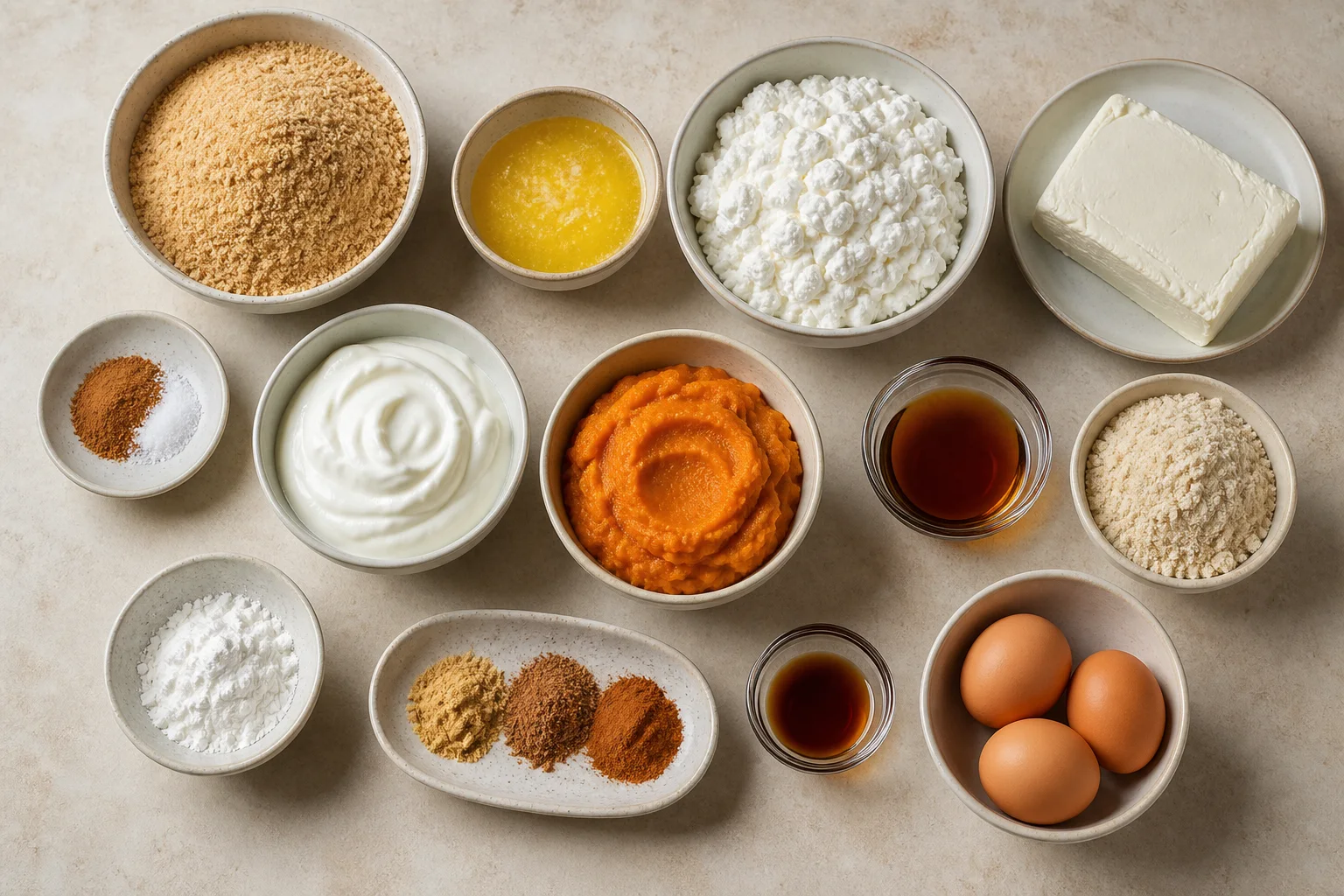
For the graham-cracker crust
- 1 1/2 cups fine graham-cracker crumbs, 150 grams
- 3 tablespoons unsalted butter, melted, 42 grams
- 1/2 teaspoon ground cinnamon
- 1/8 teaspoon fine salt
For the pumpkin protein filling
- 2 cups full-fat cottage cheese, 452 grams
- 8 ounces reduced-fat cream cheese, softened, 226 grams
- 1 cup plain Greek yogurt, 226 grams
- 1 cup pure pumpkin puree, 245 grams
- 1/2 cup pure maple syrup, 160 grams
- 1/2 cup vanilla protein powder, 55 grams
- 1 tablespoon cornstarch, 8 grams
- 1 1/2 teaspoons ground cinnamon
- 1/2 teaspoon ground ginger
- 1/4 teaspoon ground nutmeg
- 1/4 teaspoon fine salt
- 2 teaspoons vanilla extract
- 3 large eggs, about 150 grams without shells
Ingredient notes and substitutions
Cottage cheese: Full-fat cottage cheese gives the most forgiving texture. Small- or large-curd both work because the cheese is blended. Low-fat cottage cheese is usable, but it may produce a slightly firmer, less rich filling.
Cream cheese: Use a reduced-fat block, often labeled Neufchâtel, rather than whipped spread from a tub. The block contains less incorporated air and gives the filling better structure.
Greek yogurt: Plain whole-milk or 2% Greek yogurt works. Regular yogurt is thinner and is not a one-for-one substitute unless strained first.
Pumpkin: Use plain canned pumpkin puree, not pumpkin pie filling. Pie filling already contains sugar and spices and would upset the sweetness and moisture balance.
Protein powder: A whey-casein blend or a baking-friendly vanilla powder is the safest choice. Plant protein tends to absorb more liquid and may make the filling firmer. Do not increase the 55-gram amount without reformulating the liquids.
Maple syrup: Honey can replace it by weight, although the flavor will be more floral. A dry granulated sweetener cannot be substituted directly because the syrup contributes moisture.
Cornstarch: Arrowroot can work at the same weight, but the set may be slightly softer. Do not omit the starch when using this much cottage cheese and pumpkin.
How to make high-protein pumpkin cheesecake
1. Bring the dairy to room temperature
Set the cream cheese, cottage cheese, yogurt and eggs out for 30 to 45 minutes. They do not need to feel warm, but removing the refrigerator chill helps them combine without lumps.
2. Prepare the pan and oven
Heat the oven to 350°F. Lightly grease a 9-inch springform pan and line the base with a parchment round. Wrap the outside base in foil only if the pan tends to leak butter; this recipe does not require a water bath.
3. Make and prebake the crust
Mix graham crumbs, melted butter, cinnamon and salt until the texture resembles evenly damp sand. Press firmly across the base of the pan, but do not build a tall crust up the sides. Bake for 8 minutes, then set the pan on a rack. Reduce the oven to 300°F.
4. Blend the cottage cheese first
Put the cottage cheese in a food processor or high-speed blender. Process for 60 to 90 seconds, scraping once, until it looks glossy and no curds remain. This is the most important step for a smooth filling.
5. Add the dairy, pumpkin and sweetener
Add softened cream cheese, Greek yogurt, pumpkin, maple syrup and vanilla. Blend only until uniform, scraping the bowl so no dense cream-cheese pocket stays underneath the blade.
6. Disperse the dry ingredients
Whisk protein powder, cornstarch, cinnamon, ginger, nutmeg and salt in a small bowl. Sprinkle the mixture evenly over the filling and blend on low just until no dry patches remain. Avoid prolonged high-speed blending, which adds air.
7. Add the eggs last
Lightly beat the eggs in a cup. Add them to the processor and pulse in short bursts only until the yellow streaks disappear. The batter should be smooth and pourable, not foamy.
8. Fill the pan
Pour the batter over the warm or room-temperature crust. Tap the pan gently on a folded towel two or three times, then pop large surface bubbles with a toothpick.
9. Bake gently
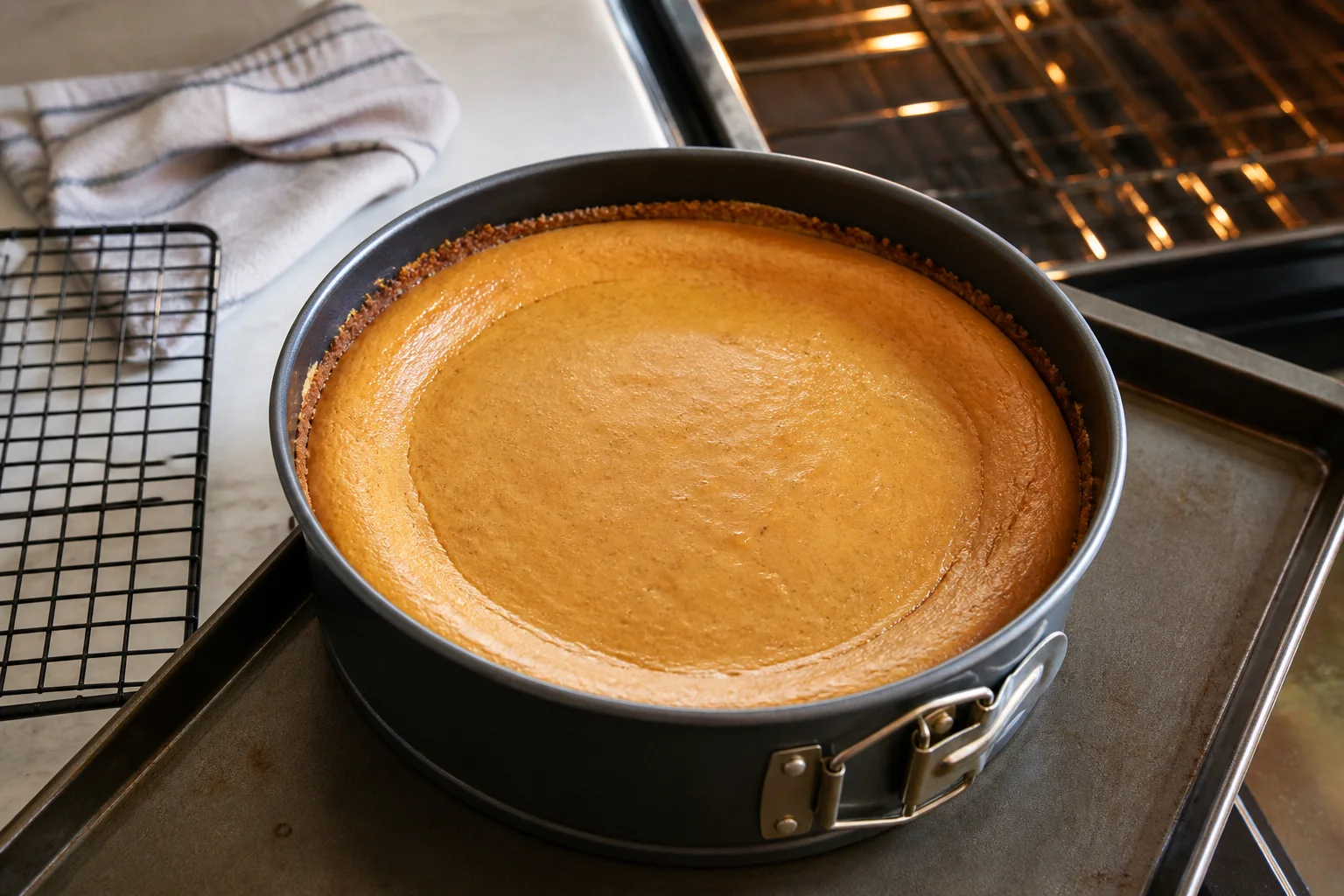
Bake at 300°F for 65 to 85 minutes. Begin checking at 60 minutes without repeatedly opening the door. The outer 2 inches should look set and slightly puffed; the center 2 to 3 inches should wobble together like soft gelatin when the pan is nudged. It should not ripple like liquid.
10. Cool in stages
Turn off the oven, prop the door open 2 inches and leave the cheesecake inside for 30 minutes. Move it to a rack and cool for 1 hour. Run a thin knife around the edge if it appears attached to the pan, but keep the springform closed.
11. Chill overnight
Cover without touching the surface and refrigerate for at least 8 hours, preferably overnight. Release the pan only when thoroughly cold. For clean slices, wipe a warm sharp knife between cuts.
Pumpkin cheesecake doneness guide
| What you see | What it means | What to do |
|---|---|---|
| Whole surface ripples like batter | Center is still raw and fluid | Bake 8 more minutes, then recheck |
| Outer 2 inches are set; center wobbles as one piece | Correct point to stop active baking | Turn off oven and crack the door |
| Center has no movement while hot | Likely overbaked | Begin staged cooling immediately |
| Small bubbles or a domed top | Too much air or heat | Do not blend eggs longer; verify oven temperature |
| Thin surface crack | Cosmetic temperature stress | Cool gradually; serve as-is or add yogurt topping |
| Chilled slice smears on the knife | It needs more chilling | Refrigerate 2 to 4 hours longer |
How this cheesecake gets more protein
Most of the protein comes from cottage cheese, Greek yogurt, eggs and protein powder. Cream cheese is present in a smaller amount for flavor and texture, rather than serving as the entire filling base.
Based on common ingredient labels, one of 12 slices provides an estimated 14 grams of protein. That number is not laboratory-tested and will change with the brands used, particularly the cottage cheese, yogurt and powder. Check package labels if a precise intake matters to you.
“High protein” describes the recipe’s protein-forward formulation; it is not a medical or weight-loss promise. A slice still contains sweetener, saturated fat and a graham crust, and suitability depends on the full eating pattern and individual needs.
Make-ahead plan
Cheesecake is naturally suited to advance preparation because the filling needs a long cold rest before slicing.
Day one, evening: Bake, cool and refrigerate the cheesecake in its pan.
Day two: Release, slice and serve. The flavor and cutting texture are often even better after 12 to 24 hours.
Two days ahead: The entire cheesecake may be made 48 hours before serving. Keep it covered and wait to add garnishes until shortly before serving.
If the refrigerator contains strong-smelling food, use a lidded cake carrier rather than loose wrap. Dairy desserts readily pick up odors.
Serving ideas
The cheesecake is complete without a topping, but restrained garnishes can add contrast without hiding the pumpkin filling.
- Add a spoonful of lightly sweetened Greek yogurt.
- Dust with cinnamon immediately before serving.
- Scatter a small amount of toasted pecan over each slice.
- Serve with fresh pear or apple slices.
- Drizzle with 1 teaspoon maple syrup per slice for a sweeter dessert.
Remember that nuts introduce a tree-nut allergen and added toppings change the nutrition estimate.
Troubleshooting
The filling is grainy
The cottage cheese was not fully blended or the cream cheese was too cold. Blend cottage cheese alone until glossy and soften the cream cheese before combining.
The cheesecake is rubbery
It was likely overbaked, mixed too aggressively after adding eggs or made with a highly absorbent protein powder. Stop while the center still wobbles and keep the powder at 55 grams.
The center is watery after chilling
It may have been removed while the center still rippled, the pumpkin could have been overmeasured or the slice may not have chilled for 8 hours. Weigh the puree and use the doneness table.
The top cracked
A crack usually comes from trapped air, high heat or abrupt cooling. It does not make the cheesecake unsafe or unusable. Cover it with a thin yogurt layer if appearance matters.
The crust is soggy
The crumb layer may have been underbaked or the springform was released before the filling became cold. Prebake for the full 8 minutes and chill in the closed pan.
The batter has tiny white flecks
Small dairy flecks point to cold cream cheese, not undercooked egg. Scrape thoroughly during blending; do not keep processing after eggs are added just to chase a few specks.
Storage and freezing
Refrigerate the cheesecake within 2 hours of finishing its room-temperature cooling stage. Keep it covered at 40°F or below and use within 4 days. USDA explains cold-storage temperatures and the two-hour rule on its refrigeration and food-safety page.
Cheesecake is best served cold or after standing for 10 minutes. Do not microwave slices; direct heat can make the protein-rich filling tough and cause moisture to separate.
For freezing, chill the cheesecake completely, cut clean slices and freeze them uncovered until firm. Wrap each slice, place in a freezer container and keep for up to 1 month for best texture. Thaw overnight in the refrigerator, not on the counter. A little surface moisture after thawing can be blotted gently with a paper towel.
Frequently asked questions
Can I make high-protein pumpkin cheesecake without protein powder?
You can omit the powder, but the recipe will no longer have the same protein estimate or moisture balance. For a formula designed without it, use the linked Greek yogurt cheesecake instead.
Does it taste like cottage cheese?
The pumpkin, vanilla and spices lead the flavor. Thorough blending removes the curd texture, while cream cheese supplies familiar cheesecake tang.
Can I use a blender instead of a food processor?
Yes. Use a high-speed blender, scrape carefully with the machine off and add eggs last. A narrow blender jar may need two pauses for scraping.
Can I use pumpkin pie filling?
No. Pumpkin pie filling contains sweetener and spices, so it would make this formula too sweet and unpredictably wet.
Is a water bath necessary?
No. The low oven temperature and staged cooling protect the filling. A shallow pan of hot water on a lower rack is optional if your oven is especially dry, but the springform should not sit in water.
Why must it chill overnight?
Cooling finishes the set and lets moisture redistribute through the dairy and protein powder. Warm cheesecake can look loose even when correctly baked.
Can I make it crustless?
Yes. Grease and parchment-line the base, pour the filling directly into the pan and begin checking about 5 minutes earlier. Slices will be more delicate at the base.
How many servings does it make?
One 9-inch cheesecake makes 12 dessert slices. Cut 10 larger slices if preferred, understanding that the nutrition per serving will increase.
Recipe development note
This high-protein pumpkin cheesecake was developed through culinary research and editorial review. It is not represented as a personal kitchen test. Protein powders, cottage cheese and ovens vary, so use weights, low-speed mixing and the set-edge/soft-center cue.
Nutrition is an estimate per one of 12 slices. The accompanying visuals are AI-assisted food-editorial images, not photographs of a kitchen test.
Printable recipe card
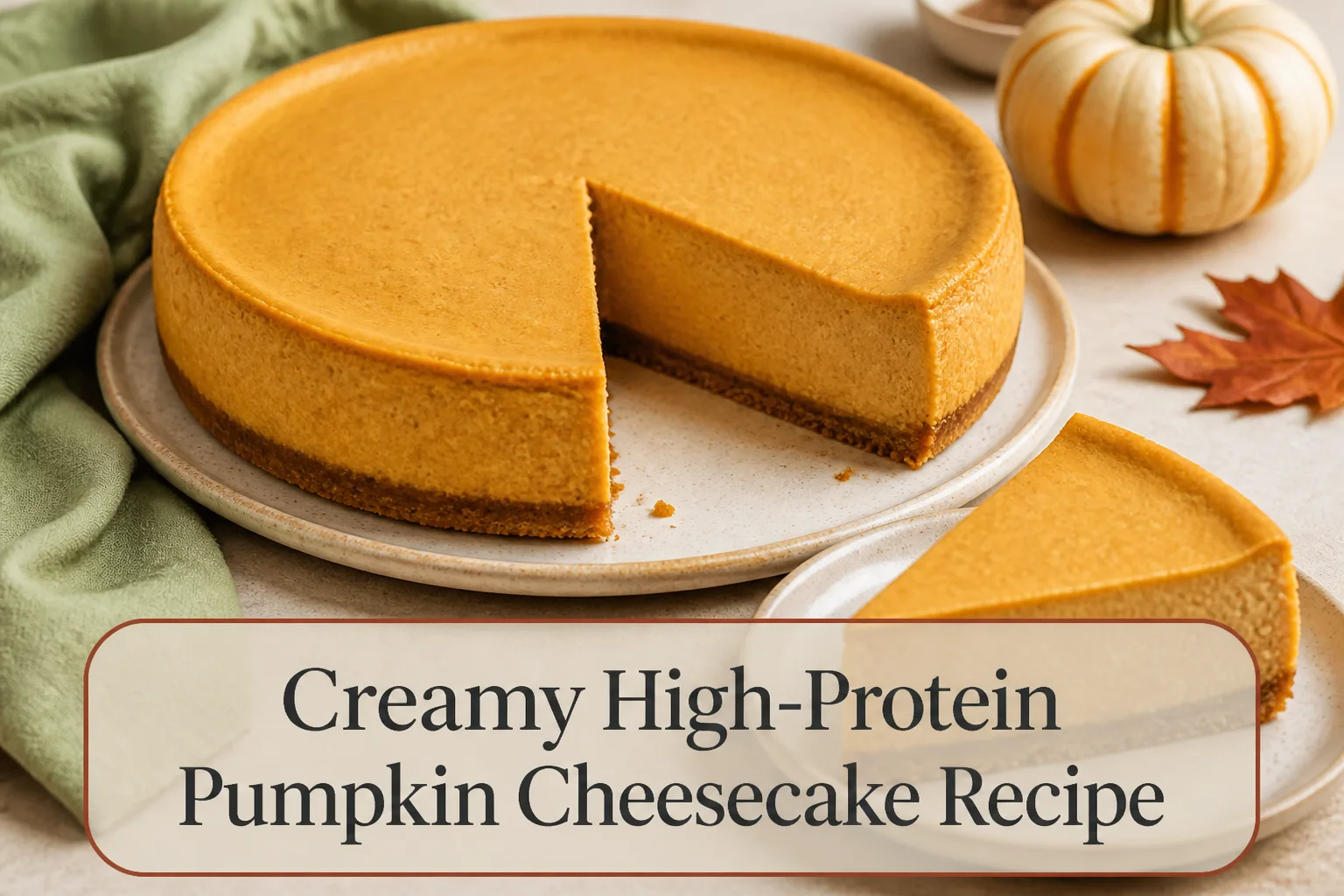
Creamy High-Protein Pumpkin Cheesecake Recipe
Ingredients
Equipment
Method
- Let cream cheese, cottage cheese, yogurt and eggs lose their refrigerator chill for 30 to 45 minutes.
- Heat oven to 350°F. Grease a 9-inch springform and parchment-line the base.
- Mix crust ingredients, press across the base and bake 8 minutes. Reduce oven to 300°F.
- Process cottage cheese alone for 60 to 90 seconds until glossy and completely smooth.
- Add cream cheese, yogurt, pumpkin, maple syrup and vanilla; blend just until uniform.
- Whisk protein powder, cornstarch and spices separately, sprinkle over filling and blend on low only until dispersed.
- Lightly beat eggs, add and pulse briefly until yellow streaks disappear without making the batter foamy.
- Pour over crust, tap the pan gently two or three times and pop large bubbles.
- Bake at 300°F for 65 to 85 minutes, until the outer two inches set and the center wobbles together without liquid ripples.
- Turn off oven, crack door and rest inside 30 minutes; then cool on a rack 1 hour.
- Cover and refrigerate in the closed pan at least 8 hours, preferably overnight.
- Release thoroughly cold cheesecake and cut with a warm sharp knife, wiping between slices.
Notes
- Blend cottage cheese alone until no curds remain.
- Keep protein powder at 55 grams.
- Add eggs last and pulse briefly.
- Stop baking while the center still wobbles as one piece.
- Chill at least 8 hours before releasing the pan.
- Store refrigerated up to 4 days.
- Contains milk, egg and wheat.
- This recipe was developed through culinary research and editorial review.
This recipe was developed through culinary research and editorial review. Protein powders, cottage cheese moisture and ovens vary; use weights, low-speed mixing and the set-edge/soft-center cue.
Nutrition is an estimate per one of 12 slices.