
This Greek yogurt dessert freezes into neat berry-studded pieces with a creamy bite. Whole-milk Greek yogurt supplies body, honey lowers the hard-freezing sensation, and a small amount of heavy cream adds fat without turning the base loose.
The method avoids two common frozen-yogurt-bark problems. First, washed berries are dried thoroughly so surface water does not create icy pockets. Second, the bark is scored while partially frozen, then cut after it becomes firm, producing tidy snack-size rectangles instead of jagged shards.
This recipe was developed through culinary research and editorial review. Yogurt solids, freezer temperature, berry size, honey viscosity and pan material vary, so use the spread-thickness, partial-freeze and tempering cues below.
For a baked Greek yogurt dessert, see the creamy Greek yogurt cheesecake recipe. The Greek yogurt strawberry smoothie is a drinkable option that uses frozen fruit without needing a set bark texture.
Why frozen yogurt bark becomes icy
Yogurt contains substantial water. In a household freezer, that water forms crystals as it freezes. Fat, dissolved sugar and milk solids interfere with large crystal formation, which is why full-fat yogurt and measured honey produce a less brittle bite than nonfat yogurt with no sweetener.
Fruit contributes more water. Berries that are wet from washing freeze with a thin ice shell, while very large pieces create hard, isolated frozen centers. Dry fruit and modest pieces distribute more evenly.
Thickness matters too. A quarter-inch smear freezes into a hard sheet and thaws quickly at the edges. A roughly half-inch layer has enough body for a creamy interior after a short tempering period.
Ingredients
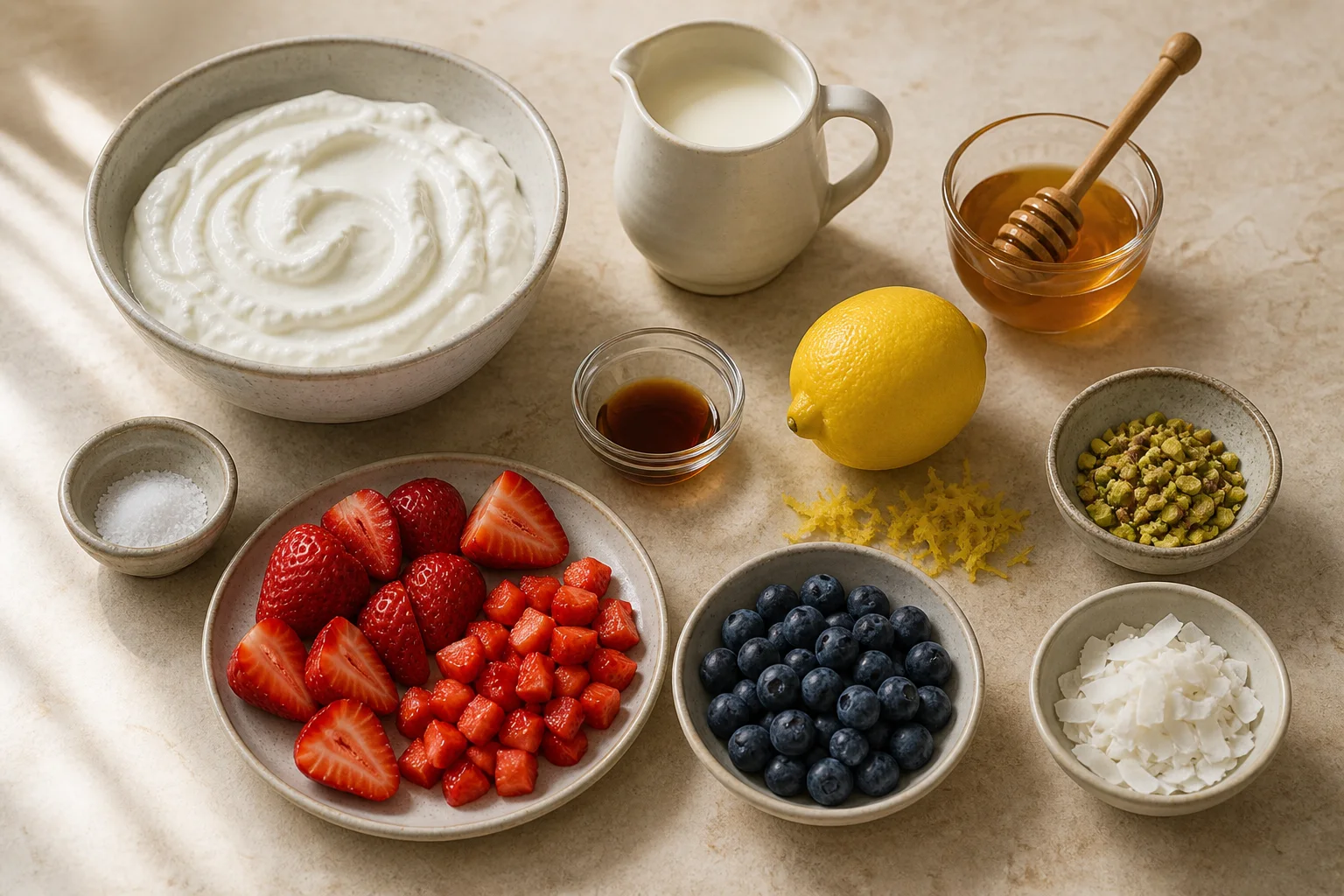
- 2 cups plain whole-milk Greek yogurt, 450 grams
- 1/4 cup heavy cream, 60 grams
- 1/4 cup honey, 85 grams
- 1 teaspoon vanilla extract
- 1 teaspoon finely grated lemon zest
- 1/8 teaspoon fine salt
- 3/4 cup strawberries, hulled and diced into 1/4-inch pieces, 110 grams
- 1/2 cup blueberries, 75 grams
- 2 tablespoons shelled pistachios, finely chopped, optional
- 1 tablespoon unsweetened coconut flakes, optional
Ingredient notes and substitutions
Greek yogurt: Whole-milk Greek yogurt gives the creamiest bark. A 2% product works but freezes firmer. Nonfat yogurt produces a noticeably icier result and is not the preferred texture choice.
Heavy cream: A small amount increases fat and keeps the frozen bite less chalky. Full-fat canned coconut milk can replace it by volume, though the bark will have a coconut flavor and may freeze differently depending on stabilizers.
Honey: Honey sweetens and softens the freeze. Pure maple syrup works by weight, but it creates a slightly icier texture because its sugar and water profile differs. Do not remove the liquid sweetener without expecting a harder bark.
Vanilla and lemon zest: Both add aroma without much water. Use zest rather than lemon juice; extra juice contributes water and can make the yogurt seem sharper after freezing.
Strawberries: Cut to approximately 1/4 inch so the pieces freeze and soften evenly. Large strawberry halves become difficult to bite. Raspberries can replace them if halved and dried carefully.
Blueberries: Small berries can remain whole. Very large cultivated blueberries may be halved. Dry them completely before adding.
Pistachios and coconut: Both are optional. Pistachios add crunch but are a tree-nut allergen. Coconut flakes provide texture without adding fruit water.
How to make Greek yogurt berry bark
1. Prepare the pan
Line a quarter sheet pan or 9-by-13-inch metal pan with parchment paper, leaving enough overhang to lift the bark. Press the parchment into the corners and set the pan on a level freezer-safe tray.
Make space in the freezer before mixing. The pan must sit flat; a tilted shelf creates one thin icy end and one thick slow-freezing end.
2. Wash and dry the berries
Rinse fresh berries gently under running water. Transfer to a clean towel and dry thoroughly, rolling blueberries carefully and blotting strawberry surfaces.
Hull strawberries only after washing so water is less likely to enter the cut center. Dice them into 1/4-inch pieces and blot the cut faces once more.
3. Mix the yogurt base
In a medium bowl, whisk Greek yogurt, heavy cream, honey, vanilla, lemon zest and salt until completely smooth and glossy.
Scrape the bottom and sides, where thick yogurt can remain unmixed. The base should fall from the whisk in a heavy ribbon rather than pour like milk.
4. Spread to an even thickness
Transfer the yogurt mixture to the center of the parchment. Use an offset spatula to spread it into an approximately 8-by-11-inch rectangle about 1/2 inch thick.
Keep the center and edges level. Feather-thin edges freeze hard and melt before the center is ready to eat.
5. Add fruit and toppings
Scatter strawberries and blueberries evenly over the surface. Press each piece only far enough to make contact with the yogurt; do not bury all the fruit.
Add optional pistachios and coconut. Keep the outer half inch relatively clear so the future pieces have stable edges.
6. Partially freeze and score
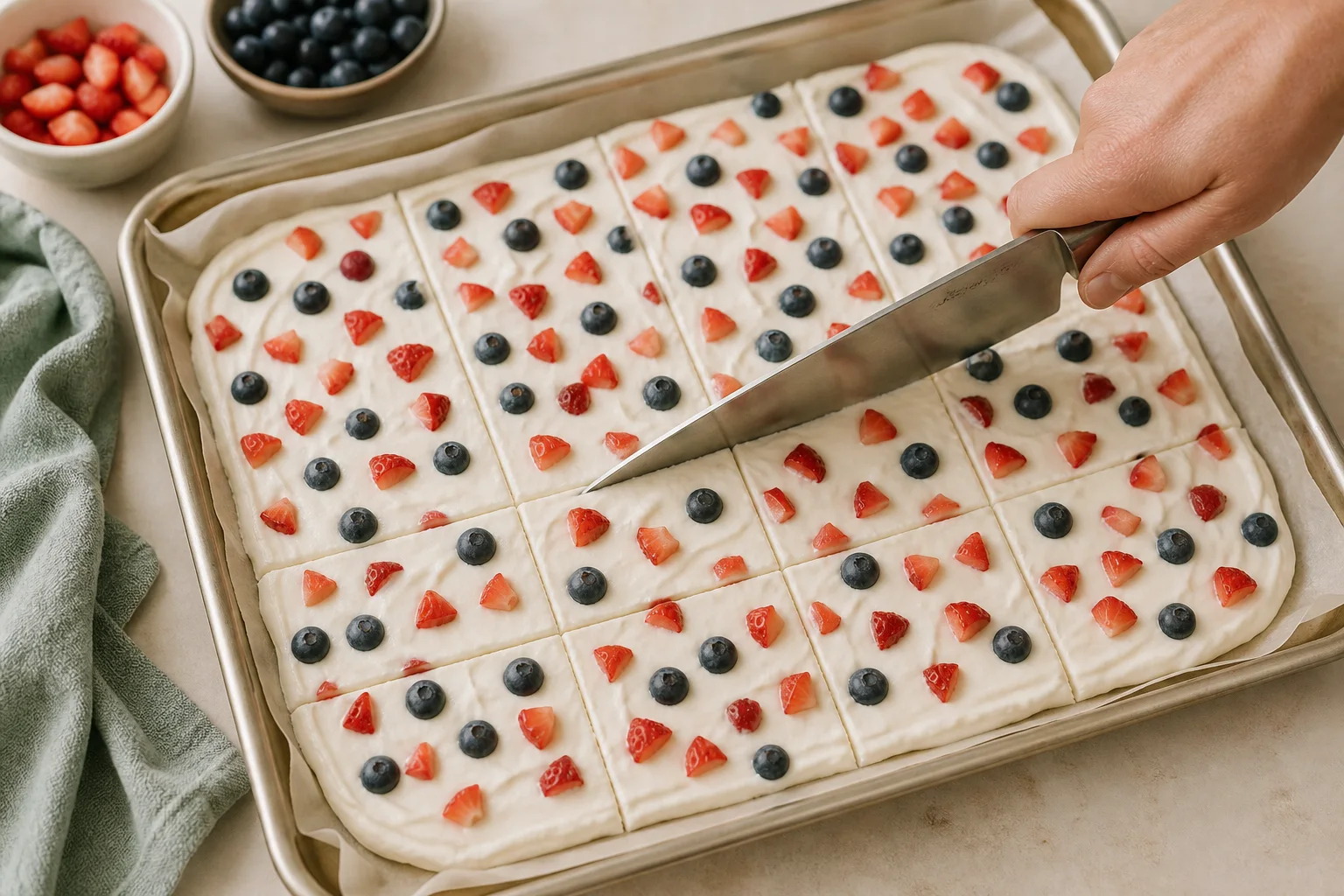
Freeze the level pan for 60 to 90 minutes. The surface should feel firm, but a sharp knife should still pass through with steady pressure.
Lift the parchment onto a cutting board if stable. Score a 4-by-4 grid to outline 16 pieces, cutting most of the way through but not forcing a fully frozen sheet. Return the bark and parchment to the pan.
7. Freeze until firm
Freeze for another 2 to 3 hours, or until the center of the thickest section is completely firm. Household freezers vary, and a crowded freezer may take longer.
Do not leave the uncovered pan overnight. Once firm, the bark should move to airtight storage to avoid freezer odors and surface dehydration.
8. Cut into pieces
Lift the bark by the parchment and follow the scored lines with a large sharp knife. If it is too hard to cut safely, wait at room temperature for 2 minutes rather than forcing the knife.
For irregular bark, the sheet can be broken along the score lines. Clean rectangles are easier to portion and stack.
9. Temper before eating
Let individual pieces stand at room temperature for 3 to 5 minutes before eating. The surface should lose its frosty appearance while the piece remains firm enough to hold.
Do not temper the entire container repeatedly. Remove only the portions being served and return the rest to the freezer promptly.
Greek yogurt bark texture guide
| Cue | Meaning | Action |
|---|---|---|
| Base pours thinly | Yogurt is loose or low in solids | Use thicker Greek yogurt; do not add more cream |
| Surface firm but knife passes after 60–90 minutes | Ideal scoring stage | Mark a 4-by-4 grid |
| Sheet cracks wildly during scoring | It froze too long | Temper 2–3 minutes before scoring |
| Piece bends after 5 minutes at room temperature | Ready for a creamy bite | Eat promptly |
| Piece turns soft at edges while center stays hard | Layer was uneven | Spread the next batch to a consistent 1/2 inch |
Freezer temperature affects every stage. Use the physical cue, not the minute mark alone.
How to wash berries without adding ice
FDA produce guidance recommends rinsing fresh produce under running water and drying it with a clean towel. Do not wash berries with soap, detergent or bleach.
Wash shortly before preparing the bark, not several days ahead. Berries stored wet soften and spoil more quickly.
After rinsing, spread the fruit in one layer on a clean towel. Blot rather than crush it. Cut strawberries after drying, then blot the newly exposed surfaces.
Frozen berries are not ideal for the top of this bark. They release colored juice as they begin to thaw during assembly and often carry surface frost, producing purple streaks and ice crystals.
How thick should frozen yogurt bark be?
Aim for about 1/2 inch before toppings. An 8-by-11-inch rectangle made from this quantity reaches that useful thickness without filling every edge of a 9-by-13-inch pan.
Measure visually at the corners and center. Use the offset spatula to move mixture from high areas to low ones.
A thicker layer takes longer to freeze and needs a longer temper. A thinner layer snaps more easily but tastes harder and melts quickly in the hand.
The fruit raises local height. Press it into contact without forcing large pieces to the pan bottom, where they can create wet gaps as the bark tempers.
Why scoring before the final freeze helps
A fully frozen dairy sheet is brittle. Pressing a knife through it can send cracks away from the intended line and make the knife slip.
At the partial-freeze stage, the base is firm enough to hold a line but soft enough to cut predictably. The second freeze firms those individual outlines.
Use a long sharp knife and downward pressure. Avoid sawing aggressively through a pan; lift the parchment to a cutting board when the sheet is stable enough.
If the bark reaches a full freeze before scoring, temper the whole sheet for 3 to 5 minutes, mark the portions, then refreeze briefly before separating.
Flavor variations
Chocolate strawberry: Whisk 2 tablespoons unsweetened cocoa into the yogurt base and add 1 extra tablespoon honey. Use strawberries only and omit lemon zest.
Peach: Replace berries with 1 cup peeled peach cut in 1/4-inch dice. Blot juicy surfaces and freeze the bark the same day the fruit is cut.
Cherry almond: Use 3/4 cup pitted quartered cherries and 2 tablespoons sliced almonds. This variation includes a tree-nut allergen.
Mango coconut: Use small mango dice, replace cream with full-fat coconut milk and add coconut flakes. Very ripe mango can release extra liquid, so blot it.
Peanut butter swirl: Warm 2 tablespoons smooth peanut butter just until fluid, drizzle over the spread yogurt and make only two or three shallow swirls. Do not overmix.
Granola: Add 1/4 cup granola just before serving rather than before freezing if you want it crunchy. Frozen granola softens as it absorbs yogurt moisture.
Troubleshooting
The bark is extremely hard
It may use nonfat yogurt, too little sweetener or a very thin layer. Temper individual pieces 3 to 5 minutes. Next time use whole-milk Greek yogurt, keep the measured honey and spread 1/2 inch thick.
The bark is icy
Berries were wet, yogurt was low in solids or the bark thawed and refroze. Dry produce carefully and store pieces airtight without repeated temperature swings.
The base will not freeze firm
The yogurt may be very loose, too much sweetener or cream was added, or the freezer is warmer than 0°F. Measure ingredients and allow additional time in a level cold freezer.
The fruit falls off
It was scattered without being pressed into contact, or the yogurt surface froze before topping. Add toppings immediately after spreading and press gently.
The bark shatters into tiny pieces
It froze solid before scoring or is too thin. Temper briefly, use the score-first method and maintain an even half-inch layer.
The parchment sticks
Moisture may have condensed during a long room-temperature temper. Peel parchment from the frozen piece rather than pulling the soft bark away from paper.
The edges melt too quickly
The layer was feathered too thin. Square the edges with the spatula and keep thickness consistent.
The bark tastes bland when frozen
Cold suppresses flavor. Keep vanilla, lemon zest, honey and salt measured; the unfrozen base should taste slightly stronger than the final frozen piece.
Storage
Once fully frozen and cut, stack pieces in an airtight freezer container with parchment between layers. Store for up to 1 month for best texture and flavor.
Press parchment or reusable freezer-safe material close to the top layer before sealing. Limiting air reduces frost and prevents the yogurt from absorbing freezer odors.
Do not refrigerate for long-term storage; the bark will become a soft yogurt mixture. Do not refreeze pieces that have completely thawed at room temperature.
Freezer-storage times are mainly quality guidance when food remains continuously frozen at 0°F, but a dairy dessert exposed to repeated thawing should be discarded rather than repeatedly returned to storage.
Frequently asked questions
Is Greek yogurt bark a healthy dessert?
It includes Greek yogurt and fruit but also honey and cream. “Healthy” depends on portion and overall dietary needs; one of 16 pieces is the defined serving here.
Can I use nonfat Greek yogurt?
Yes, but the bark will freeze harder and taste icier. Whole-milk Greek yogurt is recommended for the creamy target.
Can I make the bark without honey?
Removing honey makes the texture harder. Maple syrup can replace it by weight, but an unsweetened bark will be more brittle.
Can I use frozen berries?
Fresh, thoroughly dried berries are preferred. Frozen berries release juice and carry surface ice that can make the bark streaky and icier.
How long does yogurt bark take to freeze?
Allow approximately 3 to 4 1/2 hours total, including the partial-freeze scoring stage. Freezer temperature, pan material and layer thickness change the timing.
Why temper the bark before eating?
Three to 5 minutes at room temperature softens the frozen water and dairy fat enough for a creamier bite without fully thawing the piece.
Can children help make it?
They can whisk and place dry berries with supervision. An adult should handle the sharp knife, partial-freeze scoring and frozen-sheet cutting.
Is frozen yogurt bark the same as frozen yogurt?
No. Churned frozen yogurt incorporates air and controls crystal formation during freezing. Bark is a still-frozen sheet, so it is firmer and benefits from tempering.
Recipe development note
This Greek yogurt dessert was developed through culinary research and editorial review. It has not been represented as a personal kitchen test. Yogurt solids, freezer temperature, berry size, honey viscosity and pan material vary; use the spread-thickness, partial-freeze and tempering cues.
Nutrition is an estimate without optional pistachios or coconut. The accompanying visuals are AI-assisted food-editorial images, not photographs of a kitchen test.
Printable recipe card
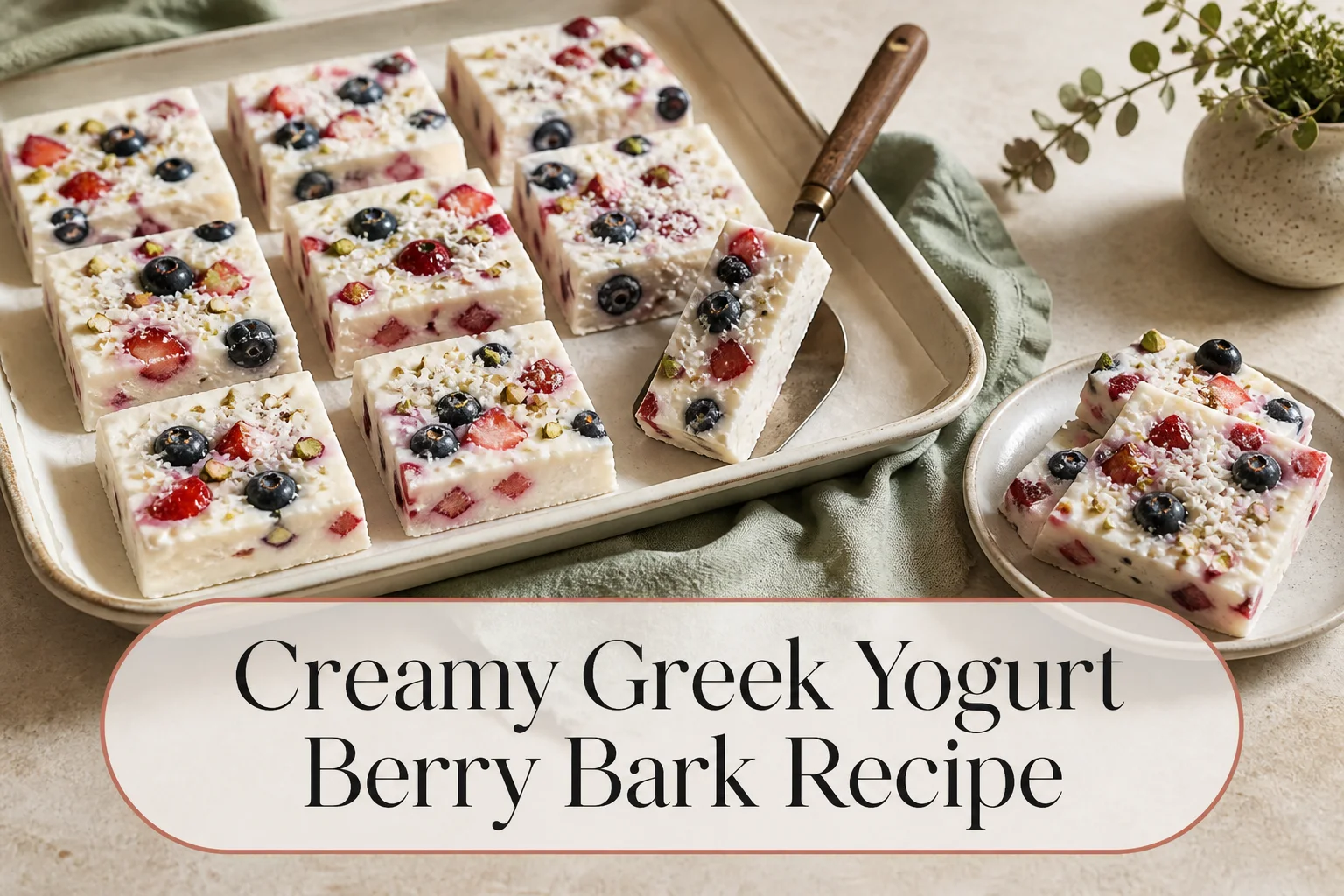
Creamy Greek Yogurt Berry Bark Recipe
Ingredients
Equipment
Method
- Parchment-line a quarter sheet pan or 9-by-13-inch metal pan and clear a level freezer shelf.
- Rinse berries under running water and dry thoroughly. Hull and dice strawberries into 1/4-inch pieces, then blot cut surfaces.
- Whisk Greek yogurt, heavy cream, honey, vanilla, lemon zest and salt until completely smooth and glossy.
- Spread into an approximately 8-by-11-inch rectangle about 1/2 inch thick, keeping the center and edges level.
- Scatter dry berries and optional pistachios and coconut evenly. Press gently so every piece contacts yogurt.
- Freeze 60 to 90 minutes, until firm but cuttable. Score a 4-by-4 grid most of the way through, then return to the pan.
- Freeze another 2 to 3 hours, or until the thickest center is completely firm.
- Lift by parchment and follow the scored lines with a sharp knife. If too hard to cut safely, temper 2 minutes first.
- Temper individual pieces at room temperature for 3 to 5 minutes for a creamier bite, keeping the rest frozen.
Notes
- Use whole-milk Greek yogurt for the least icy texture.
- Dry berries thoroughly and cut strawberries to 1/4 inch.
- Spread the base evenly to approximately 1/2 inch.
- Score during the partial freeze, then complete freezing.
- Temper only the pieces being served for 3 to 5 minutes.
- Contains milk; optional pistachios add a tree-nut allergen.
- This recipe was developed through culinary research and editorial review.
This recipe was developed through culinary research and editorial review. Yogurt solids, freezer temperature, berry size, honey viscosity and pan material vary; use the spread-thickness, partial-freeze and tempering cues.
Nutrition is an estimate per one-sixteenth batch without optional pistachios or coconut.