This Greek yogurt pancake recipe makes thick, tender pancakes with golden edges and enough structure to stack without becoming heavy. Greek yogurt adds moisture and a gentle tang, while baking powder and baking soda work together to lift the batter.
The batter should be thick enough to mound briefly when scooped, but loose enough to spread into a small circle on the griddle. A 10-minute rest hydrates the flour and gives the leaveners time to begin working. Gentle folding and moderate heat protect the bubbles that create a fluffy center.
This recipe was developed through culinary research and editorial review. Flour measurement, yogurt thickness, egg size and griddle temperature vary, so use the batter, bubble and browning cues rather than relying only on the clock.
For a quick fruit-and-yogurt breakfast, try the Greek yogurt strawberry smoothie recipe. If you are planning a make-ahead brunch dessert, the Greek yogurt cheesecake recipe uses the same thick whole-milk yogurt in a baked filling.
Why Greek yogurt makes pancakes tender
Greek yogurt brings both protein and acidity. The acidity reacts with baking soda, producing carbon dioxide that contributes to lift. Its thick texture adds moisture without thinning the batter as much as the same volume of milk would.
Too much yogurt, however, can make pancakes dense. A batter based almost entirely on Greek yogurt moves slowly on the griddle and may brown outside before the center cooks. This formula loosens one cup of yogurt with three-quarters cup milk, giving the batter enough flow while keeping it substantial.
Fat also matters. Melted butter and egg yolks soften the crumb, while whole-milk or 2% Greek yogurt prevents the dry, chalky finish that can occur with very lean dairy.
Ingredients
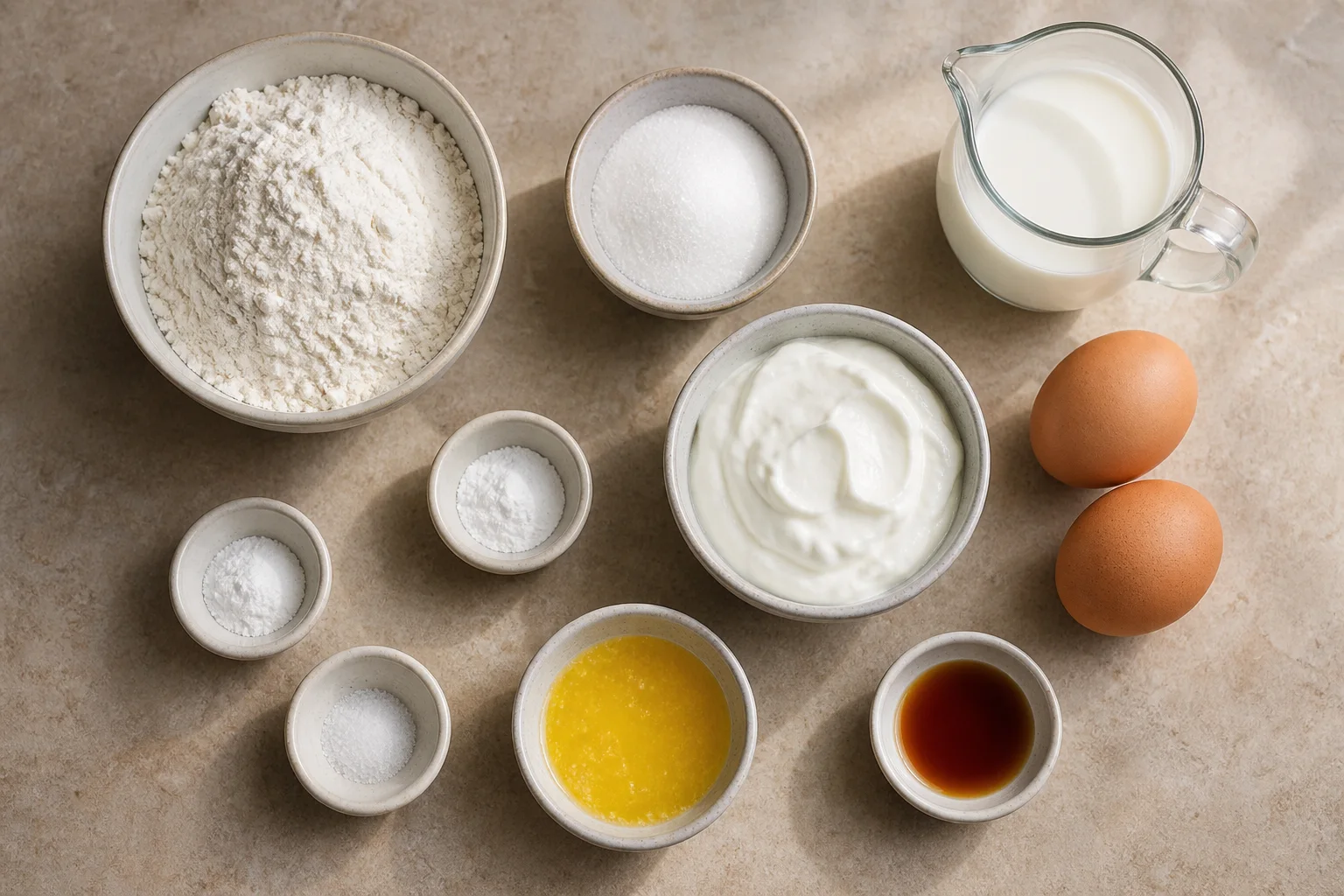
- 1 1/2 cups all-purpose flour, spooned and leveled
- 2 tablespoons granulated sugar
- 2 teaspoons baking powder
- 1/2 teaspoon baking soda
- 1/2 teaspoon kosher salt
- 1 cup plain whole-milk or 2% Greek yogurt, room temperature
- 3/4 cup whole milk, room temperature, plus 1 to 2 tablespoons if needed
- 2 large eggs, room temperature
- 3 tablespoons unsalted butter, melted and cooled slightly, plus more for the griddle
- 1 teaspoon vanilla extract
Ingredient notes and substitutions
Flour: Spoon flour into the measuring cup and level it rather than dipping the cup into the bag. Scooping compacts flour and can add enough extra to make the batter stiff. For the most consistent result, use 180 grams.
Greek yogurt: Plain whole-milk or 2% Greek yogurt gives the best balance of tenderness and thickness. Nonfat yogurt can work, but the pancakes may be a little firmer and the batter may need an extra tablespoon of milk.
Milk: Whole milk supplies enough liquid to loosen thick yogurt. Two-percent milk works with a slightly leaner result. Plant-based milk can be used, but choose an unsweetened variety and adjust by the tablespoon because viscosity differs.
Leaveners: Baking powder provides dependable lift, while baking soda reacts with yogurt’s acidity. Use both, and check that they are fresh. Do not increase the baking soda; too much creates a soapy flavor and premature browning.
Butter: Let melted butter cool until warm rather than hot before it meets the eggs. Neutral oil can replace it by volume, though the pancakes will lose some buttery flavor.
Sugar: Two tablespoons encourage browning without making the pancakes dessert-sweet. Honey or maple syrup adds liquid and changes browning, so it is better served on top than substituted in the batter.
For a blended oat batter made with cottage cheese, use oatmeal cottage cheese pancakes for the liquid proportions and batter-resting step.
If you plan to cook pancakes in an air fryer, use the air fryer pancake recipe for its batter and heat-safe pan setup instead of pouring this batter directly into a basket.
How to make Greek yogurt pancakes
1. Warm the griddle gently
Set a large nonstick skillet or griddle over medium-low heat. If using an electric griddle, begin around 350°F. Give the surface several minutes to heat evenly while the batter is mixed.
High heat creates dark outsides before thick yogurt batter cooks through. The pan should be hot enough to make a drop of water dance briefly, not smoke or evaporate instantly.
2. Combine the dry ingredients
Whisk flour, sugar, baking powder, baking soda and salt in a large bowl for about 20 seconds. Break up any tight lumps of baking powder or soda.
Even distribution matters because the batter receives very little mixing after the wet ingredients go in.
3. Whisk the wet ingredients
In a medium bowl, whisk the Greek yogurt and milk until mostly smooth. Add eggs, cooled melted butter and vanilla, then whisk until uniform.
The mixture may retain a few tiny yogurt streaks. It should pour in a thick ribbon rather than sit like spoonable yogurt.
4. Fold without overmixing
Make a well in the dry ingredients and pour in the wet mixture. Fold with a flexible spatula, scraping from the bottom and turning the bowl, just until no large pockets of dry flour remain.
Small lumps are expected. A smooth, heavily beaten batter develops more gluten and knocks out early bubbles, producing flatter, chewier pancakes.
5. Rest and check the thickness
Let the batter stand for 10 minutes. It will thicken as the flour hydrates and small bubbles may appear at the surface.
After resting, scoop some batter and let it fall back into the bowl. It should leave a mound for a second, then slowly settle. If it remains in a rigid heap, fold in milk 1 tablespoon at a time. If it runs like crepe batter, fold in 1 tablespoon flour and wait 2 minutes.
6. Test the first pancake
Lightly coat the griddle with butter and wipe away heavy puddles. Scoop a level 1/4 cup batter onto the surface and nudge it into a circle about 4 inches wide.
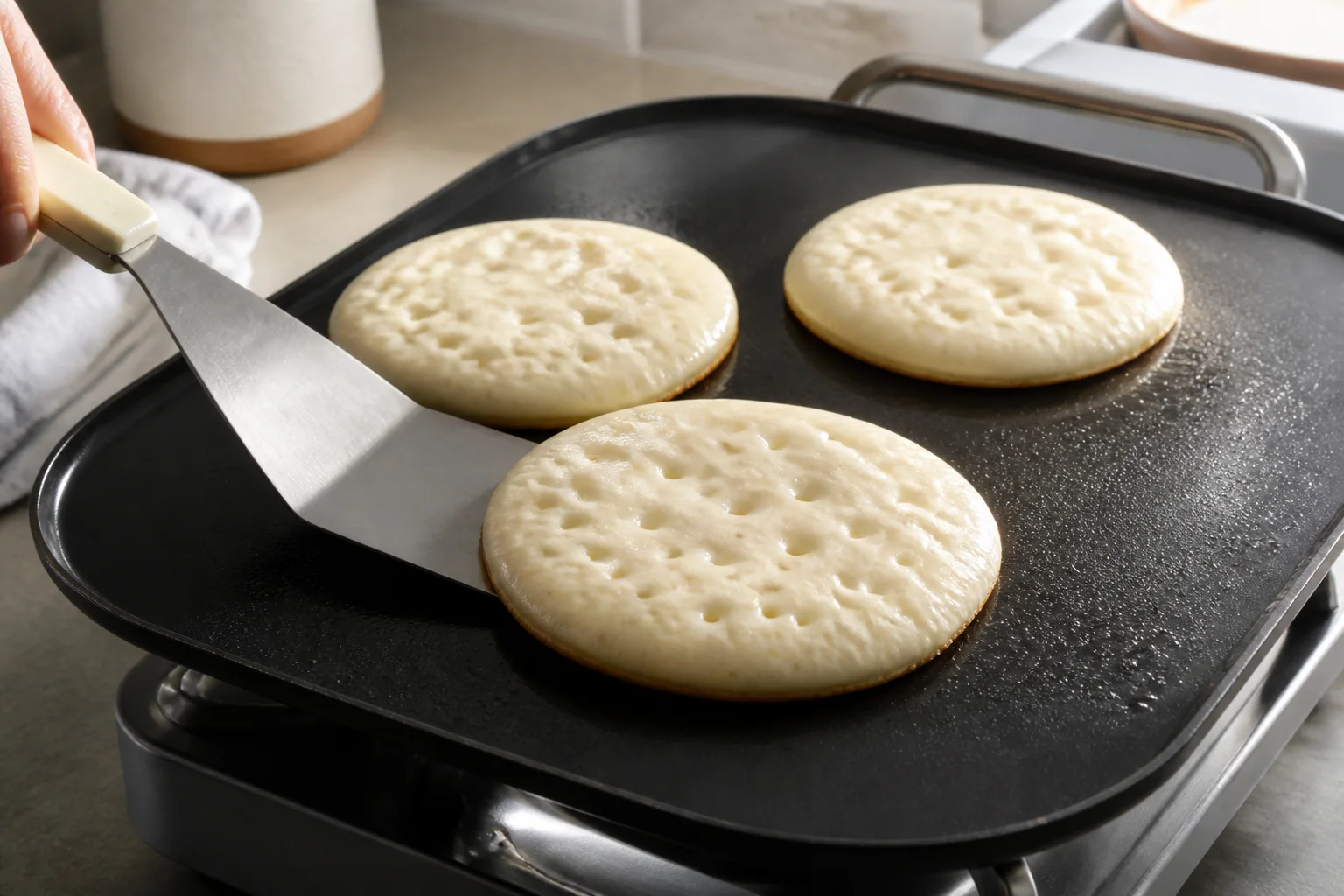
Cook for 2 to 3 minutes. The underside should become evenly golden, the edge should look matte, and bubbles should rise and begin to open across the top—not only around the perimeter.
7. Flip once
Slide a thin, wide spatula fully under the pancake and turn it in one confident motion. Do not press down; pressing releases the air that keeps the center light.
Cook the second side for 1 to 2 minutes, until golden and the center springs back lightly when touched. Split the first pancake if necessary to confirm there is no wet batter line inside.
8. Adjust and finish the batch
If the first side darkens before bubbles open, reduce the heat. If the pancake remains pale after 3 minutes, increase it slightly. Griddles retain heat, so later batches may finish faster.
Butter the surface lightly between batches and continue with 1/4-cup portions, leaving at least 2 inches between pancakes. Serve promptly or hold briefly as described below.
What the batter should look like
The ideal batter is thicker than standard boxed pancake batter but not spoon-stiff. It should spread from a 1/4-cup scoop to roughly 4 inches without being flattened aggressively.
Yogurt brands differ substantially. Some are dense enough to hold a spoon upright; others are closer to regular stirred yogurt. That is why the final 1 to 2 tablespoons of milk are optional rather than poured in automatically.
Judge thickness after the 10-minute rest. Adding liquid before the flour hydrates can produce an overly loose batter by the time the griddle is ready.
The right griddle temperature
Medium-low heat gives a thick pancake time to cook through. On an electric griddle, 350°F is a useful starting point, but surface calibration varies. The first pancake is the practical test.
Butter should foam gently when it touches the surface. If it browns immediately, the pan is too hot. If it sits without bubbling, the surface needs more time.
A deeply brown exterior with a wet center means the heat is too high, not that the pancake simply needs longer at the same setting. Lower the temperature and allow the pan to settle before continuing.
When to flip pancakes
Do not flip at the first bubble. Wait until multiple bubbles rise through the center and some openings stay visible. The perimeter should change from shiny batter to a matte, slightly set edge.
The spatula should slide under without smearing the base. If batter runs away from the edge when lifted, give it another 20 to 30 seconds.
Flip only once. Repeated turning can compress the pancake and dry the surfaces before the center finishes.
Keeping pancakes warm
For a short hold, place finished pancakes in a single layer on a wire rack set over a sheet pan in a 200°F oven. The rack prevents condensed steam from making the bottoms damp.
Avoid stacking and tightly covering hot pancakes for more than a few minutes. Trapped steam softens the golden edges. Serve within about 20 minutes for the best texture.
Flavor variations
Blueberry: Scatter 1 to 2 tablespoons blueberries over each pancake immediately after portioning it on the griddle. Adding berries to the bowl can streak the batter and make portion sizes uneven.
Chocolate chip: Sprinkle mini chocolate chips on the uncooked surface before flipping. Keep the heat moderate because melted chocolate can scorch against the pan.
Lemon: Add 2 teaspoons finely grated lemon zest to the sugar, rubbing them together before whisking in the remaining dry ingredients.
Warm spice: Add 1/2 teaspoon cinnamon and a small pinch of nutmeg to the dry mixture. More cinnamon can slow hydration and darken the batter.
Less sweet: Reduce the sugar to 1 tablespoon. Do not remove it entirely if even browning is important.
Troubleshooting
The pancakes are dense
The batter may have been overmixed, the leaveners may be old, or the yogurt may be exceptionally thick. Fold only until the flour disappears, use active baking powder and soda, and correct batter thickness after resting.
The outside burns before the middle cooks
The griddle is too hot or the pancakes are too large. Reduce the heat, wait a minute for the surface to cool and keep portions to a level 1/4 cup.
The pancakes spread too thin
The yogurt may be loose or excess milk was added. Fold in 1 tablespoon flour and rest 2 minutes before testing again. Confirm that the baking powder, not additional liquid, provides the lift.
The batter will not spread
It is too stiff. Fold in milk 1 tablespoon at a time until a scoop slowly settles. Do not force a rigid mound flat on the griddle; the center will be too thick to cook evenly.
The pancakes are pale
The pan is not warm enough, there is too much butter pooling on the surface, or the batter contains very little sugar. Increase heat slightly and wipe the butter into a thin film.
The pancakes turn rubbery
Overmixing develops gluten, and pressing after the flip compresses the crumb. Leave small lumps in the batter and let the second side cook undisturbed.
The center has a gummy line
The pancake was flipped too soon, made too large or cooked over excessive heat. Wait for center bubbles, use measured portions and lower the griddle temperature.
Storage and freezing
Cool leftover pancakes on a wire rack so steam can escape. Refrigerate in an airtight container with parchment between layers and use within 3 to 4 days. USDA guidance recommends refrigerating leftovers promptly and keeping the refrigerator at 40°F or below.
For freezing, arrange cooled pancakes in one layer on a sheet pan. Freeze until firm, then transfer to a freezer bag with parchment between layers. Press out excess air and use within 2 months for best quality.
Do not leave raw batter at room temperature for later batches. Flour and eggs are raw ingredients; FDA advises against tasting uncooked batter because raw flour and eggs can carry harmful germs.
How to reheat Greek yogurt pancakes
Toaster: Reheat one or two refrigerated pancakes on a medium setting. This restores the driest edges but can overbrown pancakes containing fruit or chocolate.
Microwave: Place two pancakes on a microwave-safe plate and cover loosely with a damp paper towel. Heat in 15- to 20-second intervals until hot. This is fast, though the edges stay softer.
Oven: Arrange a larger batch in one layer on a sheet pan, cover loosely with foil and warm at 325°F for 8 to 12 minutes. Remove the foil for the last 2 minutes if the surfaces seem damp.
From frozen: Toast directly from frozen or warm covered in a 325°F oven for about 12 to 16 minutes. Microwave in short intervals only if speed matters, as uneven heating can make the edges tough.
Frequently asked questions
Can you make pancakes with Greek yogurt?
Yes. Greek yogurt supplies moisture, acidity and protein. It works best when balanced with enough milk to create a thick but spreadable batter.
Can I use regular yogurt instead?
Yes, but begin with only 1/2 cup milk because regular yogurt is looser. Add more milk by the tablespoon after the batter rests.
Can I use nonfat Greek yogurt?
It works, although the pancakes may be slightly firmer and the batter may require an extra tablespoon of milk. Whole-milk or 2% yogurt gives a more tender result.
Why does pancake batter need to rest?
Resting allows flour to hydrate and the batter to thicken evenly. It also gives bubbles time to begin forming before the batter meets the griddle.
Should pancake batter be lumpy?
Small lumps are desirable. Large dry flour pockets should be folded in, but mixing until perfectly smooth can make the pancakes chewy.
Can I make the batter the night before?
It is better to mix the dry and wet ingredients separately and refrigerate the wet mixture. Combine them in the morning; a fully mixed batter loses some leavening strength during a long hold.
How do I know the middle is cooked?
The center should spring back lightly, and a test pancake should show a fluffy interior without a glossy wet line. Use that first pancake to adjust the heat for the batch.
Recipe development note
This yogurt pancake recipe was developed through culinary research and editorial review. It has not been represented as a personal kitchen test. Flour measurement, yogurt thickness, leavener freshness, portion size and griddle calibration can change the result; use the batter, bubble and browning cues throughout the method.
Nutrition is an estimate based on generic ingredients and does not include syrup, fruit or extra serving butter. The accompanying visuals are AI-assisted food-editorial images, not photographs of a kitchen test.
Recipe at a glance
| Metric | Details |
|---|---|
| Prep time | 20 minutes |
| Cook time | 20 minutes |
| Total time | 50 minutes |
| Yield | 12 pancakes |
Printable recipe card
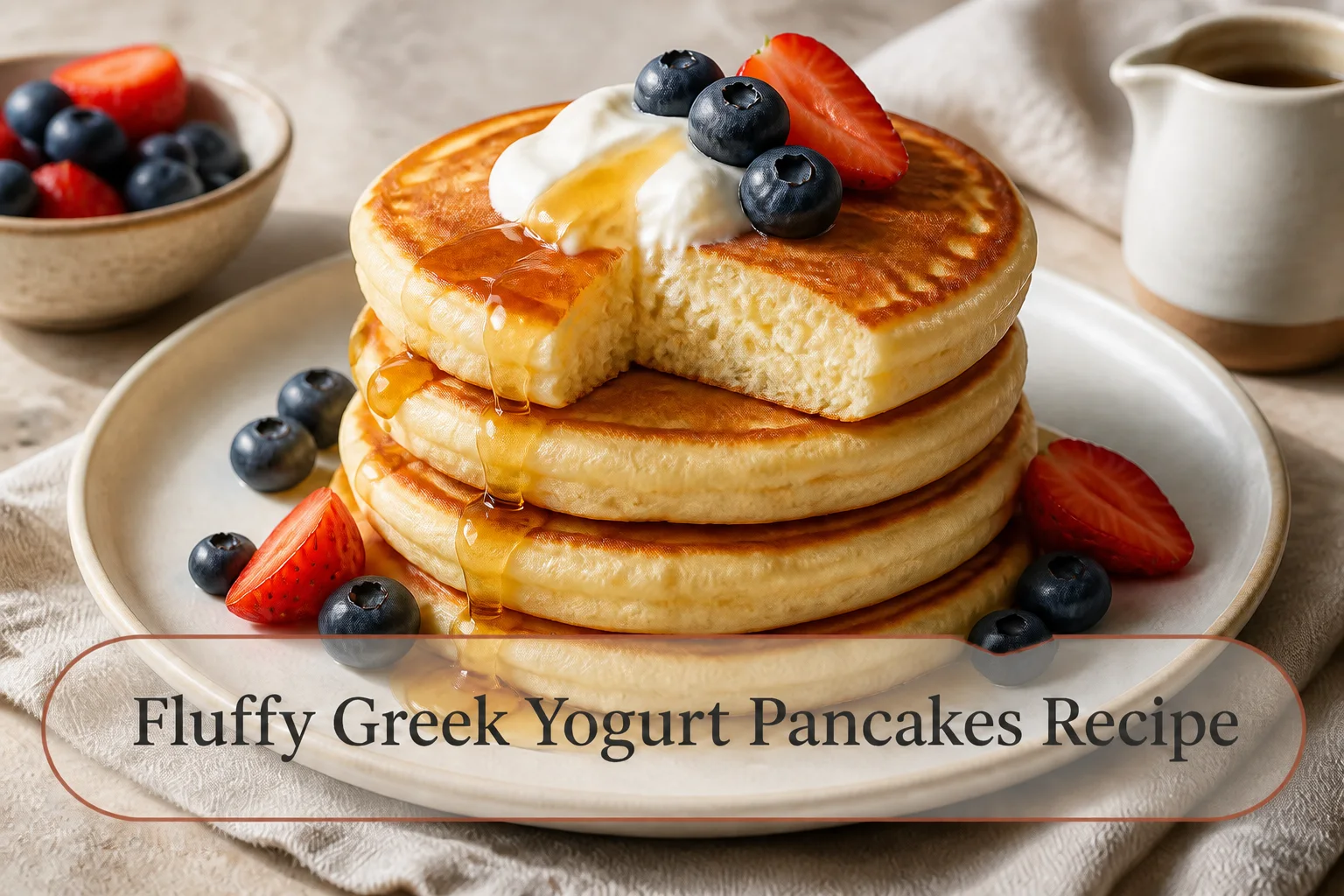
Fluffy Greek Yogurt Pancakes Recipe
Ingredients
Equipment
Method
- Heat a large nonstick skillet over medium-low or an electric griddle to about 350°F while mixing the batter.
- Whisk flour, sugar, baking powder, baking soda and salt in a large bowl for about 20 seconds.
- Whisk Greek yogurt and 3/4 cup milk until mostly smooth. Whisk in eggs, cooled melted butter and vanilla.
- Pour wet ingredients into dry and fold just until no large flour pockets remain. Leave small lumps; do not beat smooth.
- Rest 10 minutes. The batter should mound briefly, then slowly settle. If rigid, fold in milk 1 tablespoon at a time.
- Lightly butter the griddle. Portion a level 1/4 cup batter and nudge into a 4-inch circle. Cook 2 to 3 minutes, until the edge is matte and center bubbles rise and begin to open.
- Turn once with a thin wide spatula without pressing. Cook 1 to 2 minutes, until golden and the center springs back lightly with no wet batter line.
- Adjust heat based on the first pancake. Butter lightly between batches and repeat, leaving at least 2 inches between portions.
Notes
- Measure flour by spooning and leveling or use 180 grams.
- Adjust thickness only after the 10-minute rest.
- Leave small lumps and never press pancakes after flipping.
- Use the first pancake to calibrate griddle heat.
- This recipe was developed through culinary research and editorial review.
This recipe was developed through culinary research and editorial review. Flour measurement, yogurt thickness, leavener freshness, portion size and griddle calibration vary; use the batter, bubble and browning cues throughout the method.
Nutrition is an estimate based on generic ingredients and excludes syrup, fruit and extra serving butter; actual values vary.