
This baked cottage cheese cheesecake turns whole-milk cottage cheese into a smooth, creamy filling over a crisp graham cracker crust. The cottage cheese is blended before the eggs go in, eliminating visible curds without whipping excessive air into the finished batter.
The recipe uses Greek yogurt for richness, cornstarch for clean slices and lemon zest for a fresh finish. A moderate oven, a center-wobble doneness cue and gradual cooling help prevent a rubbery texture and reduce sudden surface cracks.
This recipe was developed through culinary research and editorial review. Cottage cheese moisture, blender power, pan construction and oven calibration vary, so use the visual doneness and cooling cues rather than baking only by the clock.
For a quick blended cottage cheese option, see the cottage cheese berry smoothie recipe. The cottage cheese ranch dip recipe uses a similar smooth-base technique for a savory result.
Why cottage cheese cheesecake can be smooth
Cottage cheese curds are soft enough to break down in a high-powered blender or food processor. Blending them with yogurt, sugar and cornstarch creates enough movement to form a glossy base.
Eggs go in afterward at low speed. Vigorous blending after eggs are added incorporates air; trapped bubbles expand in the oven and contract during cooling, increasing the chance of cracks and a spongy texture.
Cornstarch supports the dairy-and-egg structure without adding a floury flavor. It also makes this cheesecake naturally free of wheat in the filling, although the graham crust is not gluten-free.
Ingredients
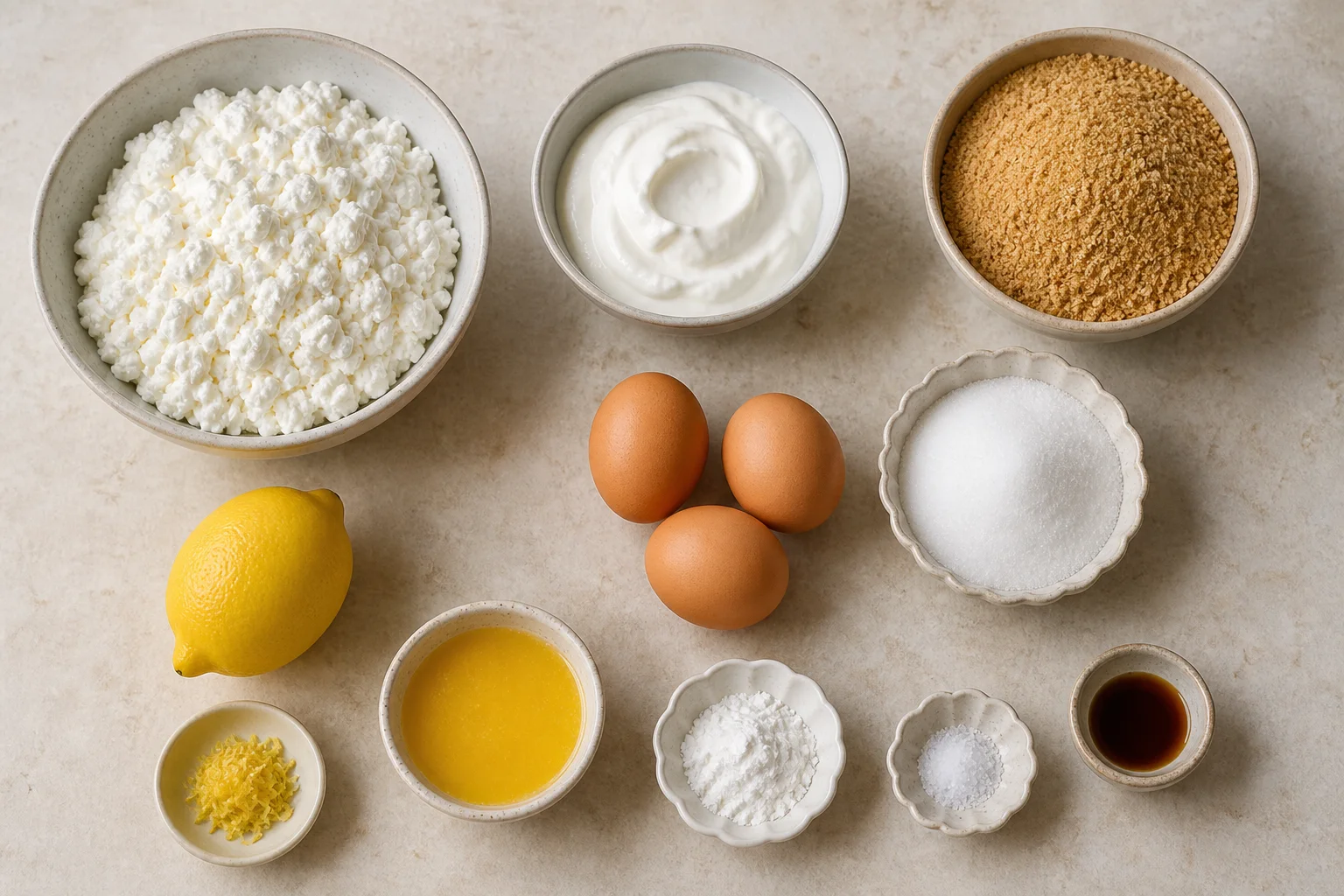
Graham cracker crust
- 1 1/2 cups fine graham cracker crumbs
- 2 tablespoons granulated sugar
- 1/4 teaspoon kosher salt
- 5 tablespoons unsalted butter, melted
Cottage cheese filling
- 24 ounces whole-milk cottage cheese, room temperature
- 3/4 cup plain whole-milk Greek yogurt, room temperature
- 3/4 cup granulated sugar
- 3 tablespoons cornstarch
- 1 tablespoon finely grated lemon zest
- 1 tablespoon fresh lemon juice
- 2 teaspoons vanilla extract
- 1/4 teaspoon kosher salt
- 3 large eggs, room temperature
Ingredient notes and substitutions
Cottage cheese: Whole-milk cottage cheese gives the creamiest texture. Small or large curds both work because they are blended. Do not drain unless the container has an unusual pool of separated whey; draining changes the intended hydration.
Greek yogurt: Whole-milk Greek yogurt adds tang and fat without loosening the filling like regular yogurt. Sour cream is a direct volume substitute with a slightly richer flavor.
Cornstarch: Measure level tablespoons and blend until no white pockets remain. Arrowroot and flour do not behave identically in this formula.
Eggs: Room-temperature eggs combine with less mixing. If cold, place uncracked eggs in warm—not hot—water for 10 minutes. Add them only after the base is smooth.
Graham crumbs: Process crackers to fine, even crumbs. Coarse pieces create gaps and make clean slices difficult. Gluten-free graham-style crumbs can work when a certified product and cross-contact controls meet your needs.
Lemon: Zest only the yellow surface. The small juice amount brightens the dairy without creating lemon cheesecake; omit zest for a more vanilla-forward version.
How to make cottage cheese cheesecake
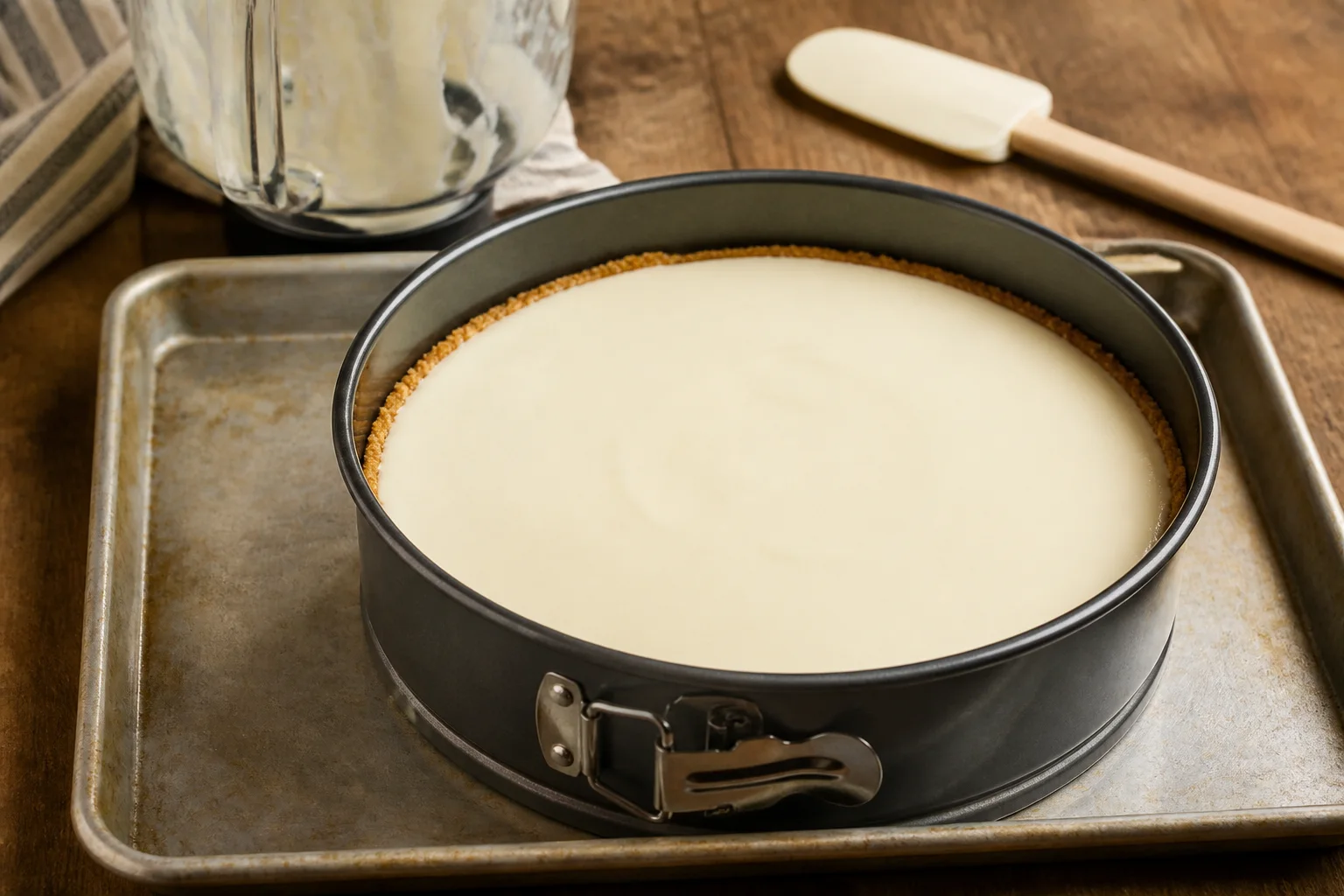
1. Prepare the pan and oven
Heat the oven to 350°F with a rack in the lower-middle position. Lightly grease a 9-inch springform pan and line the bottom with a parchment round.
Wrap the outside bottom with foil as protection from butter seepage, not as a water-bath seal. Place the springform pan on a rimmed sheet pan for baking.
2. Make the graham crust
Stir graham crumbs, sugar and salt until uniform. Add melted butter and mix until the crumbs resemble damp sand and hold together when squeezed.
Press firmly over the pan bottom in an even layer, using a flat-bottomed cup. Do not build a high side crust; a level bottom is easier to fill and slice.
3. Prebake and cool the crust
Bake for 8 minutes, until fragrant and slightly darker at the edges. Cool on a rack for at least 10 minutes while reducing the oven to 325°F.
The crust does not need to become crisp all the way through at this stage. It will bake again under the filling.
4. Blend the dairy base smooth
Add cottage cheese, Greek yogurt, sugar, cornstarch, lemon zest, lemon juice, vanilla and salt to a high-powered blender or food processor. Blend for 60 to 90 seconds, stopping safely to scrape once, until glossy and completely curd-free.
Rub a small drop between two fingers; it should feel smooth rather than pebbly. Do not taste the batter after raw eggs are added.
5. Add eggs gently
With the machine on its lowest speed, add eggs one at a time and mix only until each disappears. In a food processor, use short pulses. Scrape once and pulse just enough to combine.
The goal is a uniform batter with minimal foam. If a thick layer of bubbles appears, let the batter stand for 5 minutes and skim the largest bubbles.
FDA guidance advises against tasting raw batter containing uncooked eggs. Use clean tools and wash surfaces after handling the raw egg mixture.
6. Fill the pan
Pour batter over the cooled crust. Tap the pan gently on the counter two or three times and pop large surface bubbles with a toothpick.
Set the springform pan, still on its rimmed sheet pan, in the 325°F oven. A water bath is unnecessary for this formula and can leak into an imperfect springform pan.
7. Bake until the center wobbles
Bake for 50 to 65 minutes. The outer 2 inches should look set and slightly puffed, while a 2- to 3-inch circle in the center moves as one soft unit when the pan is nudged.
Do not wait until the entire surface is rigid. Residual heat continues setting the center, and overbaking produces a firmer, more rubbery slice.
8. Cool gradually
Turn off the oven, crack the door open several inches and leave the cheesecake inside for 30 minutes. Transfer it to a rack and cool at room temperature for about 1 hour.
Run a thin knife around the pan edge after the first 15 minutes of rack cooling. This releases the cake as it contracts. Do not remove the springform ring yet.
9. Chill thoroughly
Cover without pressing wrap onto the surface and refrigerate at least 6 hours, preferably overnight. The filling firms and flavors settle during chilling.
Remove the ring only when fully cold. Slide a thin spatula between parchment and pan bottom if transferring to a platter.
10. Slice cleanly
Dip a thin sharp knife in hot water, wipe it dry and make one cut. Clean and warm the blade between every slice.
Let slices stand at room temperature for 10 minutes before serving for a creamier mouthfeel. Do not leave the whole cheesecake out for extended periods.
How to avoid a curdy or rubbery filling
Blend the cottage cheese base long enough before adding eggs. A food processor usually takes longer than a high-speed blender; stop and scrape so curds above the blade reach the mixture.
Once eggs are present, reduce mixing. Excess air gives the cheesecake a soufflé-like rise that collapses on cooling. It can also create a porous rather than creamy interior.
Finally, remove the cake while the center still wobbles. A cheesecake that looks completely firm in the hot oven is often overbaked by the time it cools.
Doneness cues that matter
The edge should be matte and set. The center may look slightly glossy but should not ripple like liquid. When nudged, it moves in one cohesive wobble instead of sloshing.
Pan color and material influence time. Dark pans absorb heat faster, while insulated or heavy light-colored pans may need longer. Oven temperature also drifts, so an oven thermometer is useful.
A small surface crack does not mean failure. Cover cooled slices with berries or a thin yogurt topping if desired; do not keep baking an otherwise finished cheesecake in pursuit of a flawless surface.
Troubleshooting
The filling has visible curds
The base needed more blending or was too cold to circulate smoothly. Blend dairy ingredients at room temperature and scrape the container before eggs are added.
The cheesecake is rubbery
It was likely overbaked or the eggs were blended at high speed. Remove while the center wobbles and mix eggs only until incorporated.
The top cracked
Overbaking, excess air or sudden cooling can cause cracks. Use low-speed egg mixing and the gradual oven-door cooling step. A crack affects appearance more than flavor.
The center is too soft after chilling
If it was chilled at least 6 hours and still cannot hold a slice, it was underbaked or ingredients were mismeasured. Serve it in bowls rather than rebaking a fully chilled cheesecake.
The crust is soggy
The crumbs may have been coarse, the crust skipped prebaking or butter seeped into gaps. Grind fine crumbs, compact evenly and prebake for 8 minutes.
The crust sticks to the pan
Use parchment on the bottom and allow the cheesecake to chill fully. A warm crust is fragile and sticks more readily.
The batter has many bubbles
Let it stand 5 minutes, tap the filled pan gently and pop large bubbles. Next time add eggs at lower speed.
Topping ideas
Serve with fresh strawberries, blueberries or raspberries. Dry washed berries so they do not weep onto the cheesecake.
A quick compote works too: cool it completely before spooning over chilled slices. Warm topping softens the surface.
For a simple finish, dust individual slices lightly with powdered sugar immediately before serving. Powdered sugar dissolves if applied far ahead.
Storage and freezing
Refrigerate the cheesecake promptly, covered, and use within 3 to 4 days for best quality. USDA leftover safety guidance recommends keeping refrigerators at 40°F or below.
Freeze fully chilled individual slices on a lined pan, then wrap and place in an airtight container for up to 2 months for best quality. Thaw overnight in the refrigerator; do not thaw a dairy-and-egg cheesecake on the counter.
Frequently asked questions
Does cottage cheese cheesecake taste like cottage cheese?
It has a mild dairy tang but no distinct curd texture when fully blended. Vanilla, lemon zest and the graham crust are more prominent.
Can I use low-fat cottage cheese?
It can work, but the filling may be firmer, tangier or more watery depending on the brand. Whole-milk cottage cheese is the calibrated choice.
Do I need a water bath?
No. Moderate heat, minimal egg aeration and gradual cooling provide control without the leak risk of a water bath.
Can I make it crustless?
Yes. Grease the pan and line the bottom and sides with parchment. Begin checking slightly earlier because there is no crust insulating the bottom.
Can I use a hand mixer?
A hand mixer will not reliably eliminate cottage cheese curds. Use a blender, food processor or immersion blender in a tall narrow vessel for the smooth base.
How far ahead can I make it?
Cheesecake is ideal one day ahead because it needs a long chill. Add fresh fruit just before serving.
Recipe development note
This recipe was developed through culinary research and editorial review. It has not been represented as a personal kitchen test. Cottage cheese moisture, blender strength, pan construction and oven calibration vary; use the smoothness and doneness cues in the method.
Nutrition is an estimate based on generic ingredients. The accompanying visuals are AI-assisted food-editorial images, not photographs of a kitchen test.
Recipe at a glance
| Metric | Details |
|---|---|
| Prep time | 30 minutes |
| Cook time | 60 minutes |
| Total time | 540 minutes |
| Yield | 12 slices |
Printable recipe card
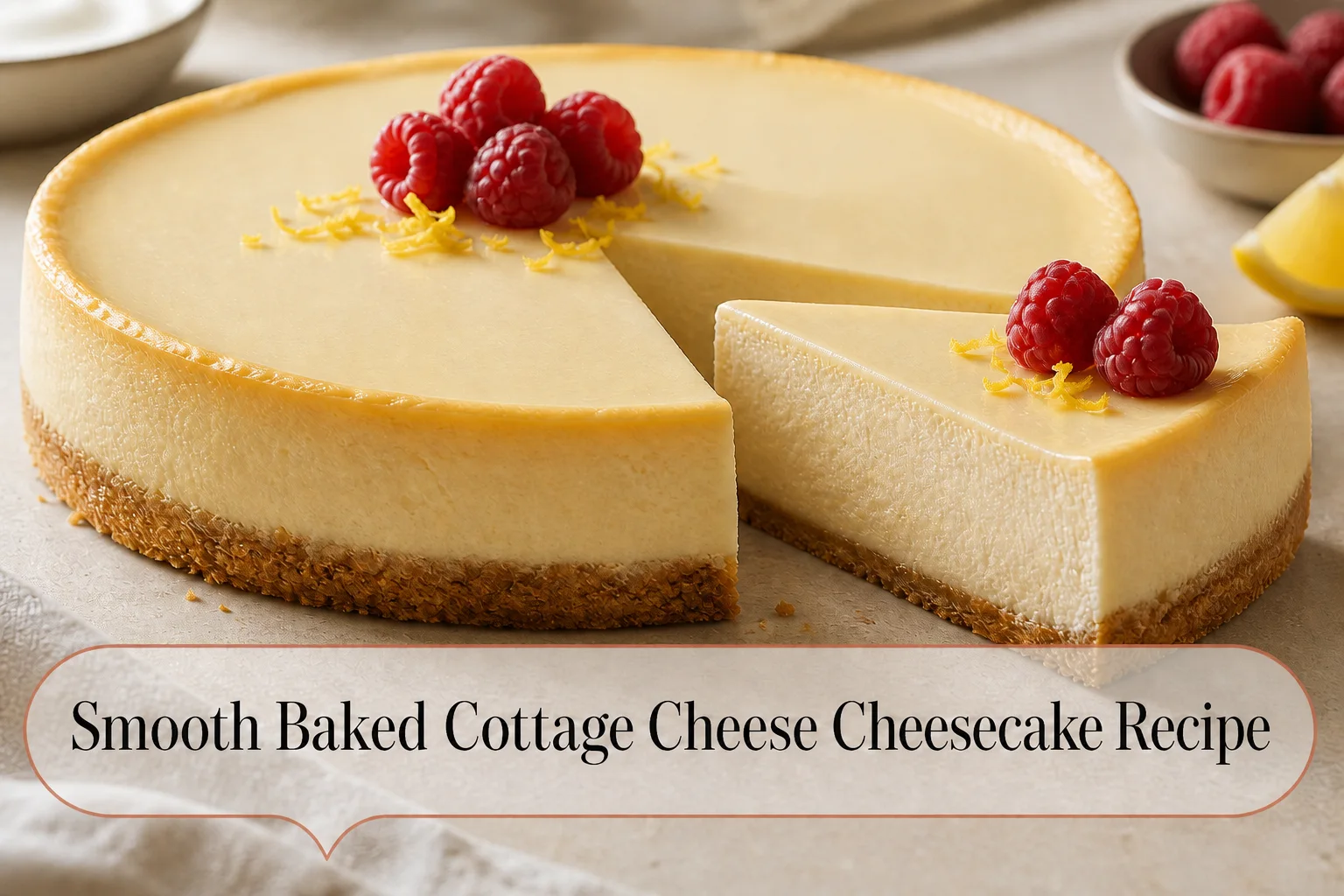
Smooth Baked Cottage Cheese Cheesecake Recipe
Ingredients
Equipment
Method
- Heat the oven to 350°F with a rack in the lower-middle position. Grease a 9-inch springform pan, line the bottom with parchment, wrap the outside bottom with foil and set it on a rimmed sheet pan.
- Stir graham crumbs, 2 tablespoons sugar and 1/4 teaspoon salt. Mix in melted butter, press evenly over the pan bottom and bake 8 minutes. Cool at least 10 minutes and reduce the oven to 325°F.
- Blend cottage cheese, Greek yogurt, 3/4 cup sugar, cornstarch, lemon zest, lemon juice, vanilla and 1/4 teaspoon salt for 60 to 90 seconds, scraping once, until glossy and completely curd-free.
- On the lowest speed, add eggs one at a time and mix only until each disappears. Let an overly bubbly batter stand 5 minutes and skim the largest bubbles.
- Pour batter over the cooled crust. Tap the pan gently two or three times and pop large surface bubbles with a toothpick.
- Bake at 325°F for 50 to 65 minutes, until the outer 2 inches are set and a 2- to 3-inch circle in the center moves as one soft unit when nudged.
- Turn off the oven, crack the door and leave the cheesecake inside 30 minutes. Cool on a rack about 1 hour, running a thin knife around the edge after the first 15 minutes.
- Cover and refrigerate at least 6 hours, preferably overnight. Remove the springform ring only when the cheesecake is fully cold.
- Dip a thin sharp knife in hot water, wipe dry and cut. Clean and warm the blade between slices; let slices stand 10 minutes before serving.
Notes
- Blend the dairy base completely smooth before adding eggs.
- Mix eggs only on low to avoid excess air.
- Remove the cake while the center still has a cohesive wobble.
- Chill at least 6 hours for clean slices.
- This recipe was developed through culinary research and editorial review.
This recipe was developed through culinary research and editorial review. Cottage cheese moisture, blender strength, pan construction and oven calibration vary; use the smoothness and doneness cues in the method.
Nutrition is an estimate based on generic ingredients; actual values vary by brand, measurement and serving size.